
Non-toxic toys for preschoolers, 3 to 5 years
One winner for each way people buy toys for preschoolers, 3 to 5 years.
The toy-buyer's version for three-, four- and five-year-olds: art supplies, face paint and dress-up, building sets, magnets and button batteries, and the helmet rule that is not a toy rule. Every pick says what it is made of on a maker or supplier page we read and dated, and where a page does not say, we say so. Every certification is the maker's statement unless we say we checked it.
How we scoreHow we earnChecked November 15, 2026
Our winner for each way people buy
How we scoreHow we earnChecked November 15, 2026
Crayons for a preschooler

Crayon Rocks
Crayons in a Rock ShapeSoy wax, ages 3 and up per the maker, which states ASTM D-4236, ASTM F-963, EN71-3 and CPSIA and links an SGS report (32-crayon set) that covers lead and element migration.
Meets our published criteria, as of Nov 15, 2026
$16.95ViewA building set for a four-year-old

Lego
Classic Large Creative Brick Box 10698LEGO's help page says most pieces are ABS, and the set is graded 4 and up with LEGO's own small-parts and small-ball warning: keep it out of reach of a child under 3.
Meets our published criteria, as of Nov 15, 2026
$33.49View
What to avoid
- Magnets or magnetic tiles in a house with a child under 3 — a swallowed magnet needs an emergency visit, not a wait-and-see, and the tiles we read are graded 3 and up
- A toy with a loose button battery compartment — CPSC says toys with button or coin batteries must have a closure that needs a tool, and a damaged one is a swallowing risk
- Face paint with no ingredient list, or a list not in English — AAP says products sold in the US must list ingredients in English, and an unlisted color cannot be checked
- A helmet sold as a toy accessory — a helmet marketed for bicycling falls under CPSC's bicycle helmet rule, not the toy standard
What to look for
- A materials list on the maker's own page — it puts a claim where you can check it
- An ingredient list on anything that goes on skin — FDA tells you to compare the color names on the list against its own color additive list
- A screw or tool closure on any battery compartment — CPSC says toys with button batteries are required to have one
- An age grade at or above your child's age, and a sibling check — the grade is where small-parts testing shows up, and the youngest child sets it
- 1Skip: Art supplies that only say non-toxicSee all non-toxic crayons, and what Crayola, Faber-Castell and Prang say Why
- 2Skip: Slime and sand toys with no ingredient listSee slime and Kinetic Sand, kit by kit Why
- 3Skip: Face paint and play makeup with no ingredient listBuy instead: Snazaroo Why
- 4Skip: Building sets that do not name the plasticBuy instead: Lego, Magna-Tiles Why
What the label card means
What to skip, and why
Magnets or magnetic tiles in a house with a child under 3
A swallowed magnet needs an emergency visit, not a wait-and-see, and the tiles we read are graded 3 and up.
A toy with a loose button battery compartment
CPSC says toys with button or coin batteries must have a closure that needs a tool, and a damaged one is a swallowing risk.
Face paint with no ingredient list, or a list not in English
AAP says products sold in the US must list ingredients in English, and an unlisted color cannot be checked.
A helmet sold as a toy accessory
A helmet marketed for bicycling falls under CPSC's bicycle helmet rule, not the toy standard.
The full guide: how we chose
At three the age grade opens art sets, building toys and magnets, so the questions change: what is the plastic, what is in the face paint, and which parts can still be swallowed. A toy legally sold in the US has already cleared a lead limit and the mandatory toy standard, so "non-toxic" on the box separates nothing. Face paint is a cosmetic, not a toy, and is regulated by FDA, so read its ingredient list and keep it away from the eyes. Magnets and button batteries are the hazards where a swallowed piece is an emergency, and a helmet is covered by its own rule, not the toy standard.
What this sheet covers
This is the preschool version of what we have already written about toys: what to check on art supplies, dress-up and face paint, building sets, and the two hazards, magnets and button batteries, that do not go away at 3. It is for the parent or grandparent choosing a gift for a three-, four- or five-year-old. The full reasoning behind the labels lives on the pages linked in each section.
Every pick above is graded 3 and up or 4 and up by its maker or its listing. That is the reason this sheet exists separately from the toddler sheet: a toy graded 3 and up is one whose maker is not claiming it is suitable for children under 3, usually because of small parts or magnets. If a younger child lives in the house or visits, the youngest child sets the age.
By age: what to look for
The ages below are the makers' own grades, not ours. Where a pick has a 3-and-up grade the maker is telling you the toy is not meant for younger children.
3 years: art and sand
This is the age crayons, markers and dough become part of the week. Our crayon pick is graded 3 and up by its maker and the marker pick by its listing and Crayola's pages. Kinetic Sand is graded 3 and up and is the sand to start with. For the full reads see non-toxic crayons, non-toxic markers and slime and Kinetic Sand. For dough, see the play dough showdown.
4 years: bricks, dress-up and face paint
The LEGO Classic box we read is graded 4 and up. This is also when dress-up and face paint become a regular request. Both are covered below, with the rule that face paint is a cosmetic.
5 years: bigger builds, magnets and ride-ons
By five, children build with magnetic tiles and ride bikes and scooters. The magnet hazard does not shrink with the child, and the helmet rule is not a toy rule. Both are covered below.
Art supplies: link-first, buy-second
We keep the full reads on their own pages so this sheet does not repeat them. In short: the standard you can look up is the ACMI AP seal, which we checked for Crayola's marker line; the standard a maker states about itself is ASTM D-4236, the art-material labeling standard. Our toys and art supplies cheat sheet covers the label rules, and the crayon page covers what Crayola, Faber-Castell and Prang say.
For slime, the open question is the cross-linker, and the useful check is whether the kit's page names it. Our slime page covers why it matters, with BfR's advice, and which kits do not say.
Pretend play, dress-up, face paint and play makeup
Dress-up is the easy part: a cape, a hat and a pile of scarves carry no label question, and the age grade on any hard accessories (a crown, a wand, a set of small play jewelry) is the only check, since those are the pieces that break into small parts.
Face paint and play makeup are different, because they go on skin. FDA classifies face paint as a cosmetic and says the law requires its color additives to be approved by FDA, with limits on where each may be used: a color that is fine for most skin may not be approved for use near the eyes. FDA lists eight fluorescent colors, none of which are allowed near the eyes. Its advice is to read the color names on the label and compare them with FDA's color additive list; if a color is not on it, the maker is not following the law.
Three further points come from AAP. Most cosmetics are not approved by FDA before they reach shelves, so companies are responsible for the safety of what they sell. Many cosmetics contain heavy metals, including arsenic, cadmium, mercury and lead, which AAP says can be toxic in large amounts, especially to children. And talc can be contaminated with asbestos because the two form in the same deposits. Our talc page covers what FDA's testing has found, and our fragrance page covers why "fragrance" on a label can stand in for a whole mixture. None of this is a reason to skip face paint; it is a reason to buy from a maker that prints a list and to read it.
The Snazaroo kit we picked is a caveat for that reason: its page prints the full ingredient list, which is more than most face paint boxes do, and talc is first on it. The list names no fragrance. Its safety text says to use under adult supervision, avoid eyes and lips, patch test on the inner elbow and wash off with soap and water. The page grades the kit 3 and up. It states no FDA or heavy-metal claim and links a safety data sheet we did not open. Whatever the brand, patch test a day or more ahead (AAP suggests a few days), keep it off the eyes and lips, and throw it away if it smells bad, which FDA and AAP both say can mean contamination.
Building sets and plastics: ABS, PVC and the rest
A rigid brick is usually ABS. LEGO's own page says most of its pieces have been ABS since 1963, that its tires are SBS or SEBS, which it compares to material in vehicle mud guards and shoe soles, and that some pieces are silicone. Magna-Tiles says its tiles are modified ABS free of BPA and phthalates. Those are the makers' statements.
PVC is the plastic to ask about when a toy is soft or flexible, since it needs plasticizers, a class that includes the phthalates CPSC caps at 0.1% in children's toys. A hard brick set that names ABS does not raise that question; a squishy figure of no stated material does. See our phthalates and PVC page and our TPR explainer, which covers soft plastic that is not PVC. For wood, our wooden toys sheet checks the board, glue and finish.
LEGO also says it cannot promise that its toys are entirely free of latex rubber pieces, which matters only if your child has a latex allergy. Nothing we read from either maker gives a lab report for the plastic, so treat "tested" as the brand's word.
Magnets and button batteries: the hazards that stay
Parents ask whether magnetic tiles are non-toxic. The plastic is the lesser question; the hazard that matters is the magnet. CPSC's account is specific. When high-powered magnets are swallowed, they can attract to each other, or to other material that attracts to magnets, through internal body tissue, which can mean perforation, twisting or blockage of the intestines, infection and death. CPSC estimates 26,600 magnet ingestions were treated in emergency rooms from 2010 through 2021 and knows of seven deaths, and says the majority of those death incidents likely involved magnet sets. CPSC's magnet rule excludes toys for children under 14, which fall under ASTM F963 instead, and its counts are not broken out by product or age, so none of these figures is about Magna-Tiles specifically. We have no figure for three- to five-year-olds.
Magna-Tiles says it uses nickel-plated rivets "for added security" and a lattice that resists cracking. It does not say how the magnets are held or what to do with a damaged tile. Our advice, not theirs: throw out any tile that is cracked or has a loose piece. A set graded 3 and up is the set a toddler sibling finds, so keep it where they cannot. If you think a child has swallowed a magnet, get medical care right away, even without symptoms; Harvard Health gives the same advice for a swallowed magnet.
Button and coin batteries are the second one. CPSC says a button cell battery can burn through a child's throat or esophagus in as little as two hours if swallowed, and that toys with these batteries are required to have a secure closure that needs a screwdriver, coin or tool to open. So check the toys you already own: if a compartment lacks a screw closure or is damaged, keep the toy away from children or replace it. Button cells are also in remotes, key fobs and greeting cards, not only toys. As soon as a spent battery comes out, tape over it with non-conductive tape and take it to a battery collection center. If a child swallows one, go to an emergency room and call the National Battery Ingestion Hotline at 800-498-8666 or the Poison Help Line at 800-222-1222. CPSC's page also discusses honey on the way to the hospital for children 12 months and older; read it there, and do not delay the trip to get it.
Ride-ons and helmets: where the toy standard does not apply
We have no ride-on or helmet pick. A ride-on is a different question from a block set, and we have not read a ride-on maker's page. What we can source is the helmet rule, and it is not the toy rule. A bicycle helmet is covered by 16 CFR part 1203, which CPSC says sets performance requirements to protect a rider from head injuries in falls or crashes. CPSC treats any helmet marketed in a way that implies bicycling as a bicycle helmet, and says helmets marketed for exclusive use in activities such as skateboarding or in-line skating are not covered. For scooters, CPSC recommends a helmet that meets its bicycle helmet standard, along with knee and elbow pads.
So for a helmet gift: look for one that meets CPSC's bicycle helmet standard, the wording CPSC's own scooter sheet uses, and do not read "toy-safe" or "non-toxic" on the box as a substitute.
How to read the label
"Non-toxic." On a toy, treat it as the brand's word; we found no standard behind it. For art supplies, the statement that carries weight is the ASTM D-4236 conformance statement, and for face paint it is the ingredient list.
The age grade. A toy for children under 3 cannot have a part that fits inside the small-parts cylinder, about the size of a young child's throat, including a piece that breaks off in testing. A 3-and-up grade means the maker is not making that claim. Check it against the youngest child in the house.
CPSIA and ASTM F963. For toys, these are the legal baseline: a lead limit and a mandatory toy standard, current version F963-23. A toy that says "CPSIA compliant" is telling you it is legal to sell. Our safer toy guide lays out what each covers.
Ingredient lists on cosmetics. FDA says to compare the color names with its summary of color additives. A list not in English, or no list at all, is a reason to leave the product on the shelf; AAP says ingredients on products sold in the US must be listed in English.
Where to go next
- Toys hub: the materials question answered once.
- Toddler toys, 1 to 3 years: the sheet for a younger sibling.
- Toys and art supplies cheat sheet: the label rules and picks by cut.
- Non-toxic crayons: what the seal covers and what the wax is.
- Non-toxic markers: what the AP seal does and does not cover.
- Slime and Kinetic Sand: the borate question and the sand.
- The play dough showdown: tested doughs and a homemade recipe.
- Talc and asbestos: what FDA's testing has found.
- Phthalates in PVC and soft vinyl: what is actually banned.
- Lead and heavy metals: where exposure still comes from.
- SafeMama's safer toy guide: lead, ASTM F963 and small parts.
Buying for a birthday or the holidays? Our gift guide by age pulls a few picks from each toy sheet and adds stocking stuffers.
The swaps, in full
Art supplies that only say non-toxic
Federal law requires art materials to be labeled for chronic hazards, so "non-toxic" on a box tells you little about one brand over another. What does differ is whether the maker prints the wax, names the standards it claims, and grades the product for the age you are buying for. These two are graded 3 and up. Our crayon and marker pages have the full read.
Hides in: The maker's product page, not the front of the box
Top pick: Crayon Rocks
Slime and sand toys with no ingredient list
Slime kits often name no cross-linker, and our slime page explains why that is the question to ask. Kinetic Sand is sand plus a silicone, according to a supplier's safety data sheet, the only composition document we found.
Hides in: Slime kits whose page names no cross-linker and no age grade

Top pick: Kinetic Sand
Face paint and play makeup with no ingredient list
Face paint is a cosmetic, and FDA says color additives in face paint must be approved for cosmetic use and may be limited to certain areas of the body; some are not allowed near the eyes. AAP adds that cosmetics can carry heavy metals, and that talc can be contaminated with asbestos. Most cosmetics do not go through FDA approval before sale. The practical test is an ingredient list in English that you can read against FDA's color list, and a patch test first.
Hides in: Costume kits sold as toys with no ingredient list on the box or the page
Snazaroo prints its full ingredient list, which is the useful part. It names talc first. AAP warns that talc can be contaminated with asbestos, and Snazaroo's page says nothing about asbestos testing, so if that matters to you, ask the maker or choose a kit whose list has no talc (we have not vetted one). The page makes no FDA or heavy-metal claim. The list names no fragrance. The page says adult supervision, no eyes or lips, a patch test, and "3 years +". We did not check each color against FDA's list.

Building sets that do not name the plastic
Hard building bricks are usually ABS, a rigid plastic that does not need the plasticizers soft PVC does, but a page that says nothing about the material gives you nothing to check. LEGO states ABS for most of its pieces, silicone for a few, and SBS or SEBS for tires, and grades this set 4 and up with a small-parts warning for under 3.
Hides in: Off-brand brick sets sold under dozens of names with no materials page
790 pieces in 33 colors. LEGO's help page says "most" pieces are ABS and that it cannot promise its toys are free of latex rubber pieces. "Tested by independent laboratories" is LEGO's statement; no report is linked.
Thirty-two tiles. Magna-Tiles says modified ABS free of BPA and phthalates and grades the set 3 and up, and says it meets EN71, ASTM and CPSIA; we read no test report. The magnets are the hazard, not the plastic: see the magnet section below before you buy, and keep the set where a younger sibling cannot reach it.
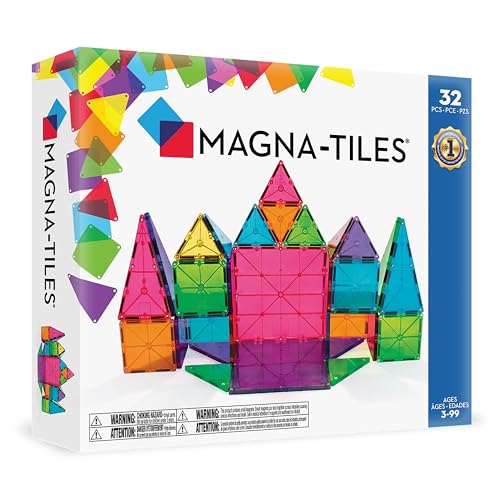
MAGNA-TILES Classic 32-Piece Magnetic Construction Set, The Original Magnetic Building Brand
Ingredient panel checked · source
Do the free things first
Make the art supply
Homemade dough and chalk on a sidewalk cover much of what a preschooler does with a craft kit, and you know what is in the dough. The recipe is on our showdown page.
Build with what you already have
Cardboard boxes, wooden spoons, nesting cups and a cleaned set of empty containers do the work of a building set, and they have no magnets or batteries to lose.
Use a costume you have, and skip the face paint
Old scarves, a hat and a cape cover most dress-up, and nothing goes on the skin. When you do want face paint, an ingredient list, a patch test and no eyes or lips are the whole rule.
Label traps
- "Non-toxic" on a toy or a cosmetic — On a toy it is the brand's word, with no standard we found behind it. On a cosmetic it is not a claim we could verify; what FDA tells you to check is the color names on the ingredient list.
- "Hypoallergenic" or "dermatologist tested" on play makeup — Neither is a safety standard for face paint, and an ingredient list is what you can check.
- "CPSIA compliant" as a selling point — Compliance is the legal baseline for toys sold in the US, so it separates nothing.
- A magnet rated 3 and up — The grade is for the child the maker is writing for. A younger sibling sets the risk in a house with both.
- A helmet described as a toy — A helmet marketed as protecting a bicycle rider falls under CPSC's bicycle helmet rule, 16 CFR part 1203, whatever the box says about play.
How we choose
We read the maker's own page and record what it says, including what it does not say. We favor products that name their materials and grade themselves for the ages we are writing for. Where a brand names a standard or a certification we repeat it as the brand's statement, not as proof.
- The maker's own page names the materials, or prints an ingredient list
- An age grade that covers a three- to five-year-old
- No PVC stated, or a rigid plastic the maker names
- Maker's page read and dated on our product panel; three picks were sourced for this sheet on November 15, 2026, and the rest are reused from our other toy pages. The Amazon listings for the three new picks were matched to the maker's page by product name or set number, not by SKU
Every source we cite is checked against our criteria first — see how we check our sources.
What the research says
The CPSC this year issued 498 notices of violations for toys through June, as of the latest data available (Sept. 23, 2025).
— A U.S. PIRG Education Fund report authored by Teresa Murray found ...
Trouble in Toyland 2025: A.I. bots and toxics present hidden dangers — U.S. PIRG Education Fund (2025-11-13)
When you buy a toy or any other product online and it's shipped directly to you from another country, it generally doesn't get inspected before it gets to your mailbox.
— A U.S. PIRG Education Fund report authored by Teresa Murray found ...
Trouble in Toyland 2024: Unsafe toys that slip through the border — U.S. PIRG Education Fund (2024-11-19)
Selecting products labeled 'fragrance-free' rather than 'unscented' may help reduce exposure to endocrine-disrupting chemicals because unscented products may contain multiple scents, still bound by phthalates, that are mixed to cancel each other out.
— According to American College of Obstetricians and Gynecologists guidance co-authored by Tracey J. Woodruff, PhD, MPH, ...
Reducing Prenatal Exposure to Toxic Environmental Agents (Committee Opinion No. 832) — American College of Obstetricians and Gynecologists
Sources
- Toy safety requirements for children's products (CPSIA) — U.S. Consumer Product Safety Commission (how we check this source)
- Safety standard mandating ASTM F963 for toys, direct final rule, effective April 20, 2024 — U.S. Consumer Product Safety Commission
- Art Materials Business Guidance (LHAMA and ASTM D-4236 conformance statements) — U.S. Consumer Product Safety Commission (how we check this source)
- Novelty Makeup — U.S. Food and Drug Administration (how we check this source)
- Face Paints & Makeup: Choose Carefully to Avoid Toxic Ingredients — American Academy of Pediatrics (HealthyChildren.org) (how we check this source)
- Magnets Business Guidance (16 CFR part 1262 and the toy exemption) — U.S. Consumer Product Safety Commission (how we check this source)
- CPSC Approves New Federal Safety Standard for Magnets to Prevent Deaths and Serious Injuries from High-Powered Magnet Ingestion — U.S. Consumer Product Safety Commission (how we check this source)
- Swallowed object (battery, magnet or object larger than a quarter: contact a doctor or go to an emergency room, even without symptoms) — Harvard Health Publishing
- Button Cell and Coin Batteries — U.S. Consumer Product Safety Commission (how we check this source)
- Bicycle Helmets Business Guidance (16 CFR part 1203) — U.S. Consumer Product Safety Commission (how we check this source)
- Scooter Safety (Publication 5026) — U.S. Consumer Product Safety Commission (how we check this source)
- CPSC Prohibits Certain Phthalates in Children's Toys and Child Care Products — U.S. Consumer Product Safety Commission (how we check this source)
- What LEGO bricks are made of (manufacturer statement) — The LEGO Group
- The MAGNA-TILES Difference (manufacturer statement) — MAGNA-TILES
Common questions
Every toys & art suppliesproduct we've reviewed— what we'd buy, what we'd skip, and where each one stands.