
Wooden and Montessori toys, materials checked
One winner for each way people buy wooden and montessori toys, materials checked.
What is actually in a wooden toy: solid wood or plywood and MDF, the glue, the paint or stain, and the age grade. Montessori is a teaching method, so the word on a box tells you about the design, not the materials. We read each pick's materials off the maker's own page and linked lab reports, and say where the page leaves something out.
How we scoreHow we earnChecked November 15, 2026
Our winner for each way people buy
How we scoreHow we earnChecked November 15, 2026
A first set of wooden blocks

PlanToys
40 Unit Blocks Wooden Montessori Building & Stacking…Forty rubberwood blocks. PlanToys names formaldehyde-free glue, organic pigments and water-based dyes, links ASTM and EN71 reports, and tags the set 18 months and up. For a 12-month-old, take a runner-up.
Meets our published criteria, as of Nov 15, 2026
A Montessori-style first toy

Fisher-Price
Wood Montessori Object Permanence Box Learning ActivityA wooden object-permanence box with four shapes, 12 months and up. Mattel names FSC-certified wood and water-based paint. Its AMS seal is a design award for a line made in partnership with AMS, not a materials test.
Meets our published criteria, as of Nov 15, 2026
$22.89ViewA painted set that grows with a toddler
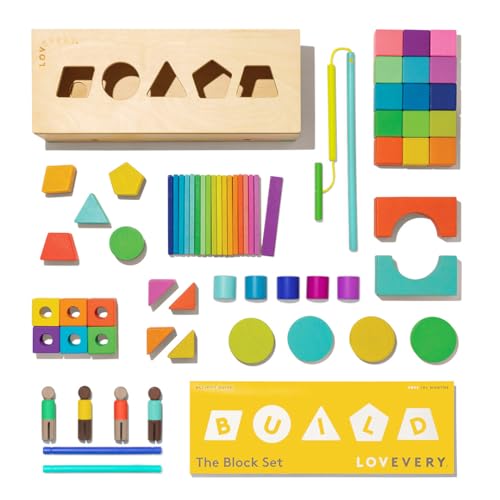
Lovevery
The Block SetSeventy solid-wood pieces with water-based paint and finishes, 12 months and up, per Lovevery. No standard is named, and the set has a toggle string.
Meets our published criteria, as of Nov 15, 2026
$95View
What to avoid
- A big plywood or MDF piece with no TSCA Title VI label on it or its box — EPA requires one on finished goods made with hardwood plywood, MDF or particleboard, except very small amounts
- Any toy graded 3+, or with a choking-hazard warning, in a house with a child under 3 — a 3+ grade often means small parts, and a choking-hazard warning on the box means it does
- Old, hand-me-down or unbranded painted wood — old paint can predate today's lead limits, and new violations turn up mostly among marketplace sellers
What to look for
- The wood or the board named on the maker's page — solid wood, plywood and MDF raise different questions
- A named finish — "water-based paint," "untreated" or a named oil is something a maker can be held to
- A glue statement on glued toys — a toy can be glued even when it is not plywood
- An age grade at or below the youngest child — the grade is where small-parts testing shows up
- 1Skip: Wooden blocks that don't name the wood or the finishBuy instead: PlanToys, Haba, Hape Why
- 2Skip: Big wooden pieces in plywood or MDF with no compliance labelBuy instead: Little Partners Why
- 3Skip: "Montessori" as the only thing a listing tells youBuy instead: Fisher-Price, PlanToys Why
- 4Skip: Painted rainbows and stackers that don't name the paintBuy instead: Fisher-Price, Lovevery Why
- 5Skip: Pull toys whose string and wheels aren't describedBuy instead: PlanToys Why
What the label card means
What to skip, and why
A big plywood or MDF piece with no TSCA Title VI label on it or its box
EPA requires one on finished goods made with hardwood plywood, MDF or particleboard, except very small amounts.
Any toy graded 3+, or with a choking-hazard warning, in a house with a child under 3
A 3+ grade often means small parts, and a choking-hazard warning on the box means it does.
Old, hand-me-down or unbranded painted wood
Old paint can predate today's lead limits, and new violations turn up mostly among marketplace sellers.
The full guide: how we chose
Wood skips two of the questions plastic raises: it needs no BPA and no plasticizer like the phthalates in soft vinyl. It does not skip the other three: what the paint or stain is, whether the piece is solid wood or a glued composite like plywood or MDF, and whether the toy is graded for your child's age. "Montessori" on a label does not answer those. It describes a teaching approach, and the American Montessori Society says any school can use the name.
What this sheet covers
People search for wooden toys and Montessori toys because both sound like the plain answer to "what is in my child's toys?" Partly they are. This sheet is about what the word "wood" does not settle: the board, the glue, the paint and the age grade, read off the makers' own pages and the lab reports they link, for blocks, a climbing triangle, an object-permanence box, a stacker, a block system and a pull toy.
The age sheets have more of these and more of everything else: toys for babies, 0 to 12 months and toys for toddlers, 1 to 3.
Solid wood, plywood and MDF
Solid wood is cut from boards. It needs no BPA and is not soft enough to need a plasticizer like the phthalates in soft PVC, which is why our safer toy guide calls wood a shortcut through two of the questions plastic raises. A solid toy can still be glued from smaller pieces, and some wooden-looking toys are pressed from wood fiber and glue (PlanToys makes some pieces this way and calls it PlanWood), so a glue statement is worth having. PlanToys prints "formaldehyde-free glue" on every product page we read.
Plywood, MDF and particleboard are panels glued together with resins that are usually formaldehyde-based; some panels are made with no-added-formaldehyde or ultra-low-emitting resins and may say so. EPA's rule under TSCA Title VI sets emission limits for hardwood plywood, MDF and particleboard, and names wooden children's toys among the goods made with them. A finished good made with those panels must carry a label, on the item or on its box, with the fabricator's name, the month and year it was made, and a TSCA Title VI compliance statement. If the item itself is not labeled, the importer, distributor or retailer has to make the label information available to you on request. Pieces with very little composite wood, 144 square inches or less on the largest face, are exempt, and solid wood is outside the rule.
Plywood is the right material for some toys. A climbing triangle or a learning tower made of solid boards would be heavy and expensive, and layered birch is strong. The question for a big piece is not "is it solid?" but "what is the board, and where is the label?" Our one big-piece pick, the Little Partners climbing triangle, names "layered birch and poplar" and a TSCA Title VI statement in its details, while another line on the same page calls it "solid hardwood." Ask Little Partners which is right before you buy if it matters to you.
Finishes, paint and lead
A wooden toy has one of three finishes: none ("untreated" or "natural"), an oil or wax, or paint and stain. Federal law caps lead at 90 parts per million in paint and surface coatings on toys and 100 ppm in any accessible part. CPSC said in June 2026 that it is not lowering those limits, because it found they already require the lowest amount of lead that is technologically feasible. Every toy sold in the US is required to meet them, so "lead-free paint" on a box tells you little.
Where lead still turns up: old toys, recalled ones, and new toys from marketplace sellers that skip testing. In September 2026 CPSC recalled a wooden busy board sold on Amazon because its zipper exceeded the lead paint limit. Our lead page covers where exposure comes from. A home lead swab reacts only at about 5,000 ppm, far above the 90 ppm toy limit, so a positive result means retire the toy and a negative one does not clear it.
"Water-based paint" or "water-based stains" is a claim about the finish that a maker can be held to. "Non-toxic paint" and "child-safe paint" are the brand's own words. Every painted pick on this sheet except the Little Partners triangle says water-based: PlanToys (water-based dyes), HABA (water-based, solvent-free paints and stains), Hape, Mattel and Lovevery. Little Partners calls its paint "non-toxic" and names no type, though it states testing for lead, heavy metals and phthalates.
Small parts, strings and the age grade
For a wooden toy, the hazard most likely to hurt a child under 3 is mechanical, not chemical. CPSC's small-parts rule bars toys for children under 3 from having parts small enough to be a choking, aspiration or ingestion hazard, including pieces that break off in testing, and toys for older children that have small parts must carry a choking-hazard warning. So a maker's "12 months and up" is its claim that the toy passes, and a "3+" grade or that warning means it is not. Check the grade against the youngest child in the house. Wood can crack and splinter with age; retire a cracked toy.
Strings matter too. ASTM F963 sets length and performance rules for cords on toys for children under 18 months, and in some cases under 3 years; CPSC gives pull toys as an example. The PlanToys snail's lab report names its string as cotton cord and marks that section as met. The Lovevery block set comes with a toggle string for threading. Keep string toys in the room where you are.
"Montessori" is a method, not a materials standard
Montessori is an education approach developed by Dr. Maria Montessori more than a century ago. The American Montessori Society, which accredits schools, says "any school can call itself Montessori, regardless of its fidelity to the philosophy and practice." No certifier controls the word on a toy either, which is why it appears on so many marketplace listings.
What Montessori design means, in AMS's own terms, is hands-on material that supports a child's independence, exploration and purposeful, self-directed work. That is why so many Montessori-labeled toys are simple: one box, one skill, real objects. It is a good way to choose a toy for what it does. It tells you nothing about what the toy is made of.
AMS runs one product program, the Montessori Seal of Excellence, judged on design, quality and alignment with Montessori principles; its published standards say nothing about paint, wood or chemical safety. Its first awardee was a Fisher-Price wooden line that Fisher-Price says it developed in partnership with AMS, sold only on Amazon. Our object-permanence box pick is from that line, so read the seal as AMS's endorsement of a collection it helped shape, not as an independent review. For materials, a "Montessori" toy gets the same read as any other wooden toy.
How to read the label
"ASTM F963" and "CPSIA." The mandatory US toy standard and the law behind the lead and phthalate limits. ASTM keeps no public registry of toys that conform, so "meets ASTM F963" is the manufacturer's statement. For toys for children 12 and under, the law requires that statement to rest on testing by a CPSC-accepted lab and a Children's Product Certificate, which you can ask the maker for. Many pages and reports cite F963-17; F963-23 has been the mandatory version since April 20, 2024, so an older report describes an older batch. PlanToys links ASTM and EN71 reports on all three of its product pages here; Hape and Little Partners state conformance without a report.
"EN 71." The European toy standard. Same reading: the maker's statement.
"Organic pigments." Not a certified-organic claim. PlanToys says its pigments come from trees, plants, flowers and minerals.
"FSC" and "PEFC." Forestry certifications for how the timber was sourced. Worth having, not a safety claim.
"TSCA Title VI compliant." The federal formaldehyde label for plywood, MDF and particleboard. On a big piece made from those boards, it is the one label to look for.
Where to go next
- Toys hub: the materials question answered once.
- Non-toxic toys for babies, 0 to 12 months: teethers, rattles and stackers.
- Non-toxic toys for toddlers, 1 to 3: blocks, play kitchens, dolls and the magnet line.
- Toys and art supplies cheat sheet: the label rules and picks by cut.
- SafeMama's safer toy guide: lead, ASTM F963 and small parts.
- Lead and heavy metals: where exposure still comes from.
- Phthalates in PVC and soft vinyl: what is actually banned.
Buying for a birthday or the holidays? Our gift guide by age pulls picks from each toy sheet.
The swaps, in full
Wooden blocks that don't name the wood or the finish
Blocks are the wooden toy almost every family buys, and they get mouthed, thrown and handed down. A maker that names the wood, the glue and the paint has put its claim where you can check it. All three sets below name a finish and are graded by their makers for 12 or 18 months and up.
Hides in: Marketplace block sets with "natural," "eco" or "Montessori" in the title and no materials on the page
Forty blocks in six shapes. PlanToys' page names rubberwood, formaldehyde-free glue, organic pigments and water-based dyes ("chemical-free" is its word), a line it uses on every product page we read, and links ASTM and EN71 test reports. The page says "wooden blocks" and does not say solid wood. For a 12-month-old, take one of the sets below.
Ingredient panel checked · source
Forty-six blocks. HABA's page says PEFC-certified wood and "water-based solvent-free paints and stains." PEFC is a forestry certification, not a toy-safety one, and the page names no wood species, does not say solid wood, and names no toy standard.

Manufacturer statement checked · source
Fifty blocks. Hape's US page says solid wood construction, water-based paint and that the toy meets EN 71 and ASTM F963, which is the maker's statement. The name says maple, but Hape's global page for the same item lists the wood as schima.

Manufacturer statement checked · source
Big wooden pieces in plywood or MDF with no compliance label
Climbing triangles, learning towers and play kitchens are often made of hardwood plywood or MDF, panels usually glued with formaldehyde-based resins. EPA requires finished goods made with them to carry a TSCA Title VI label on the piece or its box, naming the fabricator and the month and year of production; if the item itself is not labeled, the seller must give you the label information on request. Plywood is not a problem in itself. A page that says only "wood," with no label anywhere, is a question for the maker.
Hides in: Climbers and towers sold as "solid wood" or "natural wood" with no board or finish named
Little Partners' page says "layered birch and poplar" that is "EPA TSCA Title VI and FSC" compliant and "Safety tested to ASTM F963-17" and the federal phthalates rule. It calls its paint "non-toxic" without naming a type, says "Certified Safe and Non-Toxic" without naming a certifier, gives no FSC license number and links no report. The same page also calls the frame "solid hardwood," which does not match the plywood line.

Manufacturer statement checked · source
"Montessori" as the only thing a listing tells you
Montessori is an education approach, not a materials standard, and no law or certifier controls the word on a toy. The American Montessori Society does award a product seal, judged on design, quality and fit with Montessori principles. So for materials, the questions are the same as for any wooden toy: what is it made of, and what age is it graded for?
Hides in: Listings that lead with "Montessori" and list no wood, finish or age grade
A wooden box with sliding doors and four shapes. Mattel's page names FSC-certified wood (license FSC-N004566) and water-based paint ("non-toxic" is its word), but does not say whether the box is solid wood or plywood. It holds the AMS Montessori Seal of Excellence, for a line Fisher-Price says it developed in partnership with AMS.
Manufacturer statement checked · source
Nine blocks: three visual, three that make sounds, three textured. PlanToys names rubberwood, formaldehyde-free glue, organic pigments and water-based dyes. The page does not list the other parts, but its linked 2021 lab report does: fabric, plastic lenses, a mirror and cotton cord.

Ingredient panel checked · source
Painted rainbows and stackers that don't name the paint
Colorful wooden toys are where the paint question lives. Every toy sold in the US is required to keep paint and surface coatings under the federal lead limit, so "lead-free paint" on a box separates little. "Water-based paint" is a claim about the finish that a maker can be held to; "non-toxic paint" is a brand's word.
Hides in: Rainbow stackers sold under dozens of brand names, with "non-toxic paint" and nothing else
Ten wood pieces. Mattel's page says FSC-certified wood and water-based paint ("non-toxic" is its word), names no plastic part, and does not say whether the pieces are solid wood.
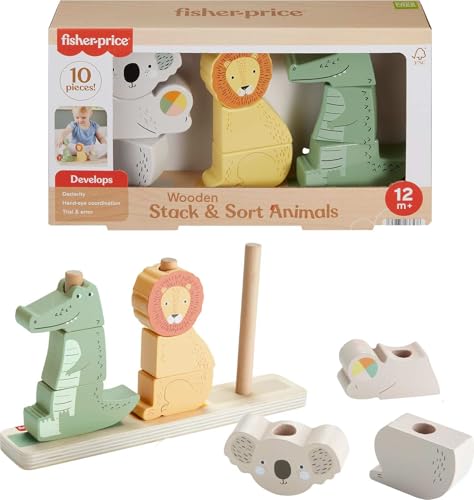
Manufacturer statement checked · source
Seventy pieces. Lovevery's page says solid wood blocks with water-based paint and finishes and "meets or exceeds global safety standards" without naming one. It includes a toggle string for threading and converts into a pull car, so keep a grown-up nearby with a young toddler.
Pull toys whose string and wheels aren't described
A pull toy is wood plus a cord, and the cord is the part a product page often skips. ASTM F963 sets length and performance rules for cords on toys for babies and young toddlers, so check the age grade, and look for a maker that says what the string is.
Hides in: Marketplace pull-alongs with no materials page and no age grade
PlanToys' page names rubberwood, formaldehyde-free glue, organic pigments and water-based dyes. Its linked 2022 lab report names the string as cotton cord and marks the ASTM F963-17 cord section as met.

Ingredient panel checked · source
Do the free things first
Use the wood you already have
Wooden spoons, a nesting set of bowls and a cardboard box cover a lot of what a baby or young toddler does with blocks. You know what they are made of.
Retire doubtful hand-me-downs
Old painted wooden toys are the ones worth questioning, since the lead limits apply to toys sold now. A home lead swab only reacts at about 5,000 ppm, far above the 90 ppm toy limit, so a positive means retire the toy and a negative does not clear it.
Find the label on the big piece you own
If you already have a wooden kitchen, tower or climber, look for the TSCA Title VI label on the piece or the box. If neither has one, the seller has to give you the label information on request.
Label traps
- "Montessori" on a toy — A description of the teaching approach the design follows. It says nothing about the wood, the glue, the paint or the age grade.
- "Solid wood" on a big piece — Check the details section too. One climber on this sheet is called "solid hardwood" and "layered birch and poplar" on the same page.
- "Lead-free paint" as a selling point — Every toy sold in the US is already required to meet the lead limit for paint, so it separates nothing.
- FSC or PEFC as a safety claim — Both certify how the timber was sourced. Neither says anything about the paint, the glue or the toy.
How we choose
We read the maker's own page, and any lab report it links, and record what it says about the wood or board, the glue, the finish and the age grade, including what it leaves out. We favor toys that name all of those. Where a brand names a standard or a certification, we repeat it as the brand's statement.
- The maker's own page names the wood and the finish; we say where it does not say solid wood or board
- An age grade that covers a child of 12 to 18 months
- For plywood or MDF, a TSCA Title VI compliance statement
- Maker's page read and dated on our product panel; five picks were read for this sheet on November 15, 2026, and the rest are reused from our other toy pages and re-checked the same day
Every source we cite is checked against our criteria first — see how we check our sources.
What the research says
The CPSC this year issued 498 notices of violations for toys through June, as of the latest data available (Sept. 23, 2025).
— A U.S. PIRG Education Fund report authored by Teresa Murray found ...
Trouble in Toyland 2025: A.I. bots and toxics present hidden dangers — U.S. PIRG Education Fund (2025-11-13)
When you buy a toy or any other product online and it's shipped directly to you from another country, it generally doesn't get inspected before it gets to your mailbox.
— A U.S. PIRG Education Fund report authored by Teresa Murray found ...
Trouble in Toyland 2024: Unsafe toys that slip through the border — U.S. PIRG Education Fund (2024-11-19)
Selecting products labeled 'fragrance-free' rather than 'unscented' may help reduce exposure to endocrine-disrupting chemicals because unscented products may contain multiple scents, still bound by phthalates, that are mixed to cancel each other out.
— According to American College of Obstetricians and Gynecologists guidance co-authored by Tracey J. Woodruff, PhD, MPH, ...
Reducing Prenatal Exposure to Toxic Environmental Agents (Committee Opinion No. 832) — American College of Obstetricians and Gynecologists
Sources
- Frequent Questions for Consumers about the Formaldehyde Standards for Composite Wood Products Act — U.S. Environmental Protection Agency (how we check this source)
- Formaldehyde Emission Standards for Composite Wood Products — U.S. Environmental Protection Agency (how we check this source)
- 40 CFR 770.45, labeling (finished goods, box labels, de minimis exemption) — Electronic Code of Federal Regulations
- Small Parts for Toys and Children's Products — U.S. Consumer Product Safety Commission (how we check this source)
- Toy safety requirements for children's products (CPSIA) — U.S. Consumer Product Safety Commission (how we check this source)
- Safety standard mandating ASTM F963 for toys, direct final rule, effective April 20, 2024 — U.S. Consumer Product Safety Commission
- Notice of Commission determination regarding technological feasibility of lead content reduction, 91 FR 37957 (June 24, 2026) — U.S. Consumer Product Safety Commission
- CPSC Prohibits Certain Phthalates in Children's Toys and Child Care Products — U.S. Consumer Product Safety Commission (how we check this source)
- SQT Recalls Lontcs Busy Boards Due to Risk of Serious Injury from Lead Poisoning (September 10, 2026) — U.S. Consumer Product Safety Commission (how we check this source)
- What Is Montessori? ("any school can call itself Montessori") — American Montessori Society
- AMS Montessori Seal of Excellence (standards for evaluation) — American Montessori Society
- Fisher-Price Introduces Montessori Toys Crafted in Partnership with the American Montessori Society (press release reprint, September 16, 2025) — Global Toy News
Common questions
Every toys & art suppliesproduct we've reviewed— what we'd buy, what we'd skip, and where each one stands.