
SafeMama's Safer Toy Guide
The original version of this guide ran in 2008, the same year Congress passed the law that rewrote U.S. toy safety from the ground up. That law is old news now — it's been the baseline for well over a decade. Here's what actually governs a toy sold in the U.S. today, and why wood, as a category, sidesteps most of the questions this guide used to have to ask.

This page used to be news about a brand-new law. It isn't anymore — the Consumer Product Safety Improvement Act of 2008 has been the floor for every toy sold in the U.S. for well over a decade, and the mandatory safety standard underneath it (ASTM F963) gets revised on its own schedule, most recently in 2023. Three things determine whether a toy clears a reasonable bar today: lead in any accessible component, mandatory small-parts age grading for children under 3, and — for anything soft and squeezable — what plasticizer, if any, made it that way. Wood, as a material category, never needs a hardening agent and never needs a plasticizer, which is why it shows up repeatedly in this guide as a shortcut rather than a guarantee.
Brands in this guide
- Fisher-Price1 pick
- WoodenEdu1 pick
- Pearhead1 pick
Our picks
Cheat-sheet winners
The winners from our cheat sheet, each chosen for one job.
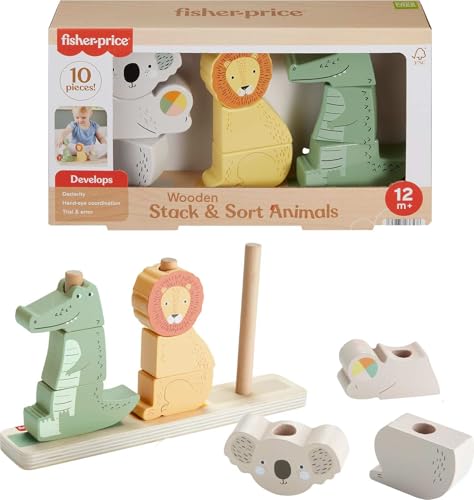
Wooden baby toy that names its materials
Fisher-Price Wood Stack & Sort Animals Toy
Ten wood pieces; Mattel's page says FSC-certified wood and water-based paint, and names no plastic part. Ages 12 months and up.
Manufacturer statement checked · source
$16.99View on Amazon
Why this page has a 2008 slug and a 2026 answer
The original SafeMama toy guide ran in 2008 — the same year Congress passed the Consumer Product Safety Improvement Act (CPSIA), rewriting toy safety regulation after a wave of recalls involving lead paint and small magnets. At the time, that law was breaking news: new lead limits, a mandatory safety standard, a federal testing regime that hadn't existed before.
None of that is news anymore. CPSIA has been the floor for every toy legally sold in the U.S. for well over a decade. Reading a 2008-era post about it today would be like reading a 2008 post explaining that seatbelts are now required — true when it was new, misleading as a description of where things currently stand. This page keeps the legacy slug because that's where the traffic and the trust already live, but the content underneath is current: what the law actually requires today, and what to look for beyond the legal floor.
The three questions worth asking about any toy
Every toy legally sold in the U.S. has already cleared a regulatory bar. The honest way to evaluate one is to know what that bar actually covers — and where it stops.
1. Lead — capped, but not zero
CPSIA caps total lead content at 100 parts per million (ppm) by weight in any accessible component of a product made for children 12 and under, with a stricter 90 ppm limit (0.009 percent) specifically for paint and surface coatings.
That's not a number sitting somewhere between the 2008 law and a tighter one still to come. The statute obliges the CPSC to keep asking whether a lower limit is technologically feasible, and it answered most recently on June 24, 2026, in a determination published in the Federal Register (91 FR 37957): the detection limits of the two methods its labs use — X-ray fluorescence and ICP-OES — "have not significantly changed over recent years," so "current regulations already require the lowest amount of lead that is technologically feasible to achieve," and the Commission is "not revising these lead limits at this time." 100 ppm substrate and 90 ppm paint is the standing standard, not a placeholder.
Lead shows up in toys almost entirely through pigments — old paint formulas, and less often, metal components or low-grade PVC stabilizers. It's a legal-compliance question rather than a "which brand cares more" one: a toy on a U.S. shelf has already been tested against this number.
2. ASTM F963 — the standard behind the law
CPSIA doesn't itself spell out every mechanical and chemical requirement a toy has to meet; it requires compliance with ASTM F963, the toy safety standard that does. F963 covers sharp points and edges, flammability, sound level limits, magnet strength (a response to a wave of ingestion injuries from high-powered magnetic toys), battery compartment accessibility, and small parts — among other things. It isn't a voluntary certification a brand can choose to skip; it's the mandatory standard behind the CPSIA law, currently in its 2023 revision (F963-23). CPSC mandated that revision in a direct final rule effective April 20, 2024, so it applies to toys manufactured from that date onward.
Practically, this means "meets ASTM F963" isn't a marketing claim worth looking for on packaging — it's already required. What's worth checking is whether a specific toy has been subject to a recall after that testing, which the CPSC tracks on an ongoing basis.
3. Small parts — a strict, no-exceptions test
For any toy marketed to children under 3, U.S. law requires that no piece — including one that breaks off during deliberate use-and-abuse testing, not just a piece that ships loose — fit entirely inside a cylinder 2.25 inches long and 1.25 inches wide, sized to approximate a young child's fully expanded throat. If a piece fits, the toy can't be marketed for that age group. There's no warning label that satisfies this for the under-3 category; it's a straightforward pass/fail.
This is where age grading on packaging actually means something specific, rather than being a vague suggestion: "3+" is the manufacturer asserting the product passed that cylinder test for children under that age.
What these three questions don't cover
None of the above addresses phthalates — the plasticizers that make PVC and soft vinyl squeezable — in any depth, because we already have a dedicated page for that question: Phthalates in PVC & Soft Vinyl Baby Products covers exactly which phthalates are restricted, since when, and what it means for bath toys, teethers, and bibs. Short version: eight specific phthalates are capped at 0.1% under CPSIA Section 108, three since the original 2008 law and five more added by a 2017 rule — but that page does the explaining, so this one won't repeat it.
They also don't cover mold and bacteria growing inside a hollow toy, which is a shape problem, not a chemistry or lead problem. If a hollow squeeze toy is on your radar, our bath toy mold explainer covers a 2018 study that found dense microbial growth inside squeeze toys regardless of material — a toy can be fully lead- and phthalate-compliant and still be exactly the shape that traps water.
And they don't cover the soft-parts materials question generally — silicone versus TPR versus PVC — which the toys hub and our TPR explainer already handle.
Why wood shows up here as a shortcut, not a rule
Wood doesn't get a regulatory exemption. A wooden toy still has to clear the same lead limit (paint and finish included) and the same ASTM F963 testing as anything else, and a wooden toy with small detachable pieces still fails the same cylinder test a plastic one would.
What wood sidesteps is narrower, and it's a materials-science point rather than a safety-halo one: wood is rigid on its own, so a wooden toy never needs a hardening agent like BPA to hold its shape, and it's naturally firm rather than squeezable, so it never needs a plasticizer — meaning the entire phthalates question our PVC explainer covers simply doesn't arise for a solid wood piece. That's one fewer chemistry question to ask, not zero questions.
Three current wooden picks, offered as an example of that category rather than a ranked "best of" list:
- Fisher-Price Wood Baby Toy Stack & Sort Animals — 10 solid wood pieces, no soft-plastic components to evaluate in the first place.
- WoodenEdu Baby Toys Car — a wooden pull-along toy sized for a toddler's hands.
- Pearhead Wooden Egg Shaker Baby Toy Set — four solid wood rattles with no rubber or vinyl grip to check.
None of these need a phthalate check or a BPA check, because neither question applies to solid wood. They still need the same lead-in-finish and small-parts scrutiny as anything else — wood is a shortcut through two of the three questions above, not all three.
The bottom line
A toy legally sold in the U.S. today has already cleared a 100 ppm lead limit, mandatory ASTM F963 testing, and — if it's marketed for children under 3 — a strict small-parts cylinder test. That's a meaningfully higher floor than existed before 2008, and it's worth knowing so that "CPSIA-compliant" reads as the baseline it is rather than a distinguishing feature. Where a toy goes further is usually a materials choice: wood or another naturally rigid material sidesteps the BPA and phthalate questions before they come up, which is why it's the shortcut worth reaching for when it fits the toy in question.
Art and craft supplies raise the same disclosure question from the other direction, and the play dough aisle is where it comes up most: our play dough showdown covers what Hasbro publishes about Play-Doh, what its own patent describes, and the brands that simply print the ingredient list on the tub.
Our top pick
Manufacturer statement checked · source
Fisher-Price Wood Baby Toy Stack & Sort Animals — 10 solid wood pieces, no soft-plastic components to evaluate at all.
Also worth considering

WoodenEdu Baby Toys Car,Wooden Pull Along Toy for Toddlers 1 2 3 Year Olds | Developmental Push Pull Toy Birthday Gift for Boys Girls Kids,Dog
WoodenEdu Baby Toys Car — a wooden pull-along toy, sized for a toddler's grip rather than a mouth.

Pearhead Wooden Egg Shaker Baby Toy Set, 4-Piece Musical Rattles | FSC-Certified Wood, Pastel Maracas, Sensory Rhythm Play, Fine Motor Skills, 0+ Months
Pearhead Wooden Egg Shaker Baby Toy Set, 4-Piece Musical Rattles — solid wood rattles with no rubber or vinyl grip to check.
What doesn't tell you a toy is safe
- "Non-toxic" on the box — It's not a defined regulatory term for toys the way it is for, say, art supplies under ASTM D-4236. A toy legally sold in the U.S. already has to clear CPSIA's lead limit and the mandatory ASTM F963 standard — the phrase on the box adds nothing you weren't already getting.
- "BPA-free" on a rigid plastic toy — BPA is a hardening agent used in polycarbonate. It was never the relevant concern for soft, squeezable toys — phthalates in PVC are. A brand advertising "BPA-free" on a soft toy is answering a question that doesn't apply to that material.
- An age recommendation with no small-parts explanation — "3+" on a package means the manufacturer is asserting the toy passed small-parts testing for that age. If a toy has genuinely tiny detachable pieces and is marketed for a younger sibling in the house, the age grading is about the child playing with it, not every child in the room.
- Assuming a big-box retailer already screened this for you — CPSC recalls run continuously and cover toys that were sold at major retailers after passing initial compliance testing — testing catches a batch, not a guarantee for every unit forever. A current recall list is still worth checking before a purchase, not instead of one.
How we choose
This guide doesn't rank toys against each other — it explains the three regulatory questions worth asking about any toy, then shows a small set of wooden picks as an example of a material category that sidesteps two of the three by default. For phthalates specifically, see our dedicated explainer; this page won't re-run that argument.
- Solid wood or another material that doesn't require a plasticizer to be soft
- No loose small parts sized for a child under 3
- Currently in production, with no active recall on the pick
- Manufacturer discloses material composition rather than staying silent
Every source we cite is checked against our criteria first — see how we check our sources.
What the research says
The CPSC this year issued 498 notices of violations for toys through June, as of the latest data available (Sept. 23, 2025).
— A U.S. PIRG Education Fund report authored by Teresa Murray found ...
Trouble in Toyland 2025: A.I. bots and toxics present hidden dangers — U.S. PIRG Education Fund (2025-11-13)
When you buy a toy or any other product online and it's shipped directly to you from another country, it generally doesn't get inspected before it gets to your mailbox.
— A U.S. PIRG Education Fund report authored by Teresa Murray found ...
Trouble in Toyland 2024: Unsafe toys that slip through the border — U.S. PIRG Education Fund (2024-11-19)
Selecting products labeled 'fragrance-free' rather than 'unscented' may help reduce exposure to endocrine-disrupting chemicals because unscented products may contain multiple scents, still bound by phthalates, that are mixed to cancel each other out.
— According to American College of Obstetricians and Gynecologists guidance co-authored by Tracey J. Woodruff, PhD, MPH, ...
Reducing Prenatal Exposure to Toxic Environmental Agents (Committee Opinion No. 832) — American College of Obstetricians and Gynecologists
Sources
- Notice of Commission determination regarding technological feasibility of lead content reduction, 91 FR 37957 (June 24, 2026) — U.S. Consumer Product Safety Commission
- Safety standard mandating ASTM F963 for toys — direct final rule, effective April 20, 2024 — U.S. Consumer Product Safety Commission
Side by side
| Attribute | Fisher-PriceWood Stack & Sort Animals Toy | Wooden Base &… | WoodenEduBaby Toys Car | PearheadWooden Egg Shaker Baby Toy Set |
|---|---|---|---|
| Why it's here | Our top pick | — | — |
| Price | $16.99 | $9.99 | $12.23 |
| Availability | In stock | In stock | In stock |
Common questions
Cheat sheets for this
Part of the Toys & Art Supplies hub— the rest of our coverage in this category.
Every toys & art suppliesproduct we've reviewed— what we'd buy, what we'd skip, and where each one stands.