
The toys and art supplies cheat sheet
One winner for each way people buy toys and art supplies.
The at-a-glance version for the toy bin and the art cart: what to look for on play dough, crayons, bath toys and baby toys, what the standards on the box do and do not mean, and our picks by cut. It points to the full pages rather than repeating them.
How we scoreHow we earnChecked October 26, 2026
Our winner for each way people buy
How we scoreHow we earnChecked October 26, 2026
Play dough that states what it is made of

Marie's Kids
Modeling Clay for KidsSoft wheat-flour dough in 12 colors. The maker's page says natural wheat flour with no other additives; it does not list water, salt or colorants.
Meets our published criteria, as of Oct 26, 2026
$14ViewCrayons for toddlers

Honeysticks
100% Pure Beeswax CrayonsPure beeswax and food-grade pigments with no paraffin wax, per the brand's own page.
Meets our published criteria, as of Oct 26, 2026
$22.95ViewWashable paint with a printed ingredient list

Natural Earth Paint
Petite Natural Earth Paint KitCorn starch, gum arabic, and earth and mineral pigments, per the maker's page. ACMI's certified-product search lists this kit with the AP seal (checked October 23, 2026). The heavy-metal line on the page is the maker's statement, with no report; its FAQ says ages 3+.
Meets our published criteria, as of Oct 26, 2026
$17.63ViewOpen cups, if you want a no-cavity bath toy

mushie
Stacking Cups ToyNot sold as a bath toy, but eight open polypropylene cups have no sealed cavity for water to sit in. mushie states them free of BPA, BPS, PVC and phthalates; wash and air-dry, per the maker.
Meets our published criteria, as of Oct 26, 2026
$14.99ViewA bath boat that names its materials

Green Toys
TugboatThe maker's page describes a wide spout for scooping and pouring and says dishwasher safe, with recycled plastic and no BPA, phthalates or PVC. Turn it upside down to drain.
Meets our published criteria, as of Oct 26, 2026
$15.36ViewWooden baby toy that names its materials
Fisher-Price
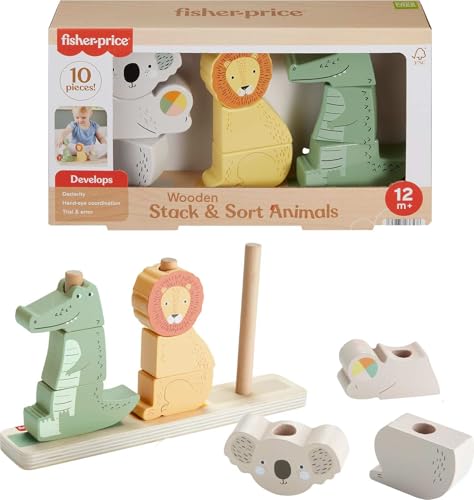
Wood Stack & Sort Animals ToyTen wood pieces; Mattel's page says FSC-certified wood and water-based paint, and names no plastic part. Ages 12 months and up.
Meets our published criteria, as of Oct 26, 2026
$16.99View
What to avoid
- Hollow bath toys with a single small hole — the shape traps water and grows biofilm, as the 2018 study found (see our bath toy explainer)
- Soft PVC with no stated material — PVC needs plasticizers to be squeezable; see our TPR explainer
- A proprietary dough recipe — if the recipe is not published, there is nothing to assess
- "Conforms to ASTM D-4236" read as a certification — it is a conformance statement, not a certification
What to look for
- A published materials list — the maker has put its claim where you can check it
- A voluntary "PVC-free" statement — a maker staking its name on it is reasonably trustworthy, per our TPR explainer
- Solid, or open wide enough to drain and dry — the shape the bath toy study points to
- 1Skip: Play dough that won't publish its recipeBuy instead: Marie's kids, ChildGen Why
- 2Skip: Crayons that only say "non-toxic"See all non-toxic crayons, and what Crayola, Faber-Castell and Prang say Why
- 3Skip: Art supplies that only say "non-toxic"Buy instead: Natural Earth Paint Eco-Friendly Paint Kits Why
- 4Skip: Hollow squeeze bath toys with a small holeBuy instead: mushie, Green Toys, PlanToys Why
- 5Skip: Soft vinyl of unknown materialBuy instead: Fisher-Price, PlanToys Why
What the label card means
What to skip, and why
Hollow bath toys with a single small hole
The shape traps water and grows biofilm, as the 2018 study found (see our bath toy explainer).
Soft PVC with no stated material
PVC needs plasticizers to be squeezable; see our TPR explainer.
Know the risks: PVC / soft vinylA proprietary dough recipe
If the recipe is not published, there is nothing to assess.
"Conforms to ASTM D-4236" read as a certification
It is a conformance statement, not a certification.
The full guide: how we chose
For toys and art supplies, the useful question is "what is it made of, and did the maker say so?" Disclosure is thin in this category, so a brand that prints a materials list is already ahead of one that prints "non-toxic." For soft parts, PVC is the material to avoid; for bath toys, the shape matters more than the plastic, so favor solid toys or ones that open wide enough to dry.
What this sheet covers
This is the short version of what we have already written about toys and art supplies. It is for the parent standing in an aisle, or in front of a browser tab, deciding between two tubs of dough or two sets of bath toys. The full reasoning lives on the pages linked in each section, and we have tried not to repeat it here.
Six cuts get a pick: play dough, crayons, washable paint, open cups and boats for the tub, and baby toys. We do not have a marker pick yet. The marker pages we read printed "nontoxic" and nothing else, and a pick on that basis would break our first rule.
The swaps
Play dough. The classic recipe is proprietary, so we only looked at doughs that publish their ingredients. Our play dough showdown covers what Hasbro does and does not disclose, the tested alternatives, and a homemade recipe. All of the picks contain wheat.
Crayons and paint. Our non-toxic crayons page has the full read: Crayon Rocks says soy wax and posts a lab report, Honeysticks prints a short materials list (beeswax and food-grade pigments) but names no safety standard, Stockmar is in ACMI's AP seal register but is only about 10% beeswax by its own FAQ, and Crayola says it is mostly paraffin and carries the seal. For paint, Natural Earth Paint prints three ingredients (corn starch, gum arabic, earth and mineral pigments), and ACMI's own certified-product search lists the Petite kit we picked with the AP seal. Its page also says the pigments are "tested and free of toxic heavy metals"; it shows no report, so we repeat that as the maker's statement.
Bath toys. The problem with hollow squeeze toys is the hole, not only the plastic. Our bath toy explainer walks through the 2018 study. The mushie cups on this sheet are not sold as a bath toy, but they are open, so water cannot sit in a sealed interior, and the brand states they are free of PVC and phthalates. The Green Toys cups are open too, and its tugboat has a wide spout you can turn upside down to drain; Green Toys states recycled plastic with no BPA, phthalates or PVC. The PlanToys boat is wood, and its page does not say whether it is solid or how to dry it, so dry it like any other bath toy.
Soft parts and baby toys. Silicone and TPR are soft by nature; PVC needs plasticizers. See what TPR is and the toys hub. Solid wood is a shortcut through two of the three regulatory questions, not all three, as our safer toy guide explains.
How to read the label
"Non-toxic." For toys this is not a defined regulatory term. Treat it as the brand's word.
"Conforms to ASTM D-4236." This is the US labeling standard for chronic hazards in art materials. As our play dough showdown describes it, a conformance statement means the formulation was reviewed by a toxicologist. It is a conformance statement, not a certification.
The AP seal. The Art and Creative Materials Institute runs a certification program that describes itself as working to protect "students, artists and creatives of all kinds," with a public product search tool. The Honeysticks and mushie pages we read do not state the seal. The Natural Earth Paint page does, and we checked ACMI's search tool for that kit (it is listed with the AP seal). The AP seal is ACMI's own program, run by an association whose members are art-supply makers and sellers. It is not a government approval, and we have not seen a lab report for this kit. For the other picks it is not recorded, so we claim it for none of them.
CPSIA and ASTM F963. For toys, these are the legal baseline: a lead limit and a mandatory toy standard. A toy that says "CPSIA compliant" is telling you it is legal to sell. We did not confirm a Children's Product Certificate for any pick on this sheet; those certificates are issued to retailers and are not public. Our safer toy guide lays out what each covers, and the phthalates page covers the plasticizer rules.
"PVC-free." A voluntary statement is reasonably trustworthy, because a maker is staking its name on it. Silence is not a claim; ask.
Where to go next
- Toys hub: the materials question answered once.
- The play dough showdown: tested doughs and a homemade recipe.
- Mold and bacteria inside squeeze bath toys: the 2018 study and what to do.
- What is TPR, and is it safe?: soft parts and the PVC question.
- Play sand: the one place where the question is a mineral one.
- SafeMama's safer toy guide: lead, ASTM F963 and small parts.
The swaps, in full
Play dough that won't publish its recipe
The classic dough's recipe is proprietary, and nobody outside the company knows the full recipe. Play-Doh is fine for most families; these picks are for when disclosure matters to you, because dough that prints its ingredients lets you decide for yourself. Every pick below contains wheat, so a wheat or gluten allergy means the homemade recipe on our showdown page.
Hides in: The product page and tub, for an ingredient list and not just "non-toxic"
Soft wheat-flour dough in 12 colors. The maker's page says natural wheat flour with no other additives; it does not list water, salt or colorants.
Publishes a full ingredient list, but its CPSIA children's certificate is unconfirmed (details on the showdown page).

The same dough in mini cups. The same unconfirmed CPSIA certificate applies.

Crayons that only say "non-toxic"
Every crayon sold in the US has to be toxicologist-reviewed and labeled to ASTM D-4236, so "non-toxic" on the box separates nothing. What differs is whether the maker prints the wax, whether a seal can be looked up in ACMI's register, and what age it is made for. We read eight makers' pages and the register.
Hides in: The maker's product page and ACMI's certified-product search, not the front of the box

Top pick: Crayon Rocks
Art supplies that only say "non-toxic"
"Non-toxic" with no materials list and no standard named gives you the brand's word and nothing to check. Paint whose maker prints what it is made of is easier to trust, and the manufacturer's page is the place to read it.
Hides in: The maker's product page, not the front of the box
A powder you mix with water. Three ingredients on the maker's page: corn starch, gum arabic, and earth and mineral pigments; "not intended for consumption." ACMI's own certified-product search lists this exact kit with the AP seal. The maker says the pigments are "tested and free of toxic heavy metals" but prints no report, so that line is its word. Its FAQ says ages 3+.
Petite Natural Earth Paint Kit – Eco-Friendly, Washable Craft Paint for Kids & DIY Projects, Non-Toxic, Gluten-Free, Made in the USA, Compostable Packaging, Organic & Mineral-Based Pigments, 6 Bright Colors, Easy Clean-Up
Ingredient panel checked · source
Hollow squeeze bath toys with a small hole
A 2018 study found dense biofilm inside every hollow squeeze toy tested. The researchers point mainly to the shape, which traps water in a warm, dark cavity; softer plastics also fed more growth. Our bath toy explainer has the full finding and how to care for the toys already in your tub.
Hides in: Squirters and squeaky animals with one small opening
Eight open polypropylene cups that the brand states are free of BPA, BPS, PVC and phthalates. They are not sold as a bath toy, but their shape has no sealed cavity.
Ingredient panel checked · source
The maker's page says recycled plastic with no BPA, phthalates or PVC, and dishwasher safe. Open cups, so no sealed cavity.

The maker's page describes a wide spout for scooping and pouring and says dishwasher safe, with recycled plastic and no BPA, phthalates or PVC. Turn it upside down to drain after bath time.
The maker's page calls it "perfect for the bath," made of PlanWood (sawdust and wood scraps) and rubberwood with formaldehyde-free glue, organic pigments and water-based dyes. It does not say whether the boat is solid and gives no drying instructions, so the air-dry advice below applies.

Soft vinyl of unknown material
PVC is rigid until it is plasticized, historically with phthalates. A wooden toy whose maker names the wood and the finish sidesteps that question and gives you something to check, though it still has to meet the same lead and small-parts rules as any other toy.
Hides in: Hollow squeaky toys and harder-feeling dolls, especially when the packaging does not name a material
Ten wood pieces; Mattel's page says FSC-certified wood and water-based paint ("non-toxic" is its word). It names no plastic part. Ages 12 months and up.
Manufacturer statement checked · source
Nine blocks, three visual, three auditory and three tactile, for 12 months and up. The maker's page names rubberwood, formaldehyde-free glue, organic pigments and water-based dyes, but does not say what the tactile and auditory blocks are made of, so it does not clear the bar for a wooden toy.

Do the free things first
Make the dough
It costs pennies and beats most of what you can buy. Use the recipe on the showdown page.
Dry the bath toys
Rinse with clean water, squeeze out what you can, and air-dry somewhere with airflow. It costs nothing and works against the cause the bath toy study identified.
Squeeze before you decide
Hold a hollow bath toy over the sink and squeeze. If cloudy liquid comes out, retire it.
Label traps
- "Non-toxic" on a toy — For toys it is not a defined regulatory term, and a toy legally sold in the US already has to clear the lead limit and the mandatory toy standard.
- "Conforms to ASTM D-4236" as proof of safety — It is a conformance statement, not a certification.
- "CPSIA compliant" as a selling point — Compliance is the legal baseline for toys sold in the US, so it separates nothing.
- "BPA-free" on a soft toy — Soft materials never needed BPA. The question that applies to them is PVC.
- An age grade you ignore — "3+" means the maker is not claiming the toy is suitable for children under 3, often because it has small parts. Check the grade against the youngest child in the house.
How we choose
We read the maker's own page and record what it says, including what it does not say. We favor products that publish a materials list, and we pick shapes and materials that avoid the questions our explainers raise. Where a brand names a standard, we repeat it as a statement and not as a certification.
- Publishes a materials or ingredient list
- No PVC stated, or a wooden toy whose maker names the wood and finish
- Open or solid shapes for anything that lives in the bath
- Maker's page read and dated on our product panel, where we have one; seven picks were sourced for this sheet (two on October 16, 2026 and five on October 23, 2026) and the rest are reused from our play-dough showdown and safer toy guide
Every source we cite is checked against our criteria first — see how we check our sources.
What the research says
The CPSC this year issued 498 notices of violations for toys through June, as of the latest data available (Sept. 23, 2025).
— A U.S. PIRG Education Fund report authored by Teresa Murray found ...
Trouble in Toyland 2025: A.I. bots and toxics present hidden dangers — U.S. PIRG Education Fund (2025-11-13)
When you buy a toy or any other product online and it's shipped directly to you from another country, it generally doesn't get inspected before it gets to your mailbox.
— A U.S. PIRG Education Fund report authored by Teresa Murray found ...
Trouble in Toyland 2024: Unsafe toys that slip through the border — U.S. PIRG Education Fund (2024-11-19)
Selecting products labeled 'fragrance-free' rather than 'unscented' may help reduce exposure to endocrine-disrupting chemicals because unscented products may contain multiple scents, still bound by phthalates, that are mixed to cancel each other out.
— According to American College of Obstetricians and Gynecologists guidance co-authored by Tracey J. Woodruff, PhD, MPH, ...
Reducing Prenatal Exposure to Toxic Environmental Agents (Committee Opinion No. 832) — American College of Obstetricians and Gynecologists
Sources
- Toy safety requirements for children's products (CPSIA) — U.S. Consumer Product Safety Commission (how we check this source)
- Art Materials Business Guidance (LHAMA and ASTM D-4236 conformance statements) — U.S. Consumer Product Safety Commission (how we check this source)
- Ugly ducklings: the dark side of plastic materials in contact with potable water — npj Biofilms and Microbiomes (2018)
- CPSC Prohibits Certain Phthalates in Children's Toys and Child Care Products — U.S. Consumer Product Safety Commission (how we check this source)
- ACMI certification program (Approved Product seal and certified product search) — Art and Creative Materials Institute
Every toys & art suppliesproduct we've reviewed— what we'd buy, what we'd skip, and where each one stands.