BPA-Free Canned Tomatoes? What Each Brand Says About Its Lining
Tomatoes are acidic, which rules out some can linings, and the 2016 Buyer Beware report says tomatoes react with oleoresin. Even so, tomato cans in that 2016 sample were less likely than the average can to have a BPA epoxy lining (44% against 67%), and a 2020 industry survey found none. So the question now is what replaced BPA, and whether you want a can lining at all.

No maker we found documents a tomato package from lining to lid. Glass jars and cartons skip the can lining entirely, but the jar lid is the part makers rarely describe, and Pomi does not publish a statement about its carton layers. Among cans, four makers name what they use instead of BPA epoxy: polyester (Red Gold), polyester or acrylic (Conagra, for Hunt's), and vinyl (Muir Glen and Del Monte). Everyone else says only "non-BPA" or nothing. We picked one jar and two alternatives and listed every product we looked at, including the ones that did not make it.
On your shelf: what the maker says about the lining
These are national and store brands we found at major US grocers and in the 2016 and 2020 can surveys. Each row starts with the maker's own wording from its own site, with the date we read it. "No BPA" tells you what is not in the lining. It does not tell you what is.
- Hunt's canned tomatoesMaker says no BPA in the lining
- The SmartLabel page for Hunt's Diced Tomatoes 28 oz carries a "Non-BPA Liner" heading with no text under it. A 2015 Conagra release says its US and Canadian canned foods moved to "coating systems using polyester or acrylic materials that do not contain BPA" and names Hunt's tomatoes. That release is eleven years old; we found no newer Conagra statement. The 2020 Can Manufacturers Institute survey recorded an acrylic body and polyester end on a Hunt's diced can. Source (checked )
- Muir Glen canned tomatoesMaker says no BPA in the lining
- Muir Glen's FAQ says "all Muir Glen cans and jars are non-BPA" and says its cans "are packaged using a can lining that is made without BPA. We use food-grade or food-safe vinyl liners in our cans." It also sells tomatoes in glass jars and gives no detail on the jar lid. The FAQ says the brand was purchased by Violet Foods in 2026. Source (checked )
- Del Monte canned tomatoesMaker says no BPA in the lining
- Del Monte's site says that in 2016 it converted 100% of its branded tomato products to non-BPA linings, and that "the alternative used for our tomato cans is a vinyl lining." Fresh Del Monte Produce announced on March 19, 2026 that it had completed its acquisition of select Del Monte Foods assets, which its release says include the Del Monte and Contadina packaged tomato brands. This lining statement is from Del Monte's site and we do not know whether it predates the sale. Source (checked )
- Contadina canned tomatoesNo clear statement for tomatoes
- We found no lining statement on contadina.com. Del Monte's FAQ covers "our branded tomato products" without naming Contadina, so we do not assume it applies. Source (checked )
- Cento canned tomatoesMaker says no BPA in the lining
- Cento's FAQ says it moved out of "epoxy based can linings" in 2014 to "other composite linings that do not utilize BPA in their formula," and that "none of our cans contain BPA as an ingredient in the protective lining." It does not name the lining material, and the wording is about ingredients, not about what a lab would find. Source (checked )
- Red Gold and Tuttorosso canned tomatoesMaker says no BPA in the lining
- Red Gold's FAQ says "all of our containers are now BPA-free" and that the lining is "a high-performance polyester." Tuttorosso is a Red Gold brand; its brand page says only that the tomatoes are packed in "Non-BPA lined cans." Source (checked )
- Trader Joe's canned tomatoesNo clear statement for tomatoes
- Trader Joe's undated FAQ says "ALL Canned Beans, Fruits & Vegetables" have no intentionally added BPA in the interior lining. It does not name tomatoes or the replacement lining. For glass jars it says "All metal lids DO have a layer of BPA coating," with another coating on top, and that test results from multiple suppliers show no BPA detected from metal lids. We found no Trader Joe's plain tomatoes in glass. Source (checked )
- 365 by Whole Foods Market canned tomatoesNo clear statement for tomatoes
- One 365 SKU, Organic Crushed Tomatoes No Salt Added 15 oz, says "BPA-free can" on Whole Foods' product page. The 365 Organic Diced Tomatoes page and Whole Foods' quality-standards pages say nothing about the lining. Source (checked )
- Kroger and Simple Truth canned tomatoesMaker says no BPA in the lining
- Kroger's July 2021 Safer Chemicals Statement says it has "transitioned 100% of our canned food products away from BPA-lined cans." That statement is five years old, covers Our Brands canned foods category-wide, and does not name tomatoes or the replacement lining. Source (checked )
- Great Value canned tomatoes (Walmart)No clear statement for tomatoes
- We could not confirm a lining statement for Great Value tomatoes; Walmart's page blocked our check. Source (checked )
- Good & Gather canned tomatoes (Target)No clear statement for tomatoes
- We found no lining statement on the Good & Gather Diced Tomatoes 14.5 oz product page. Source (checked )
Brands in this guide
- Jovial1 pick
- Pomì1 pick
- Hunt's1 pick
Our picks
Cheat-sheet winners
The winners from our cheat sheet, each chosen for one job.
Canned tomatoes
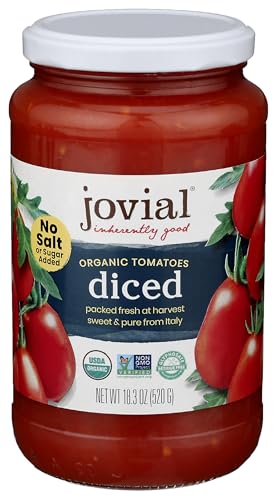
Jovial Tomatoes Diced Organic
Jovial organic diced tomatoes in an 18.3 oz glass jar — the tomatoes touch glass, not a can lining. Jovial's page says "BPA-free lids" and does not name the lid material, so the lid is the one part of this package we cannot characterize. Our tomatoes page compares every brand.
Ingredient panel checked · source
$4.25View on Amazon
What the two surveys found
Tomatoes are acidic, and that limits which can linings work. The 2016 Buyer Beware report by the Ecology Center and partners says tomatoes "react with oleoresin, causing an unpleasant taste," and Conagra said in 2015 that some foods "required a different approach, due to their acidity or other characteristics." That is a constraint on the lining. It is not evidence that tomatoes take up more of anything, and we did not find a source that says so.
Two surveys, four years apart, tell a story about what changed:
- 2016, Ecology Center and partners: 192 cans from 22 stores. Of 27 tomato cans, 44% had a BPA epoxy lining in the body or lid and 56% did not, against 67% of all cans; only corn and peas were lower. Where the lining was not BPA epoxy, it was most often vinyl (PVC): 41% of tomato can bodies.
- 2020, Can Manufacturers Institute: 234 cans in Seattle and Yakima. No tomato can had a BPA-based lining. The non-BPA linings it recorded on tomato cans were polyester, acrylic and vinyl, depending on the brand, with polyester the most common. CMI is the can makers' trade association, so read this as an industry measurement, not an independent one. It identified the lining class, not how much anything moved into the food.
Both are snapshots of one or two cans per product. They do not tell you what is on the shelf today, and neither one tests the product you will buy. The 2016 report also says that data on what migrates from can linings into food (the report names vinyl chloride and styrene) "is not publicly available." So "no BPA" tells you what is missing from the lining, and the lining on a given tomato can is something to look up, not assume.
The swaps: glass and cartons
If the lining is what you are trying to avoid, the cleanest swap is to take the can out of the picture. We looked at both formats:
- Glass jars have no can lining. The part to look at is the lid. Jovial says its jar lids are "BPA-free" and does not name the material. Eden Foods, in its own FAQ, says the first of the coatings inside its amber-glass tomato jar cap contains BPA, sealed behind a second coat and a vinyl overcoat, and that "the coating containing BPA can never be in contact with the food." Most other makers say nothing about lids.
- Cartons have no can lining. Tetra Pak describes its cartons as paperboard with layers of plastic and aluminum. Pomi's own site says the tomatoes are aseptically filled in cartons and makes no BPA statement. Pomì's own Amazon listing, sold by Pomì, says "packaged in a BPA-free carton"; its website says nothing, and Pomi does not name its carton supplier.
Neither format is documented lining-free from end to end by any maker we found. They are a reasonable swap for the lining question, and they come with their own gaps.
Every tomato product we looked at
Read on each maker's own pages on 2026-10-23 unless the row says otherwise. The last column lists the reason, not a judgment of the product. The 2016 report raises questions about both vinyl and styrene-acrylic linings, and neither survey measured migration, so nothing here ranks one lining as safer than another.
| Product | Package | What the maker says about the lining or lid | Pick, or why it is not one |
|---|---|---|---|
| Jovial organic diced, 18.3 oz | Glass jar | "BPA-free lids"; lid material not named | Top pick |
| Pomi chopped, 13.8 oz ×12 | Carton | No BPA or layer statement on the maker's website | Runner-up; the maker publishes nothing about its carton layers |
| Hunt's diced, 28 oz | Steel can | SmartLabel "Non-BPA Liner" heading, no text; 2015 Conagra release: "polyester or acrylic" | Runner-up; names a non-vinyl coating and is easy to find, not shown safer |
| Red Gold / Tuttorosso | Steel can | "all of our containers are now BPA-free"; "a high-performance polyester" | Widely found in grocery stores; the Amazon offers we sourced on 2026-10-23 were third-party multipacks at about $10 per 28 oz can |
| Cento (28 oz San Marzano, others) | Steel can | Moved out of "epoxy based can linings" in 2014 to "other composite linings that do not utilize BPA in their formula" | Lining type not named; the maker's own label page for the 28 oz SKU had no ingredients or nutrition facts on 2026-10-23 |
| Bionaturae | Glass and steel cans | Says the lining of its cans is "produced without BPA" | Lining type not named; jar lid not described |
| Natural Value | Steel can | "non-intent BPA" (diced 14.5 oz page); "non-BPA can lining" (green-chilies page) | Wording differs between products; no type named |
| Organico Bello | Steel can | No statement found on the maker's site | No statement |
| Eden Foods crushed (glass); cans | Amber glass jar; steel can | Jar lid: first coat "has BPA present," behind a second coat and a "protective vinyl base overcoat"; "The coating containing BPA can never be in contact with the food." Cans: lined with a coating "free of BPA, BPS, and phthalates"; lining type not named | Lid has a BPA-containing base coat (Eden's own disclosure); Jovial says its lids are BPA-free |
| Muir Glen | Steel can; glass jar | Cans: "food-grade or food-safe vinyl liners." Also sells glass jars | Names vinyl in its cans. Its FAQ says its jars are non-BPA too and gives no lid detail; we did not source a Muir Glen jar, so Jovial's specific lid statement ranked ahead |
| Del Monte | Steel can | "the alternative used for our tomato cans is a vinyl lining" | Names vinyl; we picked a can that names a non-vinyl coating, which is not a finding that vinyl is worse |
| Contadina | Steel can | No statement found | No statement |
| S&W | Steel can | No statement found on the pages read | No statement |
| Mutti | Steel can; glass bottle | One 2021-dated page: "NO BPA intentionally added to packaging material" | Narrow, dated wording |
| Bianco DiNapoli | Steel can | No statement on the maker's site | No statement |
| Trader Joe's | Steel can | Undated FAQ: "ALL Canned Beans, Fruits & Vegetables" have no intentionally added BPA; tomatoes not named. Jar lids carry a BPA coating with another coating on top | Tomatoes not named |
| 365 by Whole Foods Market | Steel can | One SKU (Organic Crushed No Salt Added 15 oz): "BPA-free can" on its product page; the diced page and quality-standards pages say nothing about the lining | One SKU only |
| Kroger / Simple Truth | Steel can | July 2021: "100% of our canned food products" transitioned away from BPA-lined cans (category-wide, tomatoes not named) | General, five years old |
| Great Value (Walmart) | Steel can | No statement we could confirm | No statement we could confirm |
| Good & Gather (Target) | Steel can | No statement found | No statement |
| Rao's Homemade | Glass jar (sauce) | No statement about the jar lid found | Sauce, not tomatoes |
| Pacific Foods | Carton | No plain-tomato product in the current catalog | Not a tomato |
What this page cannot tell you
We read statements, not cans. Nobody on this page has tested a finished tomato product for BPA, and neither survey above measured how much, if anything, moves into the food. Where a maker says "no BPA," that is what we quote. A few specifics are worth keeping in mind:
- Calcium chloride is added to many diced and whole tomatoes to keep them firm. FDA lists it as generally recognized as safe (21 CFR 184.1193). It is a food additive, not a lining question, but it is on the label of Hunt's, Muir Glen, 365, Contadina and Good & Gather diced tomatoes and not on Jovial's or Pomi's.
- Lining statements age. Hunt's best statement is from 2015. Kroger's is from 2021. Muir Glen and Del Monte both changed owners in 2026. A brand can change its supplier and its lining without changing its website.
- Brand-wide statements are not always product-wide. Where the scope is a single SKU, we say so in the table.
For what else to do about canned food in general, see the BPA-free canned food cheat sheet and our explainer on BPA.
Our top pick
Ingredient panel checked · source
Jovial organic diced tomatoes in an 18.3 oz glass jar. The tomatoes touch glass, not a can lining. Jovial's page says "BPA-free lids" and does not name the lid material, so the lid is the one part of this package we cannot characterize. Jovial does not say what its lid coating is, so we cannot tell you whether it avoids vinyl. Ingredients on Jovial's own page: organic tomatoes and tomato purée. Per ½ cup: 30 calories, 10 mg sodium, 4 g sugars, 0 g added. Tomatoes grown in Italy, per Jovial.
Also worth considering

Pomi chopped tomatoes in a carton, 12-pack of 13.8 oz. Ingredient: "Tomatoes." A carton has no can lining, but Pomi's own website says nothing about the carton layers or BPA. Pomì's own Amazon listing, sold by Pomì (per the Amazon Creators API), says "packaged in a BPA-free carton" and calls the product organic, which this one is not. Tetra Pak describes its aseptic cartons as paperboard with plastic and aluminum layers; Pomi does not name its carton supplier.

Ingredient panel checked · source
We couldn't confirm a live listing for this exact product — this opens a filtered search of merchants for the same model.
Hunt's diced tomatoes, 28 oz can, if you want a can: Hunt's SmartLabel page shows a "Non-BPA Liner" heading with no text, and Conagra's 2015 release names polyester or acrylic coatings for its US-made cans. We picked it because Conagra names a non-vinyl coating (polyester or acrylic) and the can is cheap and easy to find, not because acrylic has been shown safer: the 2016 report raises questions about both vinyl and styrene-acrylic linings, and neither survey measured migration. Its label lists calcium chloride, a firming salt FDA lists as generally recognized as safe (21 CFR 184.1193); we note it only for readers who prefer fewer additives.
What a label does not tell you about the lining
- "BPA-free" or "non-BPA" on its own — It says what is not in the lining, not what is. Muir Glen and Del Monte name vinyl; Red Gold names polyester; most others name nothing.
- A "BPA-free" bullet on a store listing — A third-party seller's listing is marketing copy, not the maker's statement. For store brands (365) the retailer is the brand owner, so we quote its product page, scoped to that one SKU.
- "Organic," "San Marzano" or "imported from Italy" — These describe the tomato, not the package. Italian cans are lined too.
- A glass jar with a metal lid — The jar body has no lining question, but the lid does. Eden Foods says its amber-glass jar lid has a BPA-containing first coat, sealed behind a second coat and a vinyl overcoat. Jovial says "BPA-free lids" without naming the material. Trader Joe's undated FAQ says its metal jar lids carry a BPA coating layer with another coating on top.
- A carton as proof of anything — Cartons skip the can lining. They are not a documented lining-free package; their layers are plastic and aluminum, and most makers do not publish them.
How we choose
A tomato product earns a pick here when the maker has written down something specific about the part that touches the food, we read it on the maker's own page, and the package either has no can lining or the lining type is named. We quote the wording rather than turn "no intentional addition" into "BPA-free." For a carton there is no can lining, and the maker publishes nothing about its layers; Pomi is a pick on that basis, not because it documents anything. Every product we looked at is in the table below, including the ones that did not make it, with the reason.
- The maker's own page says what the lining, lid or carton is (or is not), and we read it on that date (for a carton, see above)
- Scope is clear: this SKU, this brand, or all canned foods
- Exact label read: ingredients, calcium chloride, sodium, sugar
- In stock from a seller we can name, at a price a parent would pay
- No open recall found for the pick
Every source we cite is checked against our criteria first — see how we check our sources.
What the research says
A flexible 9-day road map for safely introducing top allergens
— Malina Malkani, MS, RDN, CDN told BenBella Books (distributed by Simon & Schuster), ISBN 9781637745359 that ...
Safe and Simple Food Allergy Prevention: A Baby-Led Feeding Guide to Starting Solids and Introducing Top Allergens — BenBella Books (distributed by Simon & Schuster), ISBN 9781637745359 (2024-11-12)
the tactile investigation of food is part of development - it's necessary, productive and speeds up the learning curve.
— Jill Castle, MS, RDN told The Washington Post that ...
Let picky eaters play with their food, and don't force 'thank you' tastes — The Washington Post (2018-11-01)
When a child's appetite is ignored, he or she may lose the ability to regulate his or her own internal hunger and fullness cues
— Jill Castle, MS, RDN told CNN that ...
Of the four parental 'feeding styles,' only one is good for kids' health, experts say — CNN (2018-10-04)
Sources
- Buyer Beware: Toxic BPA and Regrettable Substitutes in the Linings of Canned Food (Ecology Center et al., 2016) — Ecology Center et al. (how we check this source)
- Washington State Canned Food Market Basket Survey (Can Manufacturers Institute, 2020) — Can Manufacturers Institute
- Muir Glen — FAQ (can lining; ownership) — Muir Glen
- Del Monte — Our Story (Non-BPA Products) — Del Monte
- Conagra Brands — ConAgra Foods Removes BPA from Cans across Portfolio (July 30, 2015; archived copy) — Conagra Brands
- Eden Foods — FAQ (jar lids and cans) — Eden Foods
- Fresh Del Monte Completes Acquisition of Select Del Monte Foods Assets (March 19, 2026) — Fresh Del Monte Produce
- Cento Fine Foods — FAQ (BPA) — Cento Fine Foods
- Red Gold — FAQs (BPA-free containers) — Red Gold
- Hunt's Diced Tomatoes 28 oz — SmartLabel — Conagra Brands
- Jovial Foods — Organic Italian Diced Tomatoes — Jovial Foods
- Tuttorosso — quality (Non-BPA lined cans) — Red Gold
- 365 by Whole Foods Market Organic Crushed Tomatoes, No Salt Added, 15 oz — Whole Foods Market
- Tetra Pak — aseptic packaging FAQ (carton layers) — Tetra Pak
- Trader Joe's — Product FAQs (BPA) — Trader Joe's
- Kroger — Safer Chemicals Statement (July 2021) — The Kroger Co.
Side by side
| Attribute | JovialTomatoes Diced Organic | PomìPomi Chopped Tomatoes 13.8 oz | Hunt'sHunt’s Diced Tomatoes |
|---|---|---|---|
| Why it's here | Our top pick | — | — |
| Price | $4.25 | $34.99 | Varies |
| Availability | In stock | Check retailer | Out of stock |
Common questions
Cheat sheets for this
Part of the BPA & Canned Food hub— the rest of our coverage in this category.
Every bpa-free canned foodproduct we've reviewed— what we'd buy, what we'd skip, and where each one stands.