
Non-toxic play mats for babies: foam, cotton and what to check
One winner for each way people buy play mats for babies: foam, cotton and what to check.
The at-a-glance version for a floor-time surface: EVA, XPE, PVC and PU foam compared, the foam-mat chemical the EU limits and the US does not, and where an organic cotton mat or a gym with named materials is the simpler answer.
How we scoreHow we earnChecked November 15, 2026
Our winner for each way people buy
How we scoreHow we earnChecked November 15, 2026
Foam tiles

Toddlekind
Classic Mat Foam Tiles Playmat 4 x 4 ft Non-Toxic…EVA foam, 0 months and up, free of PVC, phthalates and formamide per Toddlekind's page. No lab or report is named, so each line is the maker's statement.
Meets our published criteria, as of Nov 15, 2026
$69.99ViewCotton mat for the floor

Toddlekind
Wander MatA GOTS-certified cotton top per the maker, with a recycled polyester center and a polyester base. The GOTS claim is the brand's statement; the Amazon title says 100% cotton and the maker's page does not.
Meets our published criteria, as of Nov 15, 2026
$100ViewMat and gym for a baby under a year

Lovevery
The Play Gym with Sensory StrandsLovevery names wood, silicone, cotton and a polyester mat and says OEKO-TEX STANDARD 100, the brand's statement.
Meets our published criteria, as of Nov 15, 2026
$175View
What to avoid
- A bare "non-toxic" or "BPA-free" — BPA is a hard-plastic and can-lining chemical, and "non-toxic" has no definition for a toy
- Soft vinyl or PVC with no plasticizer named — PVC needs plasticizers to be soft, historically phthalates; see our phthalates explainer
- A strong chemical smell out of the box — it is a sign the mat is still off-gassing; air it out, and ask the maker if it persists
- An age grade you ignore — a tile edge or a corner a baby can chew loose is a small-parts question whatever it is made of
What to look for
- The polymer, named — EVA, XPE, cotton, polyester; one named material is a claim you can ask the maker about
- A "no PVC, no phthalates" line — no PVC is voluntary; no phthalates is the legal baseline, so only the PVC half sets a maker apart
- A "no formamide" line on foam — the EU limits it in foam materials of toys for children under 3 and the US has no federal limit, so a maker that says so is going beyond the US rule
- A certificate number you can look up — GOTS and OEKO-TEX both let you check one; a logo with no number cannot be checked
What the label card means
What to skip, and why
A bare "non-toxic" or "BPA-free"
BPA is a hard-plastic and can-lining chemical, and "non-toxic" has no definition for a toy.
Know the risks: BPA & plastic substitutesSoft vinyl or PVC with no plasticizer named
PVC needs plasticizers to be soft, historically phthalates; see our phthalates explainer.
Know the risks: PVC / soft vinylA strong chemical smell out of the box
It is a sign the mat is still off-gassing; air it out, and ask the maker if it persists.
An age grade you ignore
A tile edge or a corner a baby can chew loose is a small-parts question whatever it is made of.
The full guide: how we chose
A play mat is the surface a baby's hands and mouth meet most, so the useful question is what it is made of, and whether the maker says. Foam mats raise one question that cloth mats do not: formamide, which the EU limits in foam materials of toys for children under 3 (and toys meant for the mouth) and the US does not. PVC raises the plasticizer question we cover elsewhere. A cotton mat or a gym that names every material avoids both, at a higher price.
What this sheet covers
This is the short version of what we know about play mats for a baby on the floor: foam tiles, cotton mats and play gyms. It is for the parent choosing between a $20 foam mat with "non-toxic" in the title and a $100 cotton one, and wondering what the difference is. The longer reasoning lives on the pages linked below, and we have tried not to repeat it here.
For the toys that go on top, see non-toxic toys for babies, 0-12 months.
What the mat is made of
EVA foam. EVA is ethylene-vinyl acetate. It is the usual material in interlocking tiles and puzzle mats, and it is not PVC, so it does not need a plasticizer to stay soft. Our play room flooring page has the longer read on what EVA is and what is regulated.
XPE foam. XPE is cross-linked polyethylene, a foam sold as a folding mat. It is also not PVC. A 2023 study in Environmental Science & Technology that tested 21 EVA, PE and XPE foam mats looked at formamide and ammonia emissions, so formamide is not only an EVA question, and a mat whose listing says only "XPE" has not told you about it either.
PVC and vinyl. PVC is stiff until a plasticizer is added, historically a phthalate: the CPSC's phthalate rule quotes its expert panel that phthalates used as PVC plasticizers are typically above 10% of the material. Eight phthalates are capped at 0.1% in children's toys and child care articles in the US, and our phthalates and PVC explainer has what is covered. A PVC mat from a maker that names its plasticizer is a statement you can check, and one that says only "vinyl" or "non-toxic" is not.
PU (polyurethane) foam. This is the foam used in furniture cushions and some thick mats. California's 1975 flammability bulletin for upholstery foam, TB 117, was met largely by treating polyurethane foam with flame retardant chemicals; it was revised in 2013 to drop the open-flame test, and California's rule for upholstered furniture lists "floor play mats" among its exemptions. No federal rule requires flame retardants in a toy or a play mat. A 2018 study of seven child care centers in Seattle (Environmental Pollution) found flame retardants in 5 of the 6 polyurethane nap mats it analyzed, and dust levels of four of those chemicals fell by 42 to 90 percent when the centers swapped in flame-retardant-free mats. The authors' exposure estimates were below reference doses. Nap mats are a different product, and California's furniture rule exempts floor play mats. So for a PU foam mat, the question to put to the maker is whether the foam is treated, and the answer is a statement we cannot verify for them.
Cotton and wool. A fabric mat has no foam and no formamide question. What it can have is a polyester center, a water-repellent finish or a polyester underside, so "organic cotton" on a listing needs the page behind it. A wool rug over a hard floor does the same job with no mat at all.
Formamide in foam mats
Formamide is the one chemical question specific to foam mats, and it is regulated in the EU and not in the US. Commission Directive (EU) 2015/2115 says that in 2010 several member states identified formamide in foam toys such as puzzle mats, with concern for children through inhalation. The Directive added an entry to Appendix C of the Toy Safety Directive, which covers toys for children under 36 months and other toys meant for the mouth: a limit of 20 micrograms per cubic meter of formamide emission after a maximum of 28 days from the start of emission testing, for foam materials containing more than 200 mg/kg. Member States had to apply it from 24 May 2017. Formamide is classified in the EU as toxic to reproduction category 1B, per the same Directive.
Where it comes from is less settled than the limit. The Directive says formamide is used, among other things, as a solvent, a plasticiser or a substance associated with a blowing agent in foam production. The French agency ANSES, whose 2011 opinion the limit was based on, said it could not establish the origin or the precise reason for formamide's presence in puzzle mats, and that other EVA foam toys were likely to contain it as well. In tests on three puzzle mats ANSES measured emissions of 50 to 200 micrograms per cubic meter in the first week and 20 to 30 after the first month. It judged the probability of harm to young children low (under 5 percent) while saying health risks could not be excluded, and advised keeping new mats several days in a room the child does not use. A 2023 chamber study of 21 EVA, PE and XPE mats reported high formamide emissions from some mats, and it named no brands, so the evidence is mixed. That is why we say airing is sensible and not a guarantee.
The US has no matching federal limit. California's Proposition 65 does not list formamide. A US seller is not required to test for formamide or say anything about it, so a "no formamide" line on a foam mat's page is the maker going beyond the rule, and it is the maker's statement. Toddlekind's page says "free from ... formamide" and "independently tested", and names no lab and no report.
Flame retardants
No federal law requires flame retardants in toys. The CPSC's toy FAQ says Congress did not include flammability requirements for toys, and the CPSC has no rule prohibiting organohalogen flame retardants in children's products, only a voluntary guidance from 2017. Our stuffed animals sheet has the longer read, including the 16 CFR 1500.3 flammable-solid test that does apply.
Phthalates
Eight phthalates are capped at 0.1% in children's toys and child care articles: three since 2009 and five more under the CPSC rule that took effect on April 25, 2018 (16 CFR 1307). The CPSC's age determination guidelines list activity gyms, play mats, cloth toys and plush toys among toys, so we treat a play mat as a children's toy. Our phthalates and PVC explainer lists them. A "phthalate-free" line from a maker is a statement about a product that already has to meet the limit, so it separates less than it sounds.
Certifications: what GOTS and OEKO-TEX do and do not tell you
Two picks name a certification on the maker's page: Toddlekind's Wander Mat (GOTS) and Lovevery (OEKO-TEX STANDARD 100). Neither gives a certificate number, so both are brand statements. Snuggle Me names none. GOTS and OEKO-TEX both keep a register you can search once you have a name or a number. Our stuffed animals sheet covers the difference between a certified company, a certified product and a logo on a listing.
How to read the label
"Non-toxic." For toys this is not a defined regulatory term. Treat it as the brand's word.
Materials list. The most useful thing a mat's page can print is the material, named: EVA, XPE, organic cotton, polyester, and the finish.
Age grade. A tile that comes apart is a small part. Check the grade against the youngest child in the house. A mat is for supervised floor play and never for sleep; our stuffed animals sheet has the AAP's safe-sleep wording.
"CPSIA compliant." This is the legal baseline for any toy sold in the US. We did not confirm a Children's Product Certificate for any pick on this sheet; they go to retailers and the CPSC on request and are not public.
Where to go next
- Toys hub: the materials question answered once.
- Non-toxic toys for babies, 0-12 months: teethers, rattles and cups for the mat.
- Non-toxic stuffed animals: the plush side of the nursery floor.
- Safe play room flooring: EVA tiles, carpet and padding.
- Phthalates and PVC and lead and heavy metals: the two chemical questions for toys.
The swaps, in full
Foam tiles that don't name the foam
Most interlocking tiles are EVA foam, not PVC, so they do not need a plasticizer to stay soft. The question specific to foam is formamide, an industrial chemical the EU found in foam puzzle mats and limits in foam materials of toys for children under 3 (and toys meant for the mouth). The US has no federal limit. A listing that names the polymer and says no formamide has given you a statement to check. A bare "non-toxic" has not.
Hides in: Puzzle and tile mats whose title says only "non-toxic" or "BPA-free"
Toddlekind's page says EVA foam, free of lead, phthalates, formaldehyde and latex, and its FAQ adds PVC, BPA and formamide, graded 0 months and up, with nine tiles in the 4.3 by 4.3 foot set. It also lists a biodegradable additive it does not identify. It names no lab and publishes no report, so every one of those lines, including "independently tested", is the maker's statement. Air the tiles out first.
Manufacturer statement checked · source
A cloth mat that says "organic" and nothing else
"Organic" is a word on a listing, not a certificate. Two things separate a cotton mat that says it from one that proves it: a named certification with a number you can look up, and the name of what is inside the cotton. A mat with a polyester filling and a water-repellent coating may be a perfectly good mat, and it is also a mat that is not 100% cotton.
Hides in: Quilted and play gym mats with "100% organic cotton" in the title but no filling, finish or certificate on the page
Toddlekind's page says a GOTS-certified organic cotton top with a PFC-free water-repellent finish, a recycled polyester center and a polyester base, and says tested to ASTM F963, CPSIA and EN71. The GOTS claim is the brand's statement: the page gives no certificate number and a name search of the GOTS database on 2026-11-15 found no Toddlekind record. The Amazon title says "100% Cotton" and "for Children 2+", which the maker's page does not. The maker's page gives no age grade.
Snuggle Me's page says a quilted 100% organic cotton twill base, 37 inches across, nine sensory toys, and a 0 to 36 month range. It names no certificate for the cotton and does not name the mat's filling or what the toys are made of, so "organic" is the brand's description here and not a certification. It stays on the sheet for its stated 0 to 36 month range and its statement that it meets 16 CFR 1243 and ASTM F963, but of the three cotton picks it documents the least.
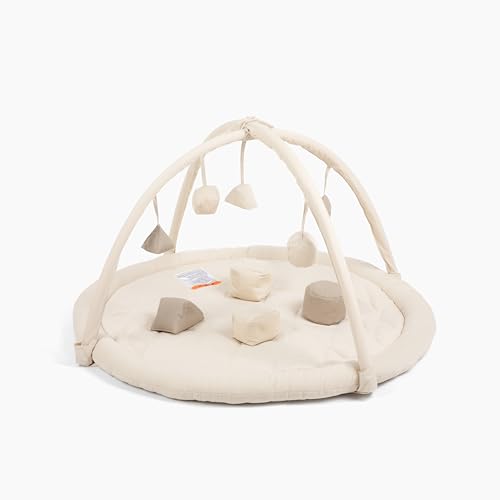
A gym that won't list what is in the mat and the toys
A gym adds toys, strands and a frame to the mat, and each is another material. A maker that lists them all has given you the most checkable page in this category, including the parts that are not cotton.
Hides in: Gyms and mats with no materials list, or a bare "baby-safe"
Lovevery's page names real wood, silicone, cotton, a polyester mat and a silicone teething ring made without PVC, and says OEKO-TEX STANDARD 100 certified. That is the brand's statement: the page gives no certificate number, so we could not use OEKO-TEX's label check. The strands that come with this listing are 95% cotton and 5% polyester, filled with polyester fiber and 2% plastic film the page does not name.
Manufacturer statement checked · source
Do the free things first
A washable blanket on a clean floor
It does the job of a play mat for tummy time and floor play. A mat is the pricier answer to a question a blanket also answers.
A rug you already own
A wool or cotton rug without a foam or latex backing, over a hard floor, is a flat surface with no foam in it. Our play room flooring page covers the carpet and padding questions.
Label traps
- "Non-toxic" on a mat — For toys it is not a defined regulatory term, and a toy legally sold in the US already has to clear the lead limit and the mandatory toy standard.
- "CPSIA compliant" as a selling point — Compliance is the legal baseline for any toy sold in the US, so it separates nothing.
- "BPA-free" on a foam mat — BPA is mainly a hard-plastic and can-lining chemical. On foam, the questions that matter more are the polymer, PVC and formamide.
- "Organic" with no certificate — Organic cotton is a claim until a certifier's register says otherwise. A name and a number you can look up is what turns the word into a check.
How we choose
We read the maker's own page and record what it says, including what it does not say. We favor mats whose maker names the material and says no PVC, and we repeat a certification as the brand's statement unless we found it in the certifier's own register. Our name search of the GOTS database on 2026-11-15 found no record for Toddlekind, which does not settle the question: a brand that sells a product made by a certified factory can hold no certificate of its own, and the number on the product's tag is the check that does.
- The maker's own page names the material, including any finish or filling
- No PVC or soft vinyl of unknown material
- A foam mat names the polymer and says whether it is free of formamide
- An age grade the maker states, where the page gives one
- Maker's page read and dated on our product panel; the Toddlekind and Snuggle Me panels were read on 2026-11-15 and the Lovevery panel on 2026-11-13
Every source we cite is checked against our criteria first — see how we check our sources.
What the research says
The CPSC this year issued 498 notices of violations for toys through June, as of the latest data available (Sept. 23, 2025).
— A U.S. PIRG Education Fund report authored by Teresa Murray found ...
Trouble in Toyland 2025: A.I. bots and toxics present hidden dangers — U.S. PIRG Education Fund (2025-11-13)
When you buy a toy or any other product online and it's shipped directly to you from another country, it generally doesn't get inspected before it gets to your mailbox.
— A U.S. PIRG Education Fund report authored by Teresa Murray found ...
Trouble in Toyland 2024: Unsafe toys that slip through the border — U.S. PIRG Education Fund (2024-11-19)
Selecting products labeled 'fragrance-free' rather than 'unscented' may help reduce exposure to endocrine-disrupting chemicals because unscented products may contain multiple scents, still bound by phthalates, that are mixed to cancel each other out.
— According to American College of Obstetricians and Gynecologists guidance co-authored by Tracey J. Woodruff, PhD, MPH, ...
Reducing Prenatal Exposure to Toxic Environmental Agents (Committee Opinion No. 832) — American College of Obstetricians and Gynecologists
Sources
- Commission Directive (EU) 2015/2115 of 23 November 2015 (formamide in foam toy materials) — Official Journal of the European Union, via EUR-Lex
- CPSC Prohibits Certain Phthalates in Children's Toys and Child Care Products — U.S. Consumer Product Safety Commission (how we check this source)
- Toy safety requirements for children's products (CPSIA) — U.S. Consumer Product Safety Commission (how we check this source)
- 16 CFR Part 1501: Method for identifying toys and other articles intended for use by children under 3 years of age which present choking, aspiration, or ingestion hazards because of small parts — Electronic Code of Federal Regulations
- GOTS Certified Suppliers Database — Global Standard gGmbH
Common questions
Every toys & art suppliesproduct we've reviewed— what we'd buy, what we'd skip, and where each one stands.