
The non-toxic pillow cheat sheet
One winner for each way people buy pillow.
The at-a-glance version for the one piece of bedding your face is pressed into all night: what each pillow filling is, which certifications cover which part of a pillow, the label words that certify nothing, and the pillows we have read the manufacturer's own page for, sorted by how people actually buy.
How we scoreHow we earnChecked October 23, 2026
Our winner for each way people buy
How we scoreHow we earnChecked October 23, 2026
An adjustable latex pillow
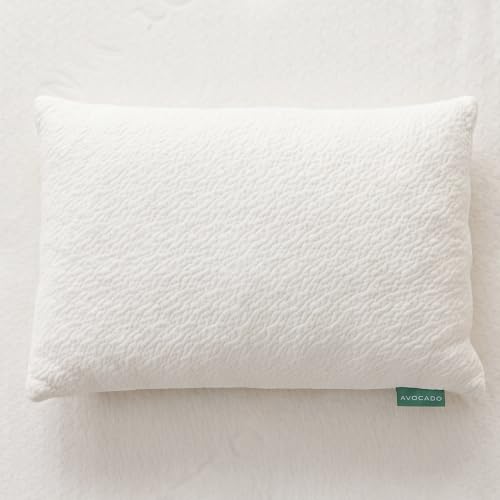
Avocado Green Mattress
Avocado Organic Green PillowShredded organic latex and organic kapok in an organic cotton cover with a zipper to add or remove fill; GOLS and GOTS confirmed for the company on the certifiers' registers, and the Green Pillow is on MADE SAFE's index. Contains latex; no wool.
Meets our published criteria, as of Oct 23, 2026
$139ViewA solid latex pillow, nothing to adjust

Naturepedic
Organic Solid Latex PillowA solid latex core in a GOTS-certified organic cotton cover per the maker; the company holds GOLS and GOTS on the registers and this model is on MADE SAFE's index. Nothing to adjust.
Meets our published criteria, as of Oct 23, 2026
$127.20ViewA wool pillow, with the open questions stated

Naturepedic
Organic Wool PillowWool fill in a GOTS-certified organic cotton cover, medium-firm. The maker's page calls the fill both natural and organic wool, and we did not find this model on the MADE SAFE index on 2026-10-23, though the maker's page displays the badge.
Meets our published criteria, as of Oct 23, 2026
$175.20ViewOur buckwheat pick

Turmerry
Buckwheat Pillow Standard Size 20"X26"Midwest buckwheat hulls the maker calls pesticide-free, in a zippered GOTS-certified organic cotton cover; adjustable by adding or removing hulls. The hulls are not certified.
Meets our published criteria, as of Oct 23, 2026
$63ViewDown, with the badge explained

Naturepedic
Down Pillow750-fill-power duck down in an organic cotton cover. The down is RDS-certified per the maker, which is an animal-welfare standard and not a chemical one; the Amazon listing and the maker's page name different cover certifications.
Meets our published criteria, as of Oct 23, 2026
$175.20ViewMemory foam with the scope stated

Coop Home Goods
Original Adjustable PillowShredded memory foam and polyester microfiber in a polyester and viscose cover. CertiPUR-US covers the foam only; GREENGUARD Gold and CertiPUR-US are maker-displayed here. Not organic.
Meets our published criteria, as of Oct 23, 2026
$71.20ViewA first pillow, age 2 and up only

Avocado Green Mattress
Avocado Organic Toddler PillowNatural latex and kapok fill sewn shut in an organic cotton cover, 20 by 12 inches (contains latex); the maker says it is not intended for children under 2. Never for a crib or an infant.
Meets our published criteria, as of Oct 23, 2026
$59View
What to avoid
- A pillow in a crib or with a baby under 12 months — the AAP lists pillows among the soft objects to keep out of an infant's sleep area; nothing here is an exception
- Polyurethane foam with no certification — a source of volatile organic compounds when new, which fall over days to weeks
- "Organic" read as the whole pillow — it can describe a cotton cover and say nothing of the fill, the liner or the foam
- A badge with no named part — GOTS, GOLS and CertiPUR-US each cover a different component
- Putting it straight on the bed from the bag — emissions from new foam are highest in the first days; air it in a ventilated room
What to look for
- GOLS — the organic-latex scheme; it covers the latex, not the cover or other fills
- GOTS — organic fibers plus restricted processing chemicals, from fiber through finished goods; it covers the textile parts
- MADE SAFE — screens the finished product's ingredients; read the product on madesafe.org, not the brand
- GREENGUARD Gold — tests emissions from the finished product against limits set with children in mind
- CertiPUR-US — a content and emissions standard for polyurethane foam only
- RDS — the Responsible Down Standard, which covers animal welfare, not chemicals
- 1Skip: A foam or polyester pillow, when you would rather not wonderBuy instead: Avocado Green Mattress, Naturepedic, Turmerry Why
- 2Skip: A synthetic fill, when a natural one suits how you sleepBuy instead: Naturepedic, Turmerry Why
- 3Skip: Memory foam, when you want to know what the badge coversBuy instead: Coop Home Goods Why
- 4Skip: A pillow in a crib, or for a babyBuy instead: Avocado Green Mattress Why
What the label card means
What to skip, and why
A pillow in a crib or with a baby under 12 months
The AAP lists pillows among the soft objects to keep out of an infant's sleep area; nothing here is an exception.
Polyurethane foam with no certification
A source of volatile organic compounds when new, which fall over days to weeks.
"Organic" read as the whole pillow
It can describe a cotton cover and say nothing of the fill, the liner or the foam.
A badge with no named part
GOTS, GOLS and CertiPUR-US each cover a different component.
Putting it straight on the bed from the bag
Emissions from new foam are highest in the first days; air it in a ventilated room.
Where to buy
The full guide: how we chose
A pillow is judged on its filling, its cover, and which certification covers which of the two. The case for choosing carefully is modest: you breathe a few inches from it for hours, and a new foam pillow gives off volatile organic compounds that fall over days to weeks. Nothing here says an ordinary pillow harms you. A latex, wool, kapok, buckwheat or down pillow in an organic cotton cover, with certifications that say what they cover, lets you skip the question. And no pillow belongs in a crib or with a baby under 12 months, whatever it is made of.
What this sheet covers
This is the quick version of how to choose a pillow, for a parent who is replacing one or registering for a bed. It does not repeat our longer pages; it points at them. The reasoning for why bedding deserves more scrutiny than most household goods is in the sleep hub, and the detail on off-gassing and what a certified mattress is and is not is in can mattresses be toxic.
The sheet sorts eight pillows by how people actually buy: three adult latex pillows, a wool pillow, a buckwheat pillow, a down pillow, a memory foam pillow with its certifications explained, and a first pillow for a child of two or older. The concern is modest and we say so. A pillow is not a mattress, and nothing here says a conventional pillow harms you. Our reasons to look are a few inches of air between your face and the filling for hours, and new foam that gives off volatile organic compounds while it is new. The honest cost of choosing carefully is money, and we mark it.
No pillow for a baby
No pillow belongs in a crib or with a baby under 12 months, whatever it is made of. The AAP's safe-sleep guide lists pillows among the soft objects and loose bedding to keep out of an infant's sleep area. For a child between one and two the guidance is less settled, so ask your pediatrician. The maker of the toddler pillow on this sheet says it is not intended for children under 2, and we follow that. If you are shopping for a crib, our crib mattress cheat sheet is the right place, and it comes with a firm, flat, bare sleep surface.
The swaps in prose
The latex pillows are the closest natural match for the feel of foam. Our pick is the Avocado Green Pillow, filled with shredded organic latex and organic kapok that you can add to or take out through a zipper. On the registers we could search, Avocado is listed with Control Union as GOLS-certified, the GOTS database lists its pillows made of organic cotton and kapok, and the Green Pillow is on MADE SAFE's index. The maker also displays GREENGUARD Gold and OEKO-TEX STANDARD 100; the OEKO-TEX label check shows a valid certificate in Avocado's name whose scope names pillows made of woven and knitted fabric, which reads as the fabric parts; that it covers the whole pillow, latex included, is the maker's reading. We could not search UL's GREENGUARD database. The maker's page notes that pillows are not required to pass the federal mattress flammability standard and says it adds no chemical flame retardants.
For a pillow with nothing to adjust, Naturepedic's solid latex pillow is a solid latex core in a GOTS-certified organic cotton cover, per the maker. Naturepedic holds GOLS at Control Union and GOTS in the GOTS database, and this model is on MADE SAFE's index. It is firm and there is nothing to adjust. Naturepedic's brand profile has the rest of the record. Turmerry's latex pillow is the lower-priced alternative to Naturepedic's; Turmerry is listed as GOLS-certified at Control Union and its GOTS certificate lists pillows, but we found no MADE SAFE or GREENGUARD claim for that model. Natural latex is still latex. If a latex allergy runs in your family, read the materials list or skip these.
Wool, buckwheat and down are the older fillings. Naturepedic's wool pillow is the wool pillow we checked, a medium-firm pillow in a GOTS-certified organic cotton cover. The maker's details call the fill "natural wool" and its specifications call it "organic wool", and the page does not reconcile the two. The page also displays MADE SAFE, but as of 2026-10-23 the MADE SAFE index for Naturepedic listed three latex pillows and we did not find the wool or the down, so we count it as a maker claim for those two; ask Naturepedic if it matters to you. Turmerry's buckwheat pillow is our buckwheat pick, in a zippered GOTS-certified organic cotton cover that you adjust by adding or removing hulls. The maker calls the hulls pesticide-free and Midwest-grown; they carry no certification, so that is the maker's word. We did not include Hullo. Its page says "100% Certified Organic Cotton" without naming the certifier, and a company-name search of the GOTS database on 2026-10-23 returned no record; a brand can be certified through its manufacturer, so that is not evidence either way.
The down pillow is on the sheet to explain its badge. Naturepedic says its duck down is certified to the Responsible Down Standard (we did not search the RDS list), which Textile Exchange describes as covering animal welfare and the chain of custody of the down, with no chemical criteria. It is a welfare standard, not a clean-materials one. The maker's page says the cover is GOTS-certified organic cotton, while the Amazon listing says OCS-certified; we could not reconcile them, so check which you receive.
If you want memory foam, Coop's Original is the one on this sheet, with its certifications stated: the maker says the foam is CertiPUR-US certified and displays GREENGUARD Gold; we could not search either register. The liner is polyester and the cover is polyester and viscose, which makes it a conventional pillow with a certified foam, not a natural one. It is on the sheet because the foam question deserves an honest answer, not because we rank it with the natural pillows.
For a child of two or older, Avocado's toddler pillow is small, flat and sewn shut with no zipper, with latex and kapok fill in an organic cotton cover. The maker says it is not intended for children under 2. We could not count its OEKO-TEX claim, because the certificate number on the maker's page, when we entered it in OEKO-TEX's label check on 2026-10-23, returned an expired certificate issued to a foam supplier rather than to Avocado. It may be a component certificate that has since lapsed or been renewed; we have not asked Avocado, and we are not counting it.
How to read the label
Six badges turn up on pillows, and each measures a different thing.
- GOLS is the organic-latex scheme. It covers the latex, not the cover or any other fill. We looked it up in Control Union's certified-company search, which lists a company, not a model.
- GOTS is an organic textile standard. It covers organic fibers and restricted chemical inputs in processing, from fiber through finished goods. On pillows it describes the cotton cover and fibers such as kapok and wool, and the GOTS database can be searched by company.
- MADE SAFE screens the finished product's ingredients. Its index lists products, so the model matters.
- GREENGUARD Gold is an emissions standard from UL. It tests the finished product against limits set with children in mind. UL's database is behind a human-verification challenge, so every GREENGUARD Gold claim here is manufacturer-displayed.
- CertiPUR-US is a standard for polyurethane foam only, and does not describe the rest of the pillow (see our explainer, which cites CertiPUR-US's own description).
- RDS, the Responsible Down Standard, covers the welfare of the birds and the chain of custody of the down. It does not cover chemicals.
Terms such as "non-toxic", "eco-friendly", "natural" and "hypoallergenic" are marketing, not standards.
Where to go next
For the full reasoning, start with the sleep hub and can mattresses be toxic, which includes the free off-gassing routine. The Naturepedic review covers the maker of three of the pillows here, and the air quality guide covers ventilating the room.
The swaps, in full
A foam or polyester pillow, when you would rather not wonder
Most pillows are polyurethane foam or polyester fiber. Polyurethane foam is a source of volatile organic compounds when it is new, and those fall over days to weeks. Latex is the closest natural match for the feel of foam. Avocado and Naturepedic list a GOLS-certified organic latex core (GOLS is the organic-latex scheme) in an organic cotton cover, and each displays MADE SAFE and GREENGUARD Gold; Turmerry's page claims neither. All three contain latex, so skip them if latex allergy runs in your family.
Hides in: The fill and cover described on the maker's own page, not the front of the box
Shredded organic latex and organic kapok in an organic cotton cover, with a zipper so you can add or remove fill to find your height. On the registers we could search: Avocado is GOLS-certified as a company (Control Union), GOTS (the GOTS database lists pillows made of organic cotton and kapok), and the Green Pillow is on MADE SAFE's index. Contains no wool.
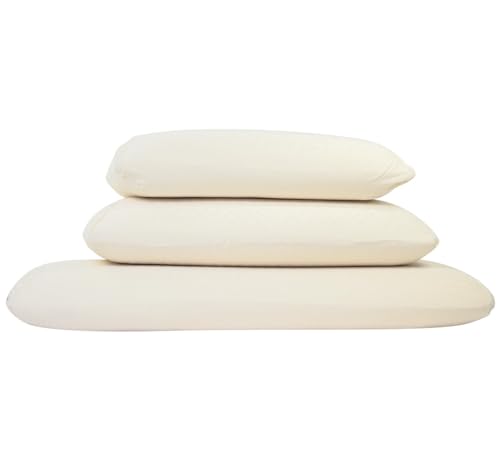
A solid latex core in a GOTS-certified organic cotton cover, per the maker. Naturepedic holds GOLS (Control Union) and GOTS, and this model is on MADE SAFE's index. Firm and solid; nothing to adjust.
Turmerry's Dunlop latex pillow, which the maker says is GOLS-certified, in an organic cotton cover. Turmerry is listed as GOLS-certified at Control Union and its GOTS certificate lists pillows; the maker states no MADE SAFE or GREENGUARD claim for it, which is why it ranks below the two above.
A synthetic fill, when a natural one suits how you sleep
Wool, buckwheat hulls and down are all older materials than polyester, and each suits a different sleeper. None is a chemical-free guarantee, and each carries its own caveat: wool and down are animal products, and buckwheat is loud and firm.
Hides in: The cover and fill on the maker's own page
Wool fill in a GOTS-certified organic cotton cover, medium-firm. The maker's details call the fill "natural wool" and its specifications call it "organic wool", and the page does not reconcile the two, so ask. The GOTS database lists Naturepedic's pillows with organic wool and kapok. The page displays MADE SAFE; we did not find this model on the MADE SAFE index on 2026-10-23.
Certifier record checked · source
Buckwheat hulls the maker calls pesticide-free and grown in the Midwest, in a zippered GOTS-certified organic cotton cover, adjustable by adding or removing hulls. Turmerry's GOTS certificate lists pillows. The hulls themselves carry no certification, so "pesticide-free" is the maker's word.
750-fill-power duck down in a GOTS-certified organic cotton cover, per the maker's page. The maker says the down is certified to the Responsible Down Standard (we did not search the RDS list); RDS is an animal-welfare standard and says nothing about chemicals. The Amazon listing calls the cover OCS-certified while the maker's page says GOTS; we could not reconcile them.
Memory foam, when you want to know what the badge covers
Memory foam is a polyurethane foam. If you want it, the useful question is what the certification covers. CertiPUR-US is a standard for the foam only, not for the polyester liner or the cover.
Hides in: The Materials and Certifications tabs on the maker's page
Shredded memory foam and microfiber fill, a polyester liner and a polyester and viscose cover, per the maker. It displays CertiPUR-US (the foam) and GREENGUARD Gold; we could not search either register, so read both as the maker's claims. Not organic and not a natural-fiber pillow; it is on this sheet because the foam question deserves an honest answer.
Manufacturer statement checked · source
A pillow in a crib, or for a baby
No pillow belongs in a crib or in the sleep space of a baby under 12 months. The AAP's safe-sleep guide lists pillows among the soft objects to keep out. Most toddlers do not need a pillow. For the second year pediatric advice varies, so ask your pediatrician; the maker of the pillow below says it is not for children under 2, and we follow that.
Hides in: A toddler bed, from age 2, not a crib
A small, flat 20 by 12 inch pillow with natural latex and kapok fill sewn shut (no zipper) in an organic cotton cover. Contains latex. The maker says it is not intended for children under 2. We are not counting its OEKO-TEX claim: the number printed on the maker's page, entered in OEKO-TEX's label check on 2026-10-23, returned an expired certificate held by a foam supplier, not Avocado (it may be a component certificate).
Do the free things first
Keep a pillow that is fine
Nothing in this sheet says an ordinary pillow harms you. If yours is comfortable, clean and not flat, replacing it for chemical reasons alone is not required. Replace it when it stops supporting your neck, and use this sheet then.
Air the new one
Emissions from new foam are highest in the first days and fall over the following weeks. A few days in a ventilated room before the first night is a free step that matters at least as much as the gap between two well-certified pillows.
Wash what touches your face
A washable protector and weekly pillowcases cost very little and keep sweat and skin oils out of whatever filling you pick.
Label traps that are not ingredients
- "Non-toxic" on a pillow — It certifies nothing. A certification means somebody independent measured a defined list, which is more useful and considerably narrower.
- An "organic cotton" cover read as the whole pillow — It can describe the cover while saying nothing about the foam, the liner or the fill. Ask which part of the pillow the claim covers.
- CertiPUR-US read as a clean pillow — It is a standard for the polyurethane foam only. The liner, the cover and everything else sit outside it.
- A badge on the page that the register does not back — A maker's page can display MADE SAFE for a model we did not find on the MADE SAFE index (an index can lag). The register lists products, so check the model.
How we choose
We read the materials and certification statement on the manufacturer's own page, record what it said and on what date (2026-10-23), and check what we can in the certifier's own register: the GOTS database for GOTS, Control Union's certified-company search for GOLS, MADE SAFE's index for MADE SAFE and OEKO-TEX's label check. A register lists a company or a product line; where the model is not individually listed, we say so. Where we could not search a register (GREENGUARD Gold, CertiPUR-US, RDS), the claim is manufacturer-displayed, and so is any badge on a maker's page that a register does not list. We favor third-party certification over manufacturer language, and we say what each certification covers.
- Third-party certified for organic fibers (GOTS), organic latex (GOLS), emissions (GREENGUARD Gold) or foam content (CertiPUR-US), stated with its scope
- Materials disclosed on the maker's own page, and the certifier's register checked where it has one
- Certifications we could not confirm are labeled as manufacturer-displayed, and mismatches between a page and a register are stated
Every source we cite is checked against our criteria first — see how we check our sources.
What the research says
The 2022 AAP policy statement, first-authored by Rachel Y. Moon, directs caregivers to place infants on a firm, flat, non-inclined sleep surface such as a tightly fitting crib mattress in a safety-approved crib, covered by a fitted sheet with no other bedding or soft objects, and states that sleep surfaces with inclines of more than 10 degrees are unsafe for infant sleep.
— According to Pediatrics 150(1), American Academy of Pediatrics guidance co-authored by Rachel Y. Moon, MD, ...
Sleep-Related Infant Deaths: Updated 2022 Recommendations for Reducing Infant Deaths in the Sleep Environment — Pediatrics 150(1), American Academy of Pediatrics
The 2022 AAP policy statement (Moon et al.) states that sitting devices - car seats, strollers, swings, infant carriers, and infant slings - are not recommended for routine sleep at home or in the hospital, particularly for infants under 4 months of age.
— According to Pediatrics 150(1), American Academy of Pediatrics guidance co-authored by Rachel Y. Moon, MD, ...
Sleep-Related Infant Deaths: Updated 2022 Recommendations for Reducing Infant Deaths in the Sleep Environment — Pediatrics 150(1), American Academy of Pediatrics
The AAP 2022 technical report, first-authored by Moon, states that room sharing decreases the risk of SIDS by as much as 50%, and the companion policy statement recommends infants sleep in the parents' room, close to the parents' bed but on a separate surface designed for infants, ideally for at least the first 6 months.
— According to Pediatrics 150(1), American Academy of Pediatrics guidance co-authored by Rachel Y. Moon, MD, ...
Evidence Base for 2022 Updated Recommendations for a Safe Infant Sleeping Environment (Technical Report) — Pediatrics 150(1), American Academy of Pediatrics
Sources
- A Parent's Guide to Safe Sleep (soft objects and loose bedding, including pillows, out of the sleep area) — American Academy of Pediatrics (HealthyChildren.org) (how we check this source)
- Global Organic Textile Standard (GOTS) — Global Standard gGmbH
- GOTS Certified Suppliers Database — Global Standard gGmbH
- Certified companies and products search (GOLS and other schemes) — Control Union Certifications
- Responsible Down Standard (RDS) — Textile Exchange
- MADE SAFE certified products index (Naturepedic and Avocado collections) — MADE SAFE / Nontoxic Certified
Common questions
Every mattresses & beddingproduct we've reviewed— what we'd buy, what we'd skip, and where each one stands.