
The best fire extinguisher for your home
NFPA's first message about a fire is to get out, and a home fire extinguisher is for a small fire, used only by an adult who knows how, with everyone already leaving and a clear way out behind them. If that describes your home, the buying rule is short: a rating of at least 2-A:10-B:C, listed by a testing laboratory, in reach on each level. Below: the two we would buy for the main floor, a rechargeable and a disposable; two smaller add-ons, one for the kitchen and one for the car, each labeled for what it is not; what to do about grease fires; and what we left out, including aerosol sprays.
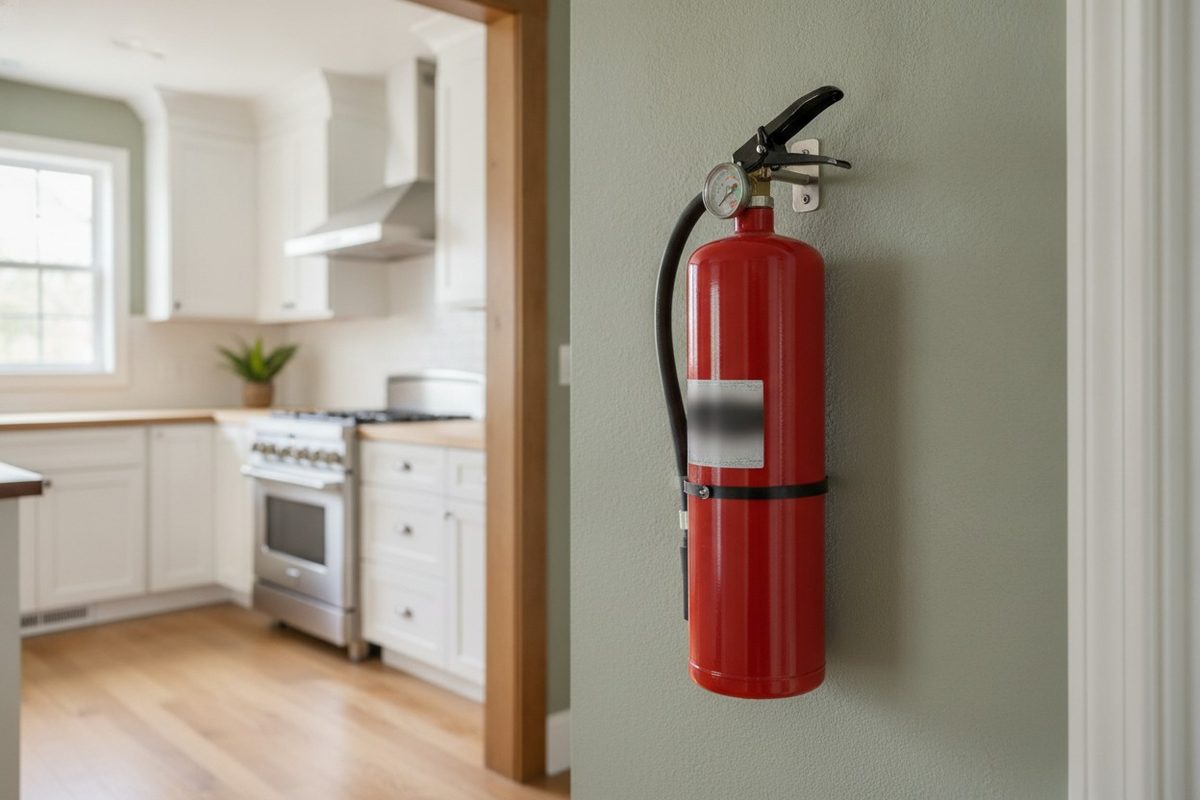
Get out first. NFPA says to use a home extinguisher only when everyone is already leaving, someone is calling 9-1-1 from outside, the fire is small and not spreading quickly, and you have a clear way out. If you do keep one, NFPA says to buy one listed by a nationally recognized testing laboratory and rated at least 2-A:10-B:C, so the cheap 1-A:10-B:C models are below the line. Our pick is the First Alert HOME2PRO, a rechargeable 2-A:10-B:C; the Kidde Living Area is the disposable alternative, whose model family appears in older recalls, none naming this model code, spelled out below. For the kitchen, NFPA's advice is a lid, not a gadget; First Alert's small 5-B:C kitchen unit and its car unit are add-ons below NFPA's minimum, not substitutes. We do not list an aerosol spray: NFPA says none of the aerosol can extinguishers on the market are listed to existing safety standards.
Brands in this guide
- First Alert3 picks
- Kidde1 pick
Our top pick
Manufacturer statement checked · source
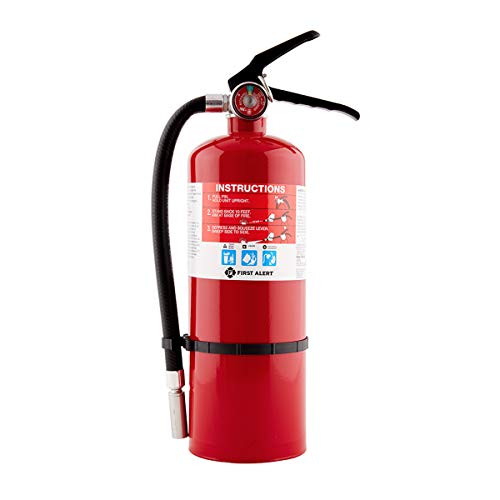
First Alert HOME2PRO, model FE2A10GR. First Alert's page lists it as 2-A:10-B:C, 9 lb, with a metal head, a metal pull pin with a safety seal, a color-coded metal pressure gauge and a wall hook, rechargeable by certified professionals after any use, with a 12-year limited warranty. The page title says UL Rated 2-A:10-B:C and its text says it meets UL standards (it does not use the word listed); its manual says the FE2A10GR is rated 2-A:10-B:C and tested to UL 711 and UL 299. In UL Product iQ, a search for FE2A10GR returns UL's certification file EX3622 for Resideo USA LLC (dry-chemical extinguishers); UL's public view does not show the model table, so read the label on the one you buy for the UL mark. We found no CPSC recall naming this model; the one First Alert extinguisher recall in CPSC's database, in 2000, covered a different model, FE1A10G. Read the 2-A:10-B:C on the label before you hang it: First Alert's page also offers a sibling option labeled 1-A:10-B:C, so confirm that the box says FE2A10GR and 2-A:10-B:C.
Also worth considering

Kidde Living Area, listed as KD143-210ABC. The disposable option: a single-use dry-chemical extinguisher with about 4 lb of agent and 7.13 lb in total, a pressure gauge, a metal handle and a wall hanger, per Kidde's store page, which says UL listed and UL rated 2-A:10-B:C and gives a 6-year limited warranty. Kidde's site page for its Living Area extinguisher is for model FX210W, and describes it as single-use with no internal examination needed for 12 years; we could not confirm that KD143-210ABC is the same unit. Three things to know before you buy. First, the model codes FX210, FX210R and FX210W appear in three CPSC recalls: 09-151 (names FX210R and FX210W; units made October 2007 to April 2008, which could lose pressure), 15-079 (names all three; disposables with plastic valves made July 2013 to October 2014, which could fail to discharge) and 18-022 (names all three among plastic-handle models made through October 25, 2015, which could fail to discharge or lose a nozzle; the recall covers 134 models in all and reports one death, in a 2014 car fire, without naming a model). Kidde's site lists FX210W as the Living Area. None of the three recall texts names KD143-210ABC or KD1431-210ABC, and Kidde's store page describes a metal handle, but a unit from an old shelf could be in range, and if KD143-210ABC is a relabel of an FX210 model that reassurance is weaker, so check the date code on the cylinder against the recall pages. Second, the model number in the specification table of Kidde's store page is KD1431-210ABC, one digit different from the Amazon listing; we treat them as the same product but could not confirm it, so read the model on the label. Third, on the wording: Kidde's store page says UL listed and UL rated 2-A:10-B:C, and its own site's page for the Living Area says UL rated and does not use the word listed. The store page also says 10-year limited warranty in one place and 6-year in another.
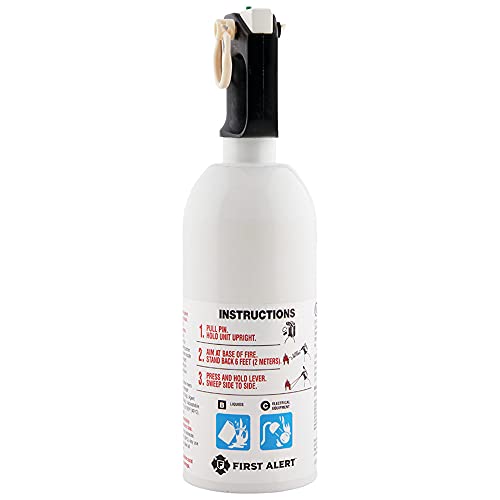
First Alert Fire Extinguisher, Standard Kitchen Use | KITCHEN5 UL RATED 5-B:C, White 1-Pack
Manufacturer statement checked · source
Kitchen add-on, not a kitchen answer. First Alert's page for the KITCHEN5 (its specification table says KFE2S5, SKU 1039891) lists a 5-B:C extinguisher, 3 lb, small enough for a cabinet or the wall, with a metal head, a metal pull pin with a safety seal, a color-coded metal gauge, an included mount, bracket and strap, and a 10-year limited warranty. It says the unit fights flammable liquid and electrical fires and meets UL standards (it does not use the word listed). What the page does not say matters more: nothing about grease, cooking oil or Class K, and nothing on whether it is rechargeable. A 5-B:C rating has no Class A at all and is below the 2-A:10-B:C NFPA sets for a home, so it does not replace the main-floor pick, and NFPA's answer to a pan fire stays a lid and the heat off. First Alert's page calls it ideal for use in a kitchen; the same page lists flammable liquid and electrical fires only. Do not use it on a pan of burning oil or grease: NFPA says only Class K extinguishers are rated for grease fires, and this one is not described as Class K. If you want one, it is a second, small unit for electrical or flammable-liquid fires, mounted by the kitchen doorway or exit side, not beside or above the stove (NFPA 21.5 says never to store one next to a potential fire hazard). The page title says UL Rated 5-B:C and the text says it meets UL standards; it never says listed. If the nameplate or manual says it is not rechargeable, NFPA's 12-year maximum life from the manufacture date applies. We found no CPSC recall naming it (searched 2026-11-23). The Amazon title says KITCHEN5; we treat it as the same product as the maker's KFE2S5 page but could not confirm it.

Manufacturer statement checked · source
Car only. First Alert's page for the AUTO5 (its specification table says FESA5) lists a 5-B:C extinguisher, 3 lb and 10.4 inches tall, described as compact and small enough to fit in the trunk, with an included mount, bracket and strap, a safety seal and a 10-year limited warranty. It says the unit fights flammable liquid and electrical fires and meets UL standards (it does not use the word listed). The page's type line reads Auto and Garage, but NFPA says to choose 2-A:10-B:C or higher for an attached or detached garage, and 5-B:C is below that, so for a garage use a main-floor pick, not this one. The page does not say whether it is rechargeable; if the nameplate or manual says it is not, NFPA's 12-year maximum life from the manufacture date applies. We found no CPSC recall naming it (searched 2026-11-23). We did not vet Kidde's comparable Auto 5 (M5G): its model code appears in CPSC recall 18-022's model lists, which cover units made through August 15, 2017, so a unit from an old shelf is worth checking against that recall, and CPSC's recall text says extinguisher recalls for motor vehicles are also on NHTSA's site. The Amazon title says AUTO5; we treat it as the same product as the maker's FESA5 page but could not confirm it.
Start with the exit
NFPA's desk reference puts smoke alarms and escape planning first, and its extinguisher guidance comes with conditions. It says extinguishers are designed to put out small fires, should not be used on large fires or ones that spread quickly, and should be used only by someone who is trained or knows how. It lists four conditions that all have to be true (21.1 and 21.4.2): everyone in the home is evacuating, someone is calling 9-1-1 from outside, the fire is small and not spreading quickly, and you have a clear escape route.
So the order of this page is the order of the advice. If you have not done the free steps (an escape plan, working alarms on every level, a carbon monoxide alarm outside the bedrooms), do those first; our smoke and carbon monoxide detector kit lays them out, and the carbon monoxide alarm guide compares the alarms. The extinguisher is for the case where all of that has already worked and the fire is still small.
What NFPA says to buy
NFPA's desk reference for home fire safety educators gives two rules for choosing a portable extinguisher: buy one listed by a nationally recognized testing laboratory (21.2.1), and choose a rating of at least 2-A:10-B:C (21.2.2). For an attached or detached garage it says 2-A:10-B:C or higher, depending on how many flammable items are stored (21.3). We read the 2026 edition (a public PDF on nfpa.org, chapters 8 and 21) on 2026-11-23, cite it by section number in the text and paraphrase it.
The rating is three things in one: the A number (wood, paper and fabric fires), the B number (flammable liquids) and the C (electrical equipment, with no number), as the makers' pages describe them. Kidde's page says a 2-A:10-B:C model has twice the Class A firefighting capability of a 1-A:10-B:C one. That is why two very common home models, the Kidde Basic 110 (FA110G) and the First Alert HOME1, fall below the line.
Rechargeable or disposable, main floor and garage
| Rechargeable | Disposable | |
|---|---|---|
| Our pick | First Alert HOME2PRO (FE2A10GR) | Kidde Living Area (KD143-210ABC) |
| Rating | 2-A:10-B:C | 2-A:10-B:C |
| Weight | 9 lb, per First Alert | About 7.1 lb, 4 lb of agent, per Kidde |
| After use | Rechargeable by certified professionals, per First Alert; NFPA says an extinguisher that has been used should be replaced | Single-use; replace after any use |
| Maximum life | Follow First Alert's manual | NFPA: 12 years from the manufacture date on the nameplate |
| Construction, per the maker | Metal head, metal pull pin, metal color-coded gauge | Metal handle, pressure gauge |
| UL wording on the maker's page | Page title says "UL Rated 2-A:10-B:C" and the text "Meets UL standards"; does not say "listed"; manual cites UL 711 and UL 299 | Store page: "UL listed", "UL rated 2-A:10-B:C"; kidde.com: "UL rated" |
| What we disclose | A sibling option on the page is labeled 1-A:10-B:C; confirm your box says FE2A10GR and 2-A:10-B:C | Three older CPSC recalls naming FX210 codes; a model code that differs by one digit |
Either one fits a main-floor spot near an exit or an attached garage. The garage is where NFPA says to go above 2-A:10-B:C if you store many flammable items, and we did not vet a higher-rated home model (see below).
The kitchen, the car and a spray
The honest kitchen answer is not a product. NFPA says to keep a lid nearby when you cook; if a small grease fire starts in a pan, smother it by sliding the lid over the pan, turn off the burner, do not move the pan, and leave the lid on until the pan has cooled (8.4.1). Never pour water on it (8.4.2). NFPA's cooking-fire advice names a lid and does not mention baking soda; NFPA doesn't address it either way, and we have no NFPA text to cite for it, so this page does not recommend it. For an oven fire, NFPA says to turn off the heat and keep the door closed until it is cool (8.4.4).
If you want an extinguisher near the kitchen too, NFPA says only Class K extinguishers are rated for grease and animal fat fires and that they should be used by trained adults (8.4.3, 21.4.4.1), and that you should be at least 6 to 8 feet from a grease fire when you use one (21.4.4.2). We found no Class K model for the home from a maker whose page we could read, and Kidde's special-purpose kitchen model gives a UL 711A rating and does not call itself Class K (see the questions below). First Alert's small kitchen extinguisher (KITCHEN5) is on this page as an add-on, and what it is not is the point: its page says it fights flammable liquid and electrical fires, says nothing about grease, and is rated 5-B:C, which has no Class A rating and is below NFPA's 2-A:10-B:C for a home. First Alert's page calls it ideal for use in a kitchen, but it is not a grease-fire answer: do not use it on a pan of burning oil, and do not mount it beside the stove. It does not replace the main-floor pick.
For the car, First Alert's AUTO5 is a compact 5-B:C unit sold for vehicles. The same caveat applies: it is below NFPA's home rating, and NFPA's garage advice is 2-A:10-B:C or higher, so a garage gets one of the two main-floor picks. We did not vet Kidde's comparable car model because its model code appears in a CPSC recall's model lists for units made through August 2017.
Aerosol sprays are not on the list. First Alert's page for its aerosol fire spray (AF400) says it extinguishes grease, paper, fabric, wood and electrical fires and discharges longer than a traditional extinguisher. The page makes no UL claim and gives no rating, and it says the product cannot ship to California, Nevada or New York. NFPA's desk reference says there are no aerosol can fire extinguishers on the market that have been listed to existing safety standards, and that it does not recommend buying products that are not listed and have not met minimum industry safety standards (21.10). We cannot tell you a spray is a sensible add-on, because nothing we can read shows it was tested to a standard; First Alert's own page says it works on cooking oils and grease and names no test or listing. We will not put a card on a category NFPA says has no listed products, and if you own one it does not change the grease-fire rule: lid on, heat off, and get out if it spreads.
What we left out
- The 1-A:10-B:C models (Kidde Basic 110 FA110G, First Alert HOME1): below NFPA's minimum rating.
- Kidde's commercial Pro line and First Alert's heavier 3-A:40-B:C units: we did not vet them. NFPA allows "2-A:10-B:C or higher" in a garage with many flammable items, so a larger unit can be reasonable; it also weighs more, and NFPA says some people cannot lift and use one.
- Marketplace brands with a UL claim in the title: no maker page we could read, so no pick.
- Aerosol-can extinguishers and fire blankets: NFPA says none are listed to existing safety standards.
- A Class K kitchen extinguisher: none for the home from a maker whose own page we could read.
- Kidde's car and kitchen models (Auto 5, Kitchen RESSP): their model codes appear in a CPSC recall's model lists; we did not vet them.
Putting it in
Mount it where you can reach it without crossing the fire: near an exit on the main floor, in an attached garage, and one on each additional level. NFPA says within 40 feet and on each level (21.5). Read the nameplate for the manufacture date. Check the gauge, the pin and the seal on a schedule, as NFPA's list says (21.6.1). If it has been used, even partly, replace it, or ask the maker about a recharge for a rechargeable model.
None of this changes the plan: if the fire is more than small, or anyone is unsure, get everyone out and call from outside.
Prices and availability on the cards above update from the live catalog, so what you see is current.
What to avoid
- Fighting a fire you should leave — NFPA says a portable extinguisher should only be used when everyone in the home is evacuating, someone is calling 9-1-1 from outside, the fire is small and not spreading quickly, and you have a clear escape route. If one extinguisher does not put the fire out, NFPA says to evacuate immediately, close doors behind you and not re-enter. NFPA's one-line version is: when in doubt, get out.
- A 1-A:10-B:C model because it is the one on every shelf — NFPA says portable fire extinguishers should have a rating of at least 2-A:10-B:C. Two of the most common home extinguishers, the Kidde Basic 110 (FA110G) and the First Alert HOME1, are labeled 1-A:10-B:C, which is one step below. They are cheaper, and they turned up first in our catalog searches; they are not on this page.
- An aerosol-can fire extinguisher or a fire blanket as the plan — NFPA says there are no fire blankets and aerosol can fire extinguishers on the market that have been listed to existing safety standards, and that it does not recommend buying products that are not listed and have not met minimum industry safety standards.
- Reaching for the extinguisher on a grease fire — NFPA says only Class K extinguishers are rated for grease and animal fat fires, that you should never use a portable extinguisher on a grease fire unless you are at least 6 to 8 feet away, and that for a pan fire you cover the pan and shut off the heat. It also says never to pour water on a cooking pan grease fire.
- Hanging it next to the thing that might burn — NFPA says to place extinguishers where they are easy to reach in an emergency, within 40 feet and on each level, and never to store one next to a potential fire hazard. A spot beside the stove or the water heater defeats the point: you cannot reach it once it is on fire.
- Marketplace brands we could not trace to a maker page — A search for home fire extinguishers returns many 2-A:10-B:C models under brand names with no manufacturer page we could read, and some with a UL claim in the title. NFPA says to buy one listed by a nationally recognized testing laboratory; a line in a listing is not proof, so we did not vet or recommend any of them. We can only stand behind a model whose maker's own page says what it is.
- An extinguisher past its life, or with the needle out of the green — NFPA says disposable extinguishers have a maximum service life of 12 years from the manufacture date on the nameplate, and to check that the pressure gauge, if there is one, is in the green range, that the pull pin or tamper seal is not broken, and that there is no corrosion or physical damage. It also says extinguishers are for one-time use: if one is used, replace it.
How we choose
We start from NFPA's two buying rules for a home extinguisher: listed by a nationally recognized testing laboratory, and rated at least 2-A:10-B:C. The two main-floor picks have to say 2-A:10-B:C on the maker's own page, say what testing laboratory standard they meet or are listed under, have a pressure gauge, and be in stock on the day we checked. The two add-ons (kitchen and car) are below that rating on purpose; each is labeled as an add-on, and each has to say on the maker's own page what it is for and what fires it handles. We searched CPSC's recall database for each maker and product on 2026-11-23 and tell you what we found. No maker page proves a model-level UL listing the way we would like (First Alert says its extinguishers meet UL standards, Kidde's own site says UL rated, and Kidde's store page says UL listed), so this page tells you to read the UL mark on the label of the unit you buy. We did not test any extinguisher.
- Main-floor picks: rated 2-A:10-B:C on the maker's own page, which is NFPA's minimum for a home
- Add-ons: the maker's own page says what the product is for and what fires it handles, and we say plainly that it is below NFPA's minimum
- The maker's page or manual names a testing-laboratory standard (UL 711 or a UL listing) for the model
- A pressure gauge you can read, and a metal head or handle, per the maker's own page
- No CPSC recall found that names the exact model code (searched 2026-11-23); older recalls of the same family are disclosed
- In stock on the day we checked the catalog
Every source we cite is checked against our criteria first — see how we check our sources.
What the research says
Farmer co-led the HOMEChem experiment, in which roughly 60 scientists from 13 universities measured indoor chemistry during typical household activities in a test house. Cooking produced the largest concentrations of potentially toxic compounds, including benzene, formaldehyde, acrolein and isocyanic acid. Farmer's team reported that most emitted compounds occur in low quantities and can be cleared through ventilation.
— Delphine Farmer, PhD of Colorado State University College of Natural Sciences explains that ...
Indoor air quality experiments show exposure risks while cooking, cleaning — Colorado State University College of Natural Sciences (2022-09-21)
This paper is a key initial step towards providing actionable and practical information on how to protect yourself and clean your home.
— Delphine Farmer, PhD of Colorado State University College of Natural Sciences explains that ...
Wildfire smoke may linger in homes long after initial blaze — Colorado State University College of Natural Sciences (2023-10-13)
Particles are one of the few things that we really know directly correlate to negative health outcomes.
— Delphine Farmer, PhD told Colorado Public Radio that ...
How luften, or 'home burping,' results in the sweet smell of success for your home — Colorado Public Radio (2026-06-24)
Sources
- Kidde Recalls to Replace Fire Extinguishers Due to Failure to Operate (CPSC 09-151, March 2009) — U.S. Consumer Product Safety Commission (how we check this source)
- Kidde Recalls Disposable Plastic Fire Extinguishers (CPSC 15-079, February 2015) — U.S. Consumer Product Safety Commission (how we check this source)
- Kidde recalls fire extinguishers with plastic handles (CPSC 18-022, November 2017) — U.S. Consumer Product Safety Commission (how we check this source)
Side by side
| Attribute | First AlertFire Extinguisher | KiddeLiving Area Fire Extinguisher for Home | First AlertFire Extinguisher | First AlertFire Extinguisher |
|---|---|---|---|---|
| Why it's here | Our top pick | — | — | — |
| Price | $40.82 | $48.87 | $22.99 | $23.69 |
| Availability | In stock | In stock | In stock | Check retailer |
Common questions
Cheat sheets for this
Part of the Indoor Air Quality hub— the rest of our coverage in this category.
Every air quality product we've reviewed— what we'd buy, what we'd skip, and where each one stands.