
Are candles toxic? What "non-toxic" really means, and which candles are safer
One winner for each way people buy are candles toxic? what " " really means, and which candles are.
Every candle that burns makes smoke, and the well-documented harm from candles in a US home is still fire. Here is what the wax, the wick and the fragrance change, what the paraffin-versus-soy studies do and do not show, and the unscented beeswax and flameless candles we would put on a table with kids around.
How we scoreHow we earnChecked November 13, 2026
Our winner for each way people buy
How we scoreHow we earnChecked November 13, 2026
Best everyday pillar

Big Dipper Wax Works
100% Beeswax Pillar Candle100% pure beeswax, a 100% cotton wick, undyed and unscented, per Big Dipper's own page. A 3" x 3.5" pillar that sits on a plate on its own.
Meets our published criteria, as of Nov 13, 2026
$22ViewTea lights

Bluecorn Beeswax
Tea Light Candles100% lightly filtered beeswax and a cotton wick with no lead or metal, per Bluecorn's own page, in aluminum cups.
Meets our published criteria, as of Nov 13, 2026
$32.99ViewHoliday table tapers

Bluecorn Beeswax
Taper CandlesHand-dipped 100% beeswax tapers. Bluecorn's own page states the wax and about an hour per inch; the cotton wick is on the brand's Amazon listing. Bluecorn says not to trim a taper's burnt wick between burns.
Meets our published criteria, as of Nov 13, 2026
$14.99ViewFlameless

Luminara
Flameless LED Battery Operated Ivory Pillar CandleAn LED pillar in a real wax shell that is never lit, on two AA batteries per the listing, with a built-in timer. No flame, no smoke, no fragrance in the unscented version.
Meets our published criteria, as of Nov 13, 2026
$29.99View
What to avoid
- "Fragrance", "parfum" or a scent name with no ingredients — the one part of a candle you cannot read, and the easiest to skip
- "Soy", "coconut" or "natural" with no percentage — often a blend, and we found no legal definition for any of them
- A metal-core wick on old or unbranded stock — banned for lead since 2003, but you cannot tell the metal by eye
- "Purifies the air" or "releases negative ions" — we found no peer-reviewed evidence that any candle cleans indoor air
What to look for
- "100% beeswax" (or 100% of one named wax), stated by the maker — a claim you can check against the maker's own page
- "Unscented" or "fragrance-free" — removes the fragrance half of what a candle releases
- A cotton or paper wick — no metal core, so no question about what the metal is
- A maker you can name, with a website — someone you can ask about the wick and the wax
- 1Skip: Scented candles, and "fragrance" you cannot readBuy instead: Big Dipper Wax Works, Bluecorn Beeswax Why
- 2Skip: Paying extra for "soy", "coconut" or "clean-burning" you cannot checkBuy instead: Bluecorn Beeswax, Big Dipper Wax Works Why
- 3Skip: Old or unbranded candles with a metal-core wickBuy instead: Bluecorn Beeswax Why
- 4Skip: An open flame near a toddler, a pet, or anyone asleepBuy instead: Luminara Why
What the label card means
What to skip, and why
"Fragrance", "parfum" or a scent name with no ingredients
The one part of a candle you cannot read, and the easiest to skip.
Know the risks: Fragrance not fully itemized"Soy", "coconut" or "natural" with no percentage
Often a blend, and we found no legal definition for any of them.
A metal-core wick on old or unbranded stock
Banned for lead since 2003, but you cannot tell the metal by eye.
"Purifies the air" or "releases negative ions"
We found no peer-reviewed evidence that any candle cleans indoor air.
The full guide: how we chose
A candle is a small fire, and the clearest harm on record is the fire itself: NFPA counts an average of 5,894 US home fires a year started by candles (2020-2024). What a burning candle does to the air is real but smaller than the internet says. Every candle gives off fine particles, and a 2023 controlled study found mild airway effects in adults with asthma. There is no good independent evidence that switching from paraffin to soy changes much. Fragrance is the part you cannot read on the label, so unscented is the easiest change. Burn one unscented candle with a trimmed cotton wick, in a ventilated room, and never leave it burning alone. Or skip the flame.
The 30-second version
The clearest harm from candles in American homes is fire. NFPA's figures for 2020 to 2024 are an average of 5,894 home fires a year started by candles, with 63 deaths and 532 injuries a year. More than half started when something flammable was too close to the flame. Christmas is the peak day.
The air question is real but smaller. Every burning candle makes fine and ultrafine particles, whatever it is made of. There is no good independent evidence that switching from paraffin to soy changes much. Fragrance is the part you cannot read, and it is the easiest to drop.
So: unscented, one stated wax, a cotton wick trimmed to a quarter inch, a ventilated room with the candle out of the draft, and never left alone. With a toddler, a cat or a sleeping house, a flameless candle is the simpler choice. If you buy one, check that its battery door needs a screwdriver.
What a burning candle actually puts in the air
A candle flame is a small combustion source, and EPA lists "burning of candles" alongside cooking, fireplaces and cigarette smoking as a source of indoor particulate matter. EPA also says children, older adults and people with asthma may be at greater risk from particle exposure. That is the part every candle shares, beeswax included.
The best human study we found is recent. Researchers at Aarhus University ran a randomized, double-blind crossover study in 2023. Thirty-six young non-smoking adults with mild asthma each spent five hours in a chamber breathing air with candle smoke, air with cooking fumes, and clean filtered air. Their conclusion was "mild inflammation following cooking and candle exposure." The candle and cooking sessions slightly affected markers in the small airways, and associations with blood markers of inflammation were weak or absent. The setup was ten stearin candles, four tapers and six pillars, burning through each five-hour session, which put fine particles around 90 micrograms per cubic meter. The authors say particle levels from candles and cooking were "comparable to real-life scenarios." Cooking produced similar or larger effects on some measures, but the candle sessions had about nine times the polycyclic aromatic hydrocarbons of the cooking sessions (10 against 1.1 nanograms per cubic meter). One candle in a ventilated room is a much smaller dose than ten in a closed one. The researchers' own advice was to turn ventilation all the way up when cooking or burning candles.
So a candle is a lot like a frying pan. Not a poison, not nothing, and much better with a fan on. Candles did produce more of the combustion compounds called PAHs than cooking did.
Paraffin, soy, beeswax, coconut: what the wax changes
This is where most candle advice overstates its case.
The "paraffin is toxic" claim has a thin source. Most of it traces back to a 2009 presentation at an American Chemical Society meeting. Two researchers reported that paraffin candles released indoor air pollutants, and that beeswax or soy candles "apparently are healthier." We could not find that work published as a paper in a journal. The society's own release quoted one of the researchers saying "an occasional paraffin candle and its emissions will not likely affect you," and in the next breath that "lighting many paraffin candles every day for years or lighting them frequently in an un-ventilated bathroom" may cause problems.
The version that circulates now, that paraffin smoke is like diesel exhaust, is not in that release. It traces to a 1999 conference abstract, recorded as not peer reviewed, from researchers who tested scented candles after at least fifty cases of heavy soot in Florida homes and concluded that "certain candles" produce emissions similar to diesel exhaust. That is a finding about those candles, not about paraffin as such. We found no peer-reviewed study showing paraffin smoke is like diesel exhaust.
The larger studies that came later were run with industry. A 2021 chamber study in Environment International burned candles of four waxes and five fragrances, plus unscented controls, under controlled conditions. It was designed "in collaboration with candle manufacturers and fragrance houses." It found the expected combustion products, along with fragrance compounds evaporating into the room. In most cases the modeled indoor levels were "well below" guidance values. The exceptions were nitrogen dioxide, acrolein and benzo[a]pyrene in some cases. A 2014 study of scented candles concluded that under normal use they "do not pose known health risks." Its authors worked for RIFM, the fragrance industry's research institute, and for SC Johnson, Procter & Gamble, Reckitt Benckiser and Firmenich. It tested scented candles and did not compare waxes.
Neither of those is a reason to ignore the findings. But neither is independent reassurance, and the 2021 study's exceptions are worth noting. What they do not support is the idea that switching from paraffin to soy is the decision that matters.
"Soy" and "coconut" are not defined. We found no legal or industry definition of how much soy makes a "soy candle". Blends of soy or coconut with paraffin and other waxes are common. A label that says "soy" without "100%" tells you little.
Why we pick beeswax anyway. Not because it cleans the air. The negative-ion claim is repeated everywhere, and we could not find a peer-reviewed study showing a beeswax candle lowering pollutants in a room. We pick it because "100% beeswax" is a single-ingredient claim a maker can state on its own page and be held to, and because unscented beeswax is easy to find. A 100% soy candle from a maker that says so is a reasonable choice too. A beeswax candle is still a flame and still makes smoke.
The wick: a solved problem, mostly
Lead wicks were a real problem. CPSC found that some candles sold before the ban had lead-cored wicks that put lead into the air, and in April 2003 it voted to ban them. The rule, 16 CFR 1500.17(a)(13), covers candles made or imported on or after October 15, 2003. Any metal-core wick may contain no more than 0.06% lead by weight of the metal. CPSC said at the time that the metal cores still in use were most likely zinc, and that tapers use cotton wicks.
What is left is old stock and unbranded imports. CPSC said you cannot tell a metal core's metal by looking, and suggested asking the retailer. Every candle on this page has a cotton wick, which ends the question.
Wick length matters more day to day. A long wick makes a tall, flickering flame that smokes. The National Candle Association, the industry's trade group, advises trimming to a quarter inch before each burn and keeping candles out of drafts.
Fragrance: the part you cannot read
Here the advice is simplest. Skip the scent.
We found no US rule that requires a candle to list its ingredients. FDA's labeling rules for fragrance apply to cosmetics, products put on the body, and candles are not that. So the label on a scented candle usually tells you a scent name and nothing about what is in it. Our fragrance explainer covers why "fragrance" is a disclosure gap on the products where it does appear. On candles there is usually no ingredient list at all.
What the scent adds is a second set of emissions. The 2021 chamber study above found fragrance compounds evaporating into the room alongside the combustion products. Most were under guidance levels, so this is not proof of harm. But it is a source you can avoid for free. The American Lung Association puts it plainly and advises avoiding air fresheners, scented candles and incense.
Two common questions:
- Phthalates. Diethyl phthalate is used as a solvent and fixative in fragrances, according to FDA. FDA also says it does not have safety concerns about it as currently used in cosmetics, and that page is about cosmetics, not candles. We cannot tell you whether a given candle's fragrance contains it, which is the point. An unscented candle removes the question.
- Essential oils. An essential oil is a mixture of volatile plant chemicals, not an absence of chemicals. Pet Poison Helpline lists candles among the household products that contain them and says they can be inhaled when aerosolized. An essential-oil candle is a scented candle with a friendlier label.
The broader picture of what gets into indoor air from everyday products is on our VOCs at home page, and the VOC and off-gassing explainer covers why there is no single indoor safety number for any of it.
Burning one well
Most of the difference between a cleaner candle and a smoky one is how it is burned.
- Trim the wick to a quarter inch before every burn.
- Keep it out of drafts, fans and open windows. A flickering flame smokes more.
- Burn for no more than four hours at a time, the trade association's guidance, then let it cool.
- Keep 12 inches of clear space around it. NFPA found that more than half of home candle fires started when décor, bedding, curtains or paper was too close.
- Ventilate the room, not the flame. Run the kitchen or bathroom fan or open a window, with the candle away from the airflow.
- Blow it out when you leave the room or go to bed. Sleep was a factor in 34% of candle fire deaths.
Kids, pets, asthma
Babies and toddlers. The risks are fire and burns before anything in the air. Never light one in the room a child sleeps in, and keep candles above reach. This is the household a flameless candle suits best.
A child with asthma. EPA says people with asthma may be at greater risk from particles, and the 2023 Danish study found mild airway effects in adults with mild asthma. If a candle seems to bother your child, that is reason enough to stop; you do not need a study to back you. Fewer candles, unscented, ventilated, or none.
Pets. A cat on a shelf or a dog's tail knocks candles over. For scented candles and diffusers, Pet Poison Helpline lists candles among the household products that can expose pets to essential oils. Unscented, high up, never left alone.
Flameless candles, and the battery to check
A flameless candle removes the fire and the smoke together, and NFPA itself suggests considering one. It brings its own hazard: coin batteries. Many LED tea lights and small remotes run on them, and a swallowed coin battery can cause severe internal burns in a child.
Reese's Law has required, since October 23, 2023, that products with coin or button batteries keep them hard for children to get at and carry warnings. Not every seller complies. In March 2026 CPSC told consumers to stop using Jolnyus flameless candle sets, sold on Amazon, because the coin battery in the remote was easy for children to reach.
So check two things: what battery it takes, and whether the battery door needs a screwdriver. Our flameless pick runs on AA batteries per its listing. If you add a remote, check the remote too.
Wax melts and diffusers take away the flame but not the fragrance, because releasing fragrance is the whole point. If you want your home to smell of something, our Citrus Magic page covers what a "natural" air freshener is and is not. The honest fix for a smell is still finding the source and opening a window.
Our picks
Every wax pick is unscented 100% beeswax with a cotton wick. The flameless pick has no wick at all; Luminara sells it both unscented and vanilla-scented, so check the name. We read each maker's own product page on 13 November 2026. Where a detail comes only from the Amazon listing, the card says so.
We made no "non-toxic" claim for any of them, because no candle that burns is. These are the candles where the label tells you what you are burning, and where nothing is added to it.
The swaps, in full
Scented candles, and "fragrance" you cannot read
No US rule we could find requires a candle to list its ingredients, and FDA's rules for listing fragrance cover products put on the body, not candles. So a scented candle's label usually says nothing about what it releases. Chamber tests of scented candles find the fragrance evaporating into the room alongside the usual combustion products. Most of those levels were under indoor guidance values, so that is not proof of harm. But it is a second source of emissions you can avoid at no cost. The American Lung Association advises avoiding scented candles. "Essential oil" does not answer the question either: those are mixtures too, and Pet Poison Helpline lists candles among the products that can expose pets to them.
Hides in: The front of the jar ("vanilla", "fresh linen", "essential oil blend") and any label that names a scent but no ingredients
Big Dipper's own page lists 100% pure beeswax, a 100% cotton wick, no dye and no added scent beyond the faint honey smell of beeswax itself.
Big Dipper Wax Works 100% Beeswax Pillar Candle, 3 x 3.5 in, Natural | 60-Hour Burn with Cotton Wick, Handmade in USA for Meditation & Home Décor, 1-Pack
Manufacturer statement checked · source
Bluecorn's own page says 100% raw beeswax with "no additives, no blends" and a cotton wick, and lists about 60 hours for this 3" x 4" size.

Bluecorn Beeswax Pillar Candle 3x4, 1 Count | 100% Pure Beeswax Candle, Hand-Poured, Clean Burning, Unscented Candle, 60 Hour Burn, Made in USA
Manufacturer statement checked · source
Paying extra for "soy", "coconut" or "clean-burning" you cannot check
We found no legal definition of a "soy candle" or a "coconut candle", and blends of soy or coconut with paraffin or other waxes are sold under both names. The claim that paraffin is uniquely toxic traces mostly to a 2009 presentation at an American Chemical Society meeting, which we could not find published as a journal paper. Its own press release said an occasional paraffin candle "will not likely affect you," while warning that many every day, or in an unventilated bathroom, might. Later chamber studies, run with candle or fragrance makers, found most emissions under indoor guidance values, with exceptions. There is no good independent evidence that switching wax changes much. A label that names one wax at 100% is simply a claim you can hold a maker to.
Hides in: Front labels that say "soy", "coconut", "natural" or "non-toxic" with no percentage
Bluecorn's own page lists 100% lightly filtered beeswax and a cotton wick with no lead or metal. This pack is listed as the aluminum-cup version (Bluecorn's clear cups are polycarbonate plastic), but one line on the listing mentions clear cups, so check the pack you receive.
Manufacturer statement checked · source
Big Dipper's own page lists 100% pure beeswax, a 100% cotton wick and no added scent, at up to 5 hours each.
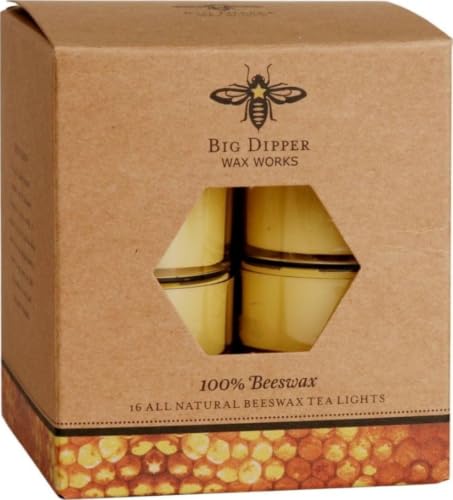
Big Dipper Wax Works 100% Pure Beeswax Tealight Candles – 16 Pack | Natural Unscented Tea Lights, Clean-Burning, Hand-Dipped, Lead-Free Cotton Wicks, Long-Lasting, Eco-Friendly
Manufacturer statement checked · source
Old or unbranded candles with a metal-core wick
CPSC banned lead-cored wicks for candles made or imported on or after October 15, 2003. The rule caps lead at 0.06% of the metal in any metal-core wick, and CPSC found that the metal cores still in use were most likely zinc. So a new candle from a known seller is very unlikely to have a lead wick. The leftovers are older candles and unbranded imports. CPSC said then that you cannot tell a metal core's metal by looking and suggested asking the retailer. A plain cotton wick ends the question.
Hides in: A stiff wick with a shiny or gray core, especially on old stock or unbranded imports
Hand-dipped 100% beeswax tapers. Bluecorn's own page states the wax; the cotton wick and about 12 hours per taper are on the brand's Amazon listing. Bluecorn says not to trim a taper's burnt wick between burns, unlike its other candles.
Manufacturer statement checked · source
An open flame near a toddler, a pet, or anyone asleep
NFPA's 2020-2024 figures are an average of 5,894 home fires a year started by candles, 63 deaths and 532 injuries. More than half began when something that burns was too close to the flame, and 36% started in a bedroom. A flameless candle removes the fire and the smoke together. It brings its own trap: many LED tea lights and remotes run on coin batteries, which can cause severe internal burns if a child swallows one, so look for a battery door that needs a screwdriver.
Hides in: Bedrooms, low shelves, bathtub edges, and anywhere a tail or a toddler reaches
Takes two AA batteries, per the listing, not a coin cell, and has a built-in timer. The shell is real paraffin wax, but it is never lit. Luminara also sells vanilla-scented versions, so check for "unscented".
Manufacturer statement checked · source
Do the free things first
Trim, then light
A quarter inch of wick is the candle industry's own advice and the cheapest way to a smaller, cleaner flame. Nail scissors work.
Burn fewer, and ventilate
One candle in a ventilated room is a different exposure from a dozen in a closed bathroom. Run an exhaust fan or open a window, but keep the candle itself out of the airflow. The Danish researchers behind the 2023 asthma study said to turn ventilation all the way up when burning candles.
Blow it out when you leave
Most candle fires start with something too close or a candle left alone. That one costs nothing.
Claims that are not on the label
- "Non-toxic" on a candle — It has no legal definition for candles. Every candle that burns makes particles, so read it as marketing, not a test result.
- "Soot-free" or "smokeless" — A cleaner-burning candle is possible; a flame that makes no particles is not. EPA lists burning candles as a source of indoor particulate matter.
- "Beeswax cleans the air" — The negative-ion claim is everywhere, and we found no peer-reviewed study that shows a beeswax candle lowering pollutants in a room. We pick beeswax because it is one wax a maker can state, not because it purifies anything.
- "Essential oils only" as a safety claim — Essential oils are fragrance chemicals too. Pet Poison Helpline lists candles among the household products that can expose pets to them.
How we choose
We read each maker's own product page and record what it says about the wax, the wick and the scent, and the date we read it. Where only the Amazon listing says something, we say so. We pick unscented 100% beeswax because it is a single wax a maker can state and you can check, not because beeswax has been shown to be healthier to breathe than other waxes. We include a flameless option because, on the evidence, fire is the bigger risk.
- Unscented: no added fragrance or essential oils
- One named wax at 100%, stated on the maker's own page
- A cotton or paper wick, with no metal core
- A named maker with a website and product pages
- Flameless picks: batteries that are not coin cells, or a battery door that needs a tool
- In stock, checked against the live catalog
Every source we cite is checked against our criteria first — see how we check our sources.
What the research says
Farmer co-led the HOMEChem experiment, in which roughly 60 scientists from 13 universities measured indoor chemistry during typical household activities in a test house. Cooking produced the largest concentrations of potentially toxic compounds, including benzene, formaldehyde, acrolein and isocyanic acid. Farmer's team reported that most emitted compounds occur in low quantities and can be cleared through ventilation.
— Delphine Farmer, PhD of Colorado State University College of Natural Sciences explains that ...
Indoor air quality experiments show exposure risks while cooking, cleaning — Colorado State University College of Natural Sciences (2022-09-21)
This paper is a key initial step towards providing actionable and practical information on how to protect yourself and clean your home.
— Delphine Farmer, PhD of Colorado State University College of Natural Sciences explains that ...
Wildfire smoke may linger in homes long after initial blaze — Colorado State University College of Natural Sciences (2023-10-13)
Particles are one of the few things that we really know directly correlate to negative health outcomes.
— Delphine Farmer, PhD told Colorado Public Radio that ...
How luften, or 'home burping,' results in the sweet smell of success for your home — Colorado Public Radio (2026-06-24)
Sources
- 16 CFR 1500.17(a)(13): candles made with metal-cored wicks (lead limit, effective October 15, 2003) — Electronic Code of Federal Regulations
- CPSC Bans Candles With Lead-Cored Wicks (release 03-105, April 7, 2003) — U.S. Consumer Product Safety Commission (how we check this source)
- Indoor Particulate Matter (last updated August 3, 2026) — U.S. Environmental Protection Agency (how we check this source)
- Laursen KR et al. Airway and systemic biomarkers of health effects after short-term exposure to indoor ultrafine particles from cooking and candles: a randomized controlled double-blind crossover study among mild asthmatic subjects (2023; vol. 20, article 26) — BioMed Central, via Europe PMC
- Burning candles and fumes from cooking is harmful for people with mild asthma (August 31, 2023) — Aarhus University, Department of Public Health
- Salthammer T et al. Measurement and evaluation of gaseous and particulate emissions from burning scented and unscented candles. Environment International 2021;155:106590 — Environment International
- Petry T et al. Human health risk evaluation of selected VOC, SVOC and particulate emissions from scented candles. Regulatory Toxicology and Pharmacology 2014 — Regulatory Toxicology and Pharmacology
- Romantic, candle-lit dinners: An unrecognized source of indoor air pollution (August 19, 2009) — American Chemical Society, via EurekAlert
- Harbison RD, Krause JD, Poor ND. Characterization of aromatic candle emissions and its similarity to diesel engine exhaust. The Toxicologist 1999;48(1-S):395 (conference abstract, not peer reviewed) — NIOSH, via CDC Stacks
- Candle fire statistics, 2020-2024 — National Fire Protection Association (how we check this source)
- Fragrances — American Lung Association
- Source Control — American Lung Association
- Essential Oils — Pet Poison Helpline
- 16 CFR part 1263: safety standard for button cell or coin batteries and products containing them (Reese's Law) — Electronic Code of Federal Regulations
- CPSC Warns Consumers to Stop Using Jolnyus LED Flameless Candle Sets (warning 26-310, March 5, 2026) — U.S. Consumer Product Safety Commission (how we check this source)
- Candle Labels 101: Understanding Product Claims & Safety Instructions (industry guidance; burn-time advice) — National Candle Association
- Candle Safety Tips (industry guidance) — National Candle Association
- Phthalates in Cosmetics (updated May 19, 2022) — U.S. Food and Drug Administration (how we check this source)
Common questions
Every air qualityproduct we've reviewed— what we'd buy, what we'd skip, and where each one stands.