
The best carbon monoxide alarm for your home
A carbon monoxide alarm is the one piece of indoor-air equipment that no amount of ventilation or filtering replaces. The choice is smaller than the shelf suggests: a model that meets the UL 2034 standard, battery-operated or with a battery backup, on every level of the home and outside the sleeping areas.

Buy a CO alarm that meets UL 2034 (CPSC's warning of August 20, 2026 says to buy only those), that is battery-operated or has a battery backup (CPSC), and from a maker that gives a model number you can look up. Then put one on every level of the home and outside each sleeping area. The five below are established-brand alarms; we read each maker's own page and manual, not UL's directory.
Brands in this guide
- First Alert4 picks
- Kidde1 pick
What the agencies say, and what we did with it
Three bodies give the advice this page follows, and we read each one's own page on 2026-10-26 (NFPA's is its "Carbon monoxide safety" page under home fire safety; we describe it here and do not reproduce its code text).
CPSC, the federal product-safety agency, says to install battery-operated CO alarms, or CO alarms with a battery backup, on every level of the home and outside sleeping areas, and that interconnected alarms are best. It also says not to install them in attics or basements unless they include a sleeping area, and to test them monthly.
NFPA, the fire-protection standards body, says CO alarms belong in a central location outside each sleeping area and on every level, to follow the manufacturer's instructions for placement and mounting height, and to choose an alarm that carries the label of a recognized testing laboratory.
CDC describes carbon monoxide as an odorless, colorless gas that kills without warning, and says to install battery-operated or battery backup detectors near every sleeping area.
That gives the buying rule on the shelf: UL 2034, and battery-operated or battery backup. On August 20, 2026, CPSC's warning about a model sold under many brand names included the note that consumers should only buy CO detectors that meet UL 2034, which is the standard these makers cite.
What we could and could not check
For each pick we read the maker's own page and, where the page did not name a standard, the user manual or data sheet. Every pick cites UL 2034 there. We did not search UL's own listing directory, so "meets UL 2034" on this page means "the maker says so", and the alarm's box should carry a testing-laboratory mark. We did not test any alarm.
Our picks
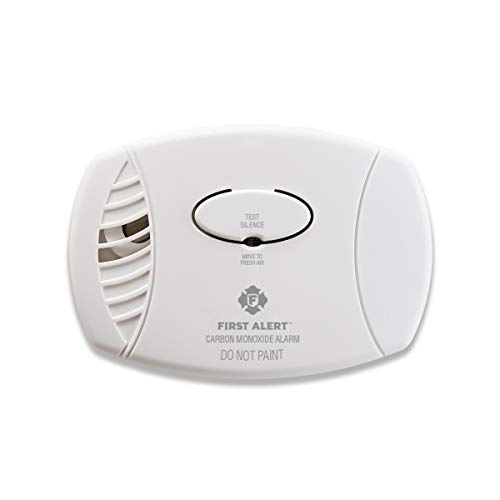
The First Alert CO400 is the default: a plain battery alarm that was the lowest-priced of the five on the day we checked, with no display and no extras. The Kidde Nighthawk is the same idea from the other major maker, on AA batteries instead of a 9V; stock on it can be thin.
The First Alert CO606 is the plug-in with a backup battery, for a spot where you would rather not climb a ladder or reach a ceiling for a battery. It is only on this list because the battery backup meets CPSC's advice.
The First Alert CO615 is the plug-in with a digital display and a peak-CO memory; it is the one to look at if CDC's suggestion of a readout appeals, and it costs more than the plain alarms.
The First Alert SMCO210 is a smoke and CO combination with a sealed 10-year battery, one device instead of two, at the price of replacing the whole unit when it reaches end of life.
Putting them in
For a home with children, the simplest reading of CPSC and NFPA is one alarm in the hallway outside the bedrooms and one on every other level people use. Check the maker's manual for the mounting height of the model you buy; for a plug-in, that is usually the outlet height unless the manual describes another mount.
Test it at least monthly, as CPSC and NFPA say; the First Alert and Kidde manuals for these models say weekly. Replace the batteries annually, as CPSC says, and replace the alarm when its end-of-life signal sounds or its replace-by date passes, whichever comes first. A CO alarm tells you carbon monoxide is already there, so it sits next to the work of getting it out of the house in the first place: the air quality hub covers the order of operations, and the appliance servicing CDC lists is the step that reduces the risk at the source.
Prices and availability on the cards above update from the live catalog, so what you see is current.
Our top pick
Manufacturer statement checked · source
First Alert CO400 — the default. A plain battery alarm with an electrochemical sensor, one 9V battery, an end-of-life warning and a 7-year limited warranty on First Alert's page. Its manual cites UL 2034, the standard for single and multiple station CO alarms, and says to replace the alarm 5 years after installation. It was the lowest-priced of the five in the catalog when we checked on 2026-10-26 (the card shows the live price), and it has no display and no extras, so there is less to explain and less to confuse.
Also worth considering

Manufacturer statement checked · source
Kidde Nighthawk KN-COB-B-LP — a battery alarm on three AA batteries with a test and silence button. Kidde's data sheet says it meets the sensitivity requirements of UL 2034 and lists it as UL Listed. The Amazon listing is titled KN-COB-B-LP, the model Kidde's page and data sheet describe; check the box for the UL mark and the replace-by date. Stock on this one was limited when we checked.
Manufacturer statement checked · source
First Alert CO606 — (First Alert's page uses CO606 in its title and specification table and CO605 in places) a plug-in alarm with a 9V battery backup, for a room where a wall outlet is easier than a battery change. First Alert's page lists an electrochemical sensor, an 85 dB horn and a 7-year limited warranty, and its manual prints UL STD 2034 and says to replace the alarm 7 years after installation. It only counts as meeting CPSC's advice because of the backup battery: CPSC says CO alarms should be battery operated or have battery backup; First Alert's manual adds that the backup battery is not meant to run the alarm for long without AC power. It has no digital display. Its manual says it plugs into an outlet close to the floor, which is within reach of a crawling child, so weigh that against the battery alarms if you have one.
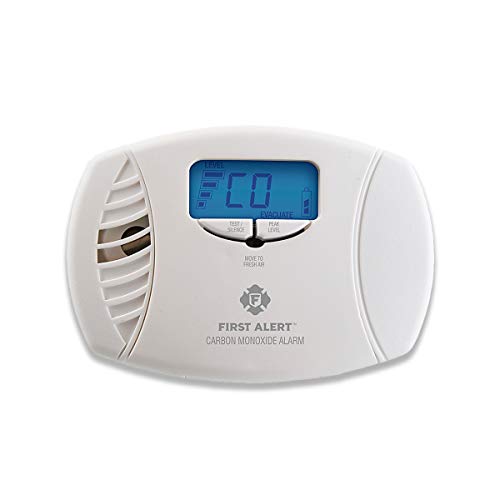
First Alert Plug in Carbon Monoxide Alarm with Digital Display | CO615, AA Battery Backup
Manufacturer statement checked · source
First Alert CO615 — the plug-in with a backlit digital display, which CDC suggests considering because a readout can show the highest level of CO in the home as well as sounding an alarm. First Alert's page lists an electrochemical sensor, two AA backup batteries, an 85 dB horn and a 7-year limited warranty; its manual prints "CONFORMS TO UL STD 2034" for model CO615, describes a peak-CO memory that keeps the highest reading for 24 hours, and says the battery is for back-up only and not meant to run the alarm for long without AC power. It costs more than the plain alarms, and it can plug in at outlet height or, with its cord, be wall-mounted or set on a shelf; follow its manual.

Manufacturer statement checked · source
First Alert SMCO210 — one unit that is both a smoke alarm and a CO alarm, with a sealed 10-year battery that cannot be replaced. First Alert's page says it conforms to UL 217 (smoke) and UL 2034 (CO). The trade is that when the battery or sensor reaches end of life, the whole alarm goes; CPSC notes that combination alarms are available.
What to avoid
- A CO alarm you cannot trace to a named maker and a testing-laboratory mark — On August 20, 2026 CPSC warned consumers to stop using a plug-in natural gas and carbon monoxide detector, model KH158, sold on Amazon, eBay and other sites under many brand names, because it can fail to alert consumers to carbon monoxide (CPSC records 91 reports of it failing to alarm). Its note says consumers should only buy CO detectors that meet the UL 2034 safety standard. A line of text on a listing is not proof, so use NFPA's test as well: choose an alarm with the label of a recognized testing laboratory, check for it on the unit and box, and buy from a maker that publishes a model number and manual.
- A plug-in alarm with no battery backup — CPSC says CO alarms should be battery operated or have battery backup. The two plug-in picks here have a backup battery, which First Alert's manual describes as back-up only, not a long-term power source.
- One alarm for the whole house — CPSC and NFPA both say every level of the home and outside the sleeping areas. In a one-storey home that is one in the hallway by the bedrooms; in a two-storey home it is at least two.
- Reading the basement exception as "skip the furnace level" — CPSC's CO Alarms page says CO alarms should not be installed in attics or basements unless they include a sleeping area. NFPA's advice is every level of the home, and local codes can require more. If your furnace, water heater or other fuel-burning appliance is in the basement, ask your fire department or follow the alarm maker's manual rather than leaving that level to chance.
- Leaving it past its end-of-life signal — NFPA says to replace CO alarms according to the manufacturer's instructions, and CDC says the same. CDC's wording is the manufacturer's instructions or every 5 years, and the makers' dates differ (the CO400 manual says 5 years after installation, the CO606 and CO615 manuals 7). Replace the alarm when its end-of-life signal sounds or its replace-by date passes, whichever comes first.
- Treating the alarm as the whole plan — It tells you after carbon monoxide is already in the air. CDC's list of steps is to have the heating system, water heater and other fuel-burning appliances serviced every year, never run a car in an attached garage and keep generators outside, more than 20 feet from windows, doors and vents.
How we choose
We start from what CPSC, NFPA and CDC say a home needs, and only then look at products. A pick has to cite UL 2034 on the maker's own page, data sheet or manual, be battery-operated or have a battery backup, come from a maker with a published model number and manual, and be in stock on the day we check. We did not look the models up in UL's own directory, so UL 2034 is the maker's statement here, not UL's.
- The maker's own page, data sheet or manual cites UL 2034 for the model (read, not assumed)
- Battery-operated, or with a battery backup, as CPSC advises
- A published model number, manual and end-of-life signal
- A maker we can name, not a marketplace brand with no published manual
- In stock on the day we checked the catalog
Every source we cite is checked against our criteria first — see how we check our sources.
What the research says
Farmer co-led the HOMEChem experiment, in which roughly 60 scientists from 13 universities measured indoor chemistry during typical household activities in a test house. Cooking produced the largest concentrations of potentially toxic compounds, including benzene, formaldehyde, acrolein and isocyanic acid. Farmer's team reported that most emitted compounds occur in low quantities and can be cleared through ventilation.
— Delphine Farmer, PhD of Colorado State University College of Natural Sciences explains that ...
Indoor air quality experiments show exposure risks while cooking, cleaning — Colorado State University College of Natural Sciences (2022-09-21)
This paper is a key initial step towards providing actionable and practical information on how to protect yourself and clean your home.
— Delphine Farmer, PhD of Colorado State University College of Natural Sciences explains that ...
Wildfire smoke may linger in homes long after initial blaze — Colorado State University College of Natural Sciences (2023-10-13)
Particles are one of the few things that we really know directly correlate to negative health outcomes.
— Delphine Farmer, PhD told Colorado Public Radio that ...
How luften, or 'home burping,' results in the sweet smell of success for your home — Colorado Public Radio (2026-06-24)
Sources
- Carbon Monoxide (CPSC safety education center; page read 2026-10-26) — U.S. Consumer Product Safety Commission (how we check this source)
- CO Alarms (CPSC; page read 2026-10-26) — U.S. Consumer Product Safety Commission (how we check this source)
- CPSC warns consumers to stop using 4 in 1 plug-in natural gas and carbon monoxide detectors (warning 26-706, August 20, 2026) — U.S. Consumer Product Safety Commission (how we check this source)
- Carbon Monoxide (CO) Poisoning Basics (page dated October 26, 2026) — Centers for Disease Control and Prevention (how we check this source)
Side by side
| Attribute | First AlertBattery Carbon Monoxide Alarm | CO400 | KiddeKN-COB-B-LP Nighthawk Carbon Monoxide Alarm | First AlertPlug in Carbon Monoxide Alarm | CO606 | First AlertPlug in Carbon Monoxide Alarm | First Alert10-Year Battery Combination Smoke & Carbon Mo… |
|---|---|---|---|---|---|
| Why it's here | Our top pick | — | — | — | — |
| Price | $21.99 | $29.99 | $23.99 | $44.95 | $41.93 |
| Availability | In stock | Check retailer | In stock | In stock | In stock |
Common questions
Cheat sheets for this
Part of the Indoor Air Quality hub— the rest of our coverage in this category.
Every air qualityproduct we've reviewed— what we'd buy, what we'd skip, and where each one stands.