
Pool safety for kids
Bought a house with a pool? Secure access first. Then compare fences, covers and alarms, and set rules for home and travel.
Just moved in? Start here
Secure every way to the water. Lock doors and gates to the pool. Keep kids away from the area if a gate or barrier needs repair.
Walk the whole fence. Check the fence on all four sides. If the house is one side, check that each door to the pool has an alarm (CPSC asks for one on house-side doors), ideally plus a self-closing latch or a lock out of reach, or a cover, as your local code requires. Release the gate from just ajar and see if it closes and latches.
Pick a Water Watcher. Give one adult the job of watching. Stay within arm’s reach of young children and weak swimmers.
Fences and gates that block access
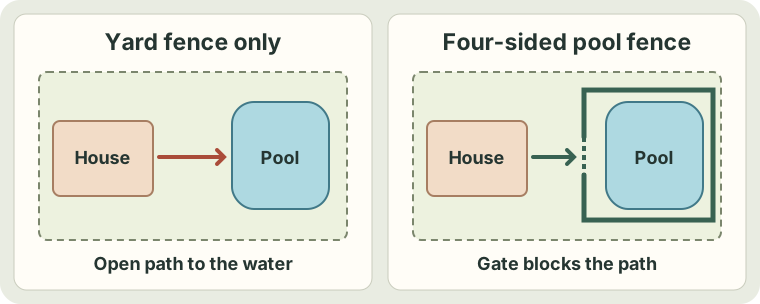
A four-sided isolation fence surrounds the pool itself. A fence around the whole yard can still leave a direct path from the back door to the water. The CDC recommends a four-sided fence at least 4 feet high with self-closing, self-latching gates. Ask your city or county building department for the rules that apply to your address, including height, openings, gate hardware and permits. CDC drowning prevention guidance · CPSC residential barrier guide
- Permanent aluminum or steel suits a dedicated enclosure. Look for vertical pickets, narrow gaps and rails a child cannot use as steps.
- Removable mesh can fit a curved deck or a retrofit. Ask about ASTM F2286 documentation, the deck anchors and a separate self-closing, self-latching gate. Leave the enclosure installed and latched between swims.
- Glass, solid vinyl or wood can preserve a sightline or add privacy. Check the panel gaps, hardware, footholds and whether the proposed design meets local rules.
Above-ground pool? Check the ladder, stairs, deck and external supports. CPSC has recalled certain Bestway, Intex and Polygroup models and Sunneday and Blue Bay pools with external straps children can climb even after the ladder comes off. Compare the model number and follow the recall instructions if it matches.
Compare fence types, mesh systems and installer quotes →
Alarms and cameras by what they detect
Start with the point you need to monitor. A door, window or gate alarm signals an opening. A surface or subsurface alarm responds to a disturbance after entry into the water. A perimeter sensor or camera may alert on movement in a configured area. A wearable immersion alarm alerts when the person wearing it gets wet or enters the water, depending on the model. Every alert depends on an adult hearing it and responding. CPSC pool alarm overview · ASTM F2208
Five kinds of pool alarm at a glance
Pick the card that matches the point you need to watch. Each opens that type on the comparison page, with the tradeoffs and our listed picks.
- Type 1Door, window and gate alarmsA door, window or gate being opened.
 Featured pickDoor alarm (listing says UL 2017) with adult pass-throughabout $574 picks and tradeoffs
- Type 2Floating surface alarmsWaves made by something entering the water.
 Featured pickFloating alarm, NSF-listed to ASTM F2208about $3002 picks and tradeoffs
- Type 3Subsurface alarmsUnderwater disturbance from entry.
 Featured pickSubsurface alarm, NSF-listed to ASTM F2208about $2231 pick and tradeoffs
- Type 4Cameras and perimeter sensorsA person near or entering the pool zone.
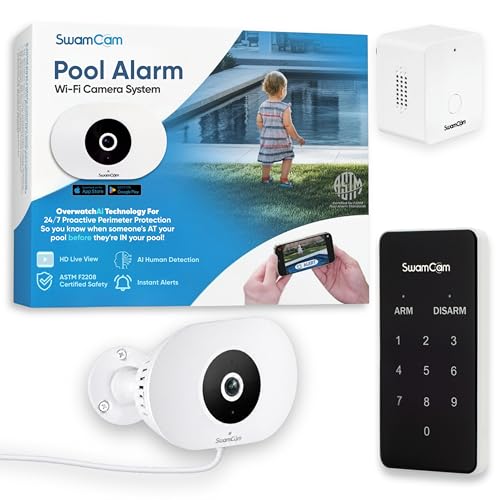 Featured pickAI pool camera with local alarmabout $5001 pick and tradeoffs
- Type 5Wearable immersion alarmsA child wearing the band going under water.
 Featured pickWristband alarm kitabout $2001 pick and tradeoffs
Pool safety covers and hot tub locks
A fitted safety cover adds a layer when secured across the whole pool. Look for the exact model’s ASTM F1346 documentation. An automatic cover may be easier to close daily if the pool can accept tracks. An anchored mesh or solid cover typically takes more work to secure and may suit seasonal use. Check the anchors, edges and drainage, and fully uncover the pool before swimming. Floating solar blankets and ordinary debris covers serve a different purpose. Cover and lock a hot tub after every use. AAP cover guidance · ASTM F1346
Compare automatic, anchored mesh and solid safety covers →
Pool rules for your household
These are habits, not one-time jobs, so they are not on the to-do list. Read them with every adult and babysitter, and print this section for the fridge.
Every time anyone is in or near the water
- Name a Water Watcher. One sober, attentive adult with no phone in hand. Before the watcher leaves, the next adult says "I've got them" by name.
- Stay within arm's reach of a toddler or weak swimmer, in the bath and at the pool. Get in with them.
- Fit a U.S. Coast Guard-approved life jacket to the child and the activity. Keep water wings and inflatable toys for play, not protection.
When swim time ends
- Take the children with you, latch the gate, lock the doors to the pool and re-arm any alarm.
- Clear the toys out of the water and off the deck so nothing draws a child back.
- Empty and flip kiddie and inflatable pools so rain cannot refill them.
- Never prop the gate open, including while guests come and go at a party.
If a child goes missing, check the pool and spa first, before anywhere else, and call 911 if you find them in the water.
For guests: swim only with an adult watching, walk on the deck, and go in feet first unless there is a designated diving area.
CDC supervision and life jacket guidance · Red Cross home pool safety · U.S. Coast Guard life jacket fit
Pool safety at rentals, hotels and relatives’ homes
Before booking, ask for a current photo showing all four sides of the pool fence and the gate, and ask whether any room, patio or balcony opens directly to the pool area. When you arrive, walk every route to water before kids unpack or explore. If a young child can get to the water on their own and you cannot secure that route, choose a different setup. At a shared hotel pool, check the gate, depth, rules and lifeguard hours and name your own Water Watcher. CPSC vacation rental advice
Copy the questions to send your host and use the arrival checklist →
What to buy, by job
Buy for the hole you found in the to-do list, not the whole list at once. Each guide shows the products we looked at, with what the listing says and what to check before you order.
- A fence or gate that doesn't close by itself: removable mesh kits, self-closing gates, top-pull latches and a ladder lock. Fence and gate picks →
- A door that opens to the pool: a UL 2017 door alarm and a high sliding-door lock. Door alarm picks →
- Another layer of warning: in-water alarms, cameras and wearables, with what we couldn't verify about each. Alarm and camera picks →
- Water gear: life jackets and a rescue pole are listed in the to-do list below, under Skills and gear.
To-do list
Start ticking things off
Saved on this device
This weekend, at the fence and gate
Ask three things: the fence and gate rules for an existing pool, whether doors to the pool need alarms, and what work triggers an inspection. Write down the name and the date.
Height (CPSC asks for at least 4 ft), the gap under the fence (4 in or less), and the widest gap between pickets (1¾ in or less where the horizontal rails are under 45 in apart). Anything over, note it for repair or a quote.
It should swing outward, close and latch every time without a push. If it sticks, bounces or only latches from one position, repair or replace the hinges and latch before the kids use the pool.
Chairs, planters, grills, pool equipment and stacked toys on the approach side.
Check your exact model against the CPSC recalls database. Some recalled pools have an external strap a child can climb even with the ladder off.
This weekend, at the house
For each one, write down what stops a child today: an alarm, a self-closing latch, a lock above reach, or nothing. Fix the 'nothing' first. CPSC says never to have a pet door that leads directly to the pool.
If the house is one side of the barrier, CPSC asks for a UL 2017 alarm that starts within 7 seconds and is at least 85 dB at 10 feet. After you install it, open the door with the house quiet and listen from the room where you sleep.
- Optional
Check you can hear it indoors with doors closed, replace the battery, and put 'arm the alarm' where you close up the pool.
Covers and hot tubs
Look for ASTM F1346 on the label or in the manual. A floating solar blanket is not a safety cover.
Check that the straps, fasteners and locks work and the edges sit snugly.
Skills and gear
The Red Cross, the American Heart Association or your pediatric office run them. Put the renewal date in your calendar when you finish.
Ask about readiness at your next visit, and sign up yourself if you cannot swim.
Check the Coast Guard approval and the weight range on the label. It should buckle snugly and stay put when you lift it at the shoulders.
- Optional
Example: a 15-foot telescoping fiberglass hook, which the listing says extends from 4 to 15 feet and is rated to 260 lb of pulling force. Keep a phone at the pool too. Reaching from the edge is safer for you than going in after someone.
 exablo
 15FT Telescopic Pool Safety Hook & Rescue Pole | Fiberglass Water Safety Equipment for Pools, Docks, Marinas & Lakefronts
$57.99View on Amazonexablo — exablo 15FT Telescopic Pool Safety Hook & Rescue Pole | Fiberglass Water Safety Equipment for Pools, Docks, Marinas & Lakefronts
- Optional
Example: a Coast Guard approved infant jacket that the listing says has a head-support collar and a grab strap, for infants under 30 lb. Check the weight range printed on the label.
 Full Throttle
 U.S. Coast Guard Approved Baby-Safe Life Jacket For Infants Less Than 30 Pounds For Pool, Beach, Or Boat
$33.95View on AmazonFull Throttle — Full Throttle U.S. Coast Guard Approved Baby-Safe Life Jacket For Infants Less Than 30 Pounds For Pool, Beach, Or Boat
- Optional
Example: a Type III jacket that the listing says is Coast Guard approved, in the 30 to 50 lb size. The maker also sells 50 to 90 lb.
 Stohlquist
 Kids Life Jacket 30-50 lbs - Coast Guard Approved Life Vest - Type III PFD for Boys and Girls - Secure & Adjustable Fit for Swimming, Boating & Water Sports
$23.99View on AmazonStohlquist — Stohlquist Kids Life Jacket 30-50 lbs - Coast Guard Approved Life Vest - Type III PFD for Boys and Girls - Secure & Adjustable Fit for Swimming, Boating & Water Sports
Drains, and your next trip
Keep children away from suction outlets. Keep the pool closed if a cover is loose, damaged or missing.
Ask for photos of all four sides of the fence and a video of the gate latching.
Common pool safety mistakes
- Leaving the gate propped open — Let it close and latch every time, including while people are coming and going at a party.
- Using floaties for protection — Keep water wings and inflatable toys for play. Choose a properly fitted, U.S. Coast Guard-approved life jacket for a child who needs one.
How we choose
We start with CDC, CPSC and AAP guidance. In the buying guides we compare published specifications, manuals and exact-model certification listings where available. The product examples are drawn from manufacturer documentation and registry listings where available. We have not tested them.
Every claim traces to a listed trusted source.
Common questions
Sources
Every source we cite is checked against our criteria first — see how we check our sources.