
Pool safety fences and gates
How to inspect the fence you inherited, compare mesh, metal, glass, vinyl and wood, and get quotes for a barrier that fits your pool.
← Pool safety guide and printable checklist
A four-sided isolation fence blocks access from both the house and the yard. Choose the enclosure and gate first. Material comes next. Use the CDC’s 4-foot recommendation as a starting point and ask your building department what applies at your address.
Jump to Inspect your fence · Compare materials · Compare mesh systems · Get quotes
Inspect an existing pool fence and gate
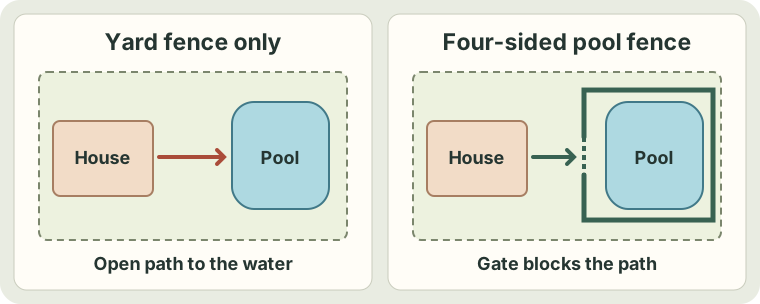
- Walk every route from the house and yard. Check back doors, pet doors, decks and stairs. Move chairs, toys and other footholds away from the approach side.
- Measure from the side away from the pool. CPSC's guideline (Pub. 362) asks for a fence at least 4 feet high, and says 5 feet or higher is preferable. The gap under the fence should be no more than 4 inches (industry recommends 2 inches where the fence rests on grass or gravel). No opening should let a 4-inch ball through. Picket spacing is 1¾ inches or less where horizontal rails are less than 45 inches apart, and 4 inches or less where they are 45 inches or more apart. Removable mesh has its own numbers: 48 inches high, posts no more than 40 inches apart, and no more than 1 inch under the mesh. Local codes can be stricter, so check yours.
- Let the gate go. CPSC asks for a gate that opens outward, away from the pool, and is self-closing and self-latching. It asks for a release at least 54 inches up. If the release is lower, put it on the inside of the gate at least 3 inches below the top, with no opening larger than ½ inch within 18 inches of it. A bottom hinge a toddler can step on is a foothold, so cap it. Test the gate yourself from wide open and from just ajar: a gate that only closes from one position is the weak link. One that sticks or bounces open needs repair.
- Check unusual access points. For an above-ground pool, walk the route via any deck, stairs, ladder or exposed frame. Look up the exact model in the CPSC recalls database. Some recalled pools have a strap children can climb even with the ladder removed.
If the house is a side of your current barrier, ask the local building department how to secure doors, windows and pet access while you plan an isolation fence. CPSC barrier diagrams and dimensions
Which pool fence material fits your yard?
- Permanent aluminum or steel. A practical quote to get for a dedicated enclosure on a straightforward layout. Vertical pickets preserve the view. Check the opening under each panel on sloping ground and the position of horizontal rails.
- Removable mesh. Worth pricing for a retrofit or curved layout. A good quote accounts for the exact deck surface, how the posts lock into it and the gate assembly. Keep the fence in place and latched between swim sessions.
- Glass. Worth a quote when visibility is the priority. Ask for an appropriate safety glazing specification, hardware details, replacement costs and service options.
- Solid vinyl or wood. Worth considering when privacy matters. Check the pool sightline, the effect of slopes or changes in grade and whether rails or braces create footholds. Inspect hardware and fit as the fence ages.
Two mesh fence systems (examples)
Life Saver Pool Fence DIY is a system to investigate for a straightforward retrofit if your building department permits DIY installation and the deck is compatible. The kit's manual-release opening is where two panels meet; it is not a gate. Price the separate self-closing, self-latching gate as part of the enclosure. The manufacturer calls for concrete footers when installing its dirt sleeves. Pool Fence DIY instructions and FAQ
All-Safe removable mesh with U-Safe gate is a second system to price, especially if you want an installer to measure and quote the route. Compare the exact panel height, spacing and gate hardware on the quote. Ask who will service the latch and anchors after installation. All-Safe system and installer directory · U-Safe installation guide
These comparisons use published instructions and specifications. The installed layout, gate and anchors determine whether a system fits your property. Ask for documentation against ASTM F2286 for the exact removable mesh system and verify local acceptance before ordering.
What to ask a pool fence installer
Ask each installer to quote the same route, including all four sides and every gate. Have them itemize fence length, hardware, deck drilling or footings, grading, permit or inspection costs, old fence removal and service. Ask who checks for utilities and pool plumbing before anyone drills. Bring photos of corners, deck edges and any change in height.
Before accepting the job, walk the enclosure with the installer, measure the largest gaps and ask them to demonstrate the gate from both positions. Get the hardware and care instructions. Then check door and water-entry alarms if you need another alert layer.
Vetted picks

Pool Fence DIY by Life Saver Fencing Section Kit, 4 x 12-Feet, Black
Removable mesh fence kit
A DIY kit of 4-foot by 12-foot mesh sections that the listing says are installed under tension in deck sleeves, with a brass safety latch. It needs a rotary hammer drill and a masonry bit that are not included. A mesh fence only protects while it is up and its gate is latched. Check it against your local code first.

Pool Fence DIY by Life Saver Self-Closing Gate Kit, Black (Pack of 1)
Matching self-closing gate
The maker's gate for the same system. The listing says it is 4 feet tall and 36 inches wide with a magnetic latch and self-closing hinges. Pair a mesh fence with a gate that closes and latches on its own.

D&D MLTPTCA1CAPSPKA Pool Safety Gate Kit: MagnaLatch Top Pull, Hinges & Cap | Pool safety gate hardware kit includes MagnaLatch Top Pull 20-inch gate latch, 2 self-closing TruClose hinges & a Safety Cap
Gate kit: magnetic latch, self-closing hinges, hinge cap
The listing describes a top-pull magnetic latch, two self-closing hinges and a cap that makes the bottom hinge harder to use as a step. It fits square frames and posts, so measure first. It does not make a gate swing outward; check that and test the latch after you install it.

D&D ML3TPKA MagnaLatch Top Pull 20-inch Pool Safety Gate Latch, Black | Pool safety gate latch & lock, magnetic latching system. Weather-resistant. For any square gate frame & fence post.
Replacement top-pull gate latch
For a gate that already closes by itself and only needs a better latch. The listing says top pull, lockable and rekeyable. Pair it with self-closing hinges.

Grandma's Child Saver - Expert Pool Safety Chain Lock - Pool Ladder Guard - Bunk Bed Protector - RV Ladder Guard - Prevent Drowning
Above-ground pool ladder lock
A chain-and-lock ladder guard for an above-ground pool. A climbable ladder gives a child a way up. Check that the pool wall itself counts as a barrier under your local code; the AAP says large above-ground and inflatable pools need a fence on all four sides.