
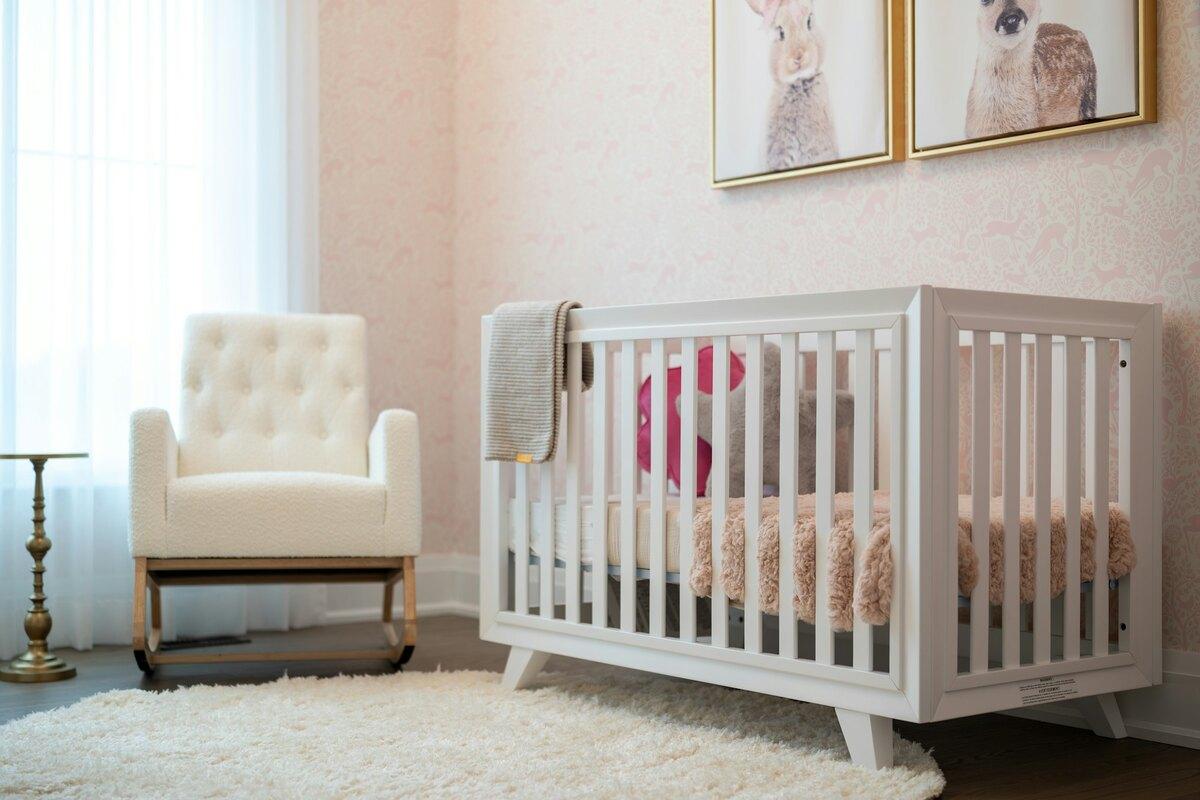

babyletto Hudson 3-in-1 Convertible Baby Crib
Manufacturer statement checked · source
Currently unavailable
Search optionsWe couldn't confirm a live listing for this exact product, so this opens a search for the same model.
Cribs, mattresses and the room itself. A nursery is the one space where a small person spends twelve hours a day breathing the same air, which makes it the place where material choices compound more than anywhere else in the house.
Twelve hours a day, in a small enclosed space, with a developing respiratory system. That is the whole argument — time and volume, not any one alarming product. Which is also why the highest-value moves here are not purchases: ventilation and time do more than most of what you can buy.
Twelve hours a day, in a small enclosed space, with a developing respiratory system. That is the whole argument, and it is about time and volume rather than any one alarming product.
It also means the highest-value moves here are not purchases. Ventilation and time do more than most of what you can buy.
Most nursery marketing is noise. Two third-party marks are not.
GREENGUARD Gold tests finished products for chemical emissions against limits set with children and sensitive people in mind. It is an emissions standard — it tells you what comes out of the product into the air, which is precisely the nursery question.
CertiPUR-US applies to polyurethane foam and covers what is in the foam: no specified flame retardants, low VOC emissions, restrictions on certain other substances.
Both are in our Sources registry, with their scope and limits written out. Neither means "no chemicals." They mean somebody independent measured a defined list, which is a much more useful claim than "non-toxic" on a box.
The solid wood crib guide goes through this properly, but the short version: engineered panels — MDF, particleboard — are bonded with adhesives that can emit formaldehyde, and emissions are highest when the product is new.
Solid wood sidesteps the adhesive question in the panels themselves. It costs more, and it is one of the few places in a nursery where the premium buys something specific rather than a nicer finish.
Whatever the frame, check it against current CPSC crib standards. Cribs made or sold since June 2011 have to meet a mandatory federal crib standard, which makes older hand-me-downs and marketplace finds worth a second look rather than an automatic yes.
A crib mattress is the single largest surface a baby is in contact with, for the longest time. Our Naturepedic review covers what the certifications on these actually certify — which is narrower than the marketing implies, and still worth having.
Unbox early and ventilate. Emissions from a new mattress, crib or painted surface are highest when new and fall off over weeks. Assembling the nursery a month ahead with the window open does more for the air in that room than choosing between two well-certified mattresses.
If you want to go further, our air quality guide covers what actually helps indoors — and what is sold as helping but does not.
We favor solid wood over engineered panels, and third-party certification over manufacturer claims — GREENGUARD Gold and CertiPUR-US are the two that actually mean something here. Where a certification has limits worth knowing, we say what they are rather than treating a logo as the end of the conversation.
Save & share
Emissions are highest when a product is new. Unbox early, air it out, and let time do work no certification can do for you.
The science, briefly
GREENGUARD Gold tests finished products for chemical emissions against limits set with children and sensitive people in mind. It is an emissions standard — what comes out of the product into the air, which is precisely the nursery question. CertiPUR-US applies to polyurethane foam and covers what is in it: no specified flame retardants, low VOC emissions, restrictions on certain other substances.
Neither means "no chemicals". They mean somebody independent measured a defined list, which is a much more useful claim than "non-toxic" on a box.
On cribs: engineered panels — MDF, particleboard — are bonded with adhesives that can emit formaldehyde, and emissions are highest when the product is new. Solid wood sidesteps the adhesive question in the panels themselves. It costs more, and it is one of the few places in a nursery where the premium buys something specific rather than a nicer finish.
Common mistakes
Ventilation and time do more than most of what is for sale. Emissions are highest when a product is new, so unboxing early and airing the room is free and effective.
Cribs made or sold since June 2011 have to meet a mandatory federal crib standard. Marketplace finds and hand-me-downs are worth checking against current CPSC standards rather than an automatic yes.
It means a defined list was measured by someone independent. That is genuinely useful and considerably narrower than the marketing around it.
Start here
What we'd buy
Manufacturer statement checked · source
We couldn't confirm a live listing for this exact product, so this opens a search for the same model.
Manufacturer statement checked · source

Manufacturer statement checked · source
Go deeper
Child passenger safety technicians across the country report identifying one to two unregulated or counterfeit seats each month during routine safety checks.
— In 2026-02-07 testimony, Ben Hoffman, MD, CPST-I cited ...
Public testimony on counterfeit car seats, Oregon House Committee on Commerce and Consumer Protection — Oregon Legislative Information System (2026-02-07)
Car seat use reduces the risk for injury in a crash by 71-82% for children, compared with seat belt use alone
— In 2026-02-07 testimony, Ben Hoffman, MD, CPST-I cited ...
Public testimony on counterfeit car seats, Oregon House Committee on Commerce and Consumer Protection — Oregon Legislative Information System (2026-02-07)
At just 30 miles per hour-a speed consistent with many urban and residential crashes-the counterfeit seat completely disintegrated
— In 2026-02-07 testimony, Ben Hoffman, MD, CPST-I cited ...
Public testimony on counterfeit car seats, Oregon House Committee on Commerce and Consumer Protection — Oregon Legislative Information System (2026-02-07)