
The non-toxic bath toys cheat sheet
One winner for each way people buy bath toys.
The short version of what to buy for the tub: the shape that matters most, the materials worth asking about, how to clean and dry what you own, and when to throw a toy out. It points to our bath toy explainer for the research rather than repeating it.
How we scoreHow we earnChecked November 13, 2026
Our winner for each way people buy
How we scoreHow we earnChecked November 13, 2026
A bath toy built to drain and dry

Boon
Fleet Toy Boat Baby Bath ToysBoon's page describes stack-and-pour boats with wide decks and drain holes, names polypropylene, and says top-rack dishwasher safe and to drain fully and store dry. No BPA, PVC or phthalate statement.
Meets our published criteria, as of Nov 13, 2026
$9.99ViewA squishy animal with no hole (an option, with caveats)

caaocho
Pure Natural Rubber Bath ToyA sealed natural rubber whale; the brand's listing says PVC- and phthalate-free and to air dry after each use. Latex, so not for a latex allergy. The 2018 study did not test sealed designs, and you cannot look inside.
Meets our published criteria, as of Nov 13, 2026
$14.99View
What to avoid
- A hollow toy with one small hole — hard to rinse through and dry; the 2018 study found biofilm in every toy it opened but did not test shapes (see our bath toy explainer)
- Soft vinyl with no stated material — PVC needs plasticizers to be squeezable, so it is the one to ask about; see our TPR explainer
- Drying a wet toy in a closed mesh bag — it can hold in moisture
- "Non-toxic" or "mold free" with nothing behind it — neither is a defined term for toys, so they are the brand's words
What to look for
- Solid, or open wide enough to rinse and drain — the study did not test shapes, but a toy that drains and dries gives water less place to sit
- A named material and a "PVC-free" statement — worth more than silence, but still the maker's word; none of these picks names a test report
- Care instructions on the page — dishwasher safe or air-dry guidance tells you the maker expects the toy to be cleaned
- 1Skip: Hollow squeeze bath toys with a small holeWhat the 2018 study found and did not test, and how to care for the toys already in your tub Why
- 2Skip: Squishy toys where you cannot tell whether water got inBuy instead: caaocho Why
- 3Skip: Toys that do not name a materialBuy instead: PlanToys Why
What the label card means
What to skip, and why
A hollow toy with one small hole
Hard to rinse through and dry; the 2018 study found biofilm in every toy it opened but did not test shapes (see our bath toy explainer).
Soft vinyl with no stated material
PVC needs plasticizers to be squeezable, so it is the one to ask about; see our TPR explainer.
Know the risks: PVC / soft vinylDrying a wet toy in a closed mesh bag
It can hold in moisture.
"Non-toxic" or "mold free" with nothing behind it
Neither is a defined term for toys, so they are the brand's words.
The full guide: how we chose
A small 2018 study cut open 25 bath toys and found a biofilm inside every one, including new toys that were only ever filled with clean water, never bathed in. The authors point to carbon leaching from the flexible plastic and to what bathers add to the water; they did not test whether a toy's shape or hole matters. Our rule is common sense, not their finding: buy toys you can rinse through and dry, then ask what they are made of. A maker that names the material and says "PVC-free" has given you something to check, but it is still the maker's word.
What this sheet covers
This is the buying version of our bath toy research. It is for the parent standing in front of a shelf of rubber ducks, or a browser tab of them, deciding what goes in the tub. The research itself lives in our bath toy explainer, and we have tried not to repeat it here.
The rule that decides most of it: choose toys that drain and dry
A small 2018 study from Eawag, ETH Zurich and the University of Illinois cut open 25 bath toys: 19 used ones from real households and six new identical ones used for 11 weeks, half in clean water and half in bathwater. Every toy had a biofilm on its inside surface, including the ones that were only ever filled with clean water. The authors argue that four things influenced it: carbon leaching from the flexible plastic, tap-water quality, nutrients from soap and body fluids, and bacteria from dirt and the user. They did not compare shapes, and they did not test a solid or open toy. They close with a quip that the easiest prevention would be to close the hole.
So the rule on this sheet is ours, not theirs. A hollow toy with a small hole is hard to rinse through and hard to dry, so water and residue can sit in a cavity you cannot see. A toy you can see through and get dry has less place for that to happen. Nothing here has been measured, which is why we call it common sense and not a finding.
That gives three kinds of toy worth buying: solid toys, open toys like cups, boats and scoops, and anything with a wide opening or drain holes you can rinse through. A sealed toy with no hole at all is a fourth design the study did not test; some of our picks are that, and we mark them with a caveat.
Materials: what to ask about
PVC. Rigid until it is plasticized, historically with phthalates, which is how a hollow squeaky toy gets soft. U.S. law has capped eight phthalates in children's toys since 2018, so a toy sold here has to clear that bar, but the rule is about what the plastic contains and says nothing about the shape. Our phthalates and PVC page covers the rule, and our TPR explainer covers why TPR and silicone, which are made without PVC's phthalate plasticizers, are easier materials to trust on the chemical question; the 2018 study did not compare materials. A maker that states "PVC-free" has given you something to check; silence is not a claim, so ask. None of the picks here names a test report, so every one is the maker's word.
Recycled plastic and polypropylene. The Green Toys and mushie picks are rigid plastic, and both makers state no PVC or phthalates. mushie names polypropylene; Green Toys says only "recycled plastic" on the pages we read. The cups are open by our reading of a stacking-cup set; the Green Toys tugboat is the one whose hull the page does not describe.
Natural rubber. It is soft without PVC, but it is latex. A latex allergy rules it out, and the listings we read do not mention it, so we say it here.
Silicone. Soft and plasticizer-free, which is why it is a sensible material for a squishy bath toy; check the maker's care instructions before putting it in the dishwasher. We do not have a silicone pick: the sets we found were from brands with nothing we could read.
Wood. A wooden toy whose maker names the wood and the finish sidesteps the plastic question, but wood and wet bathwater do not mix well, so dry it between baths and watch the finish.
Cleaning and drying
- Rinse with clean water after every bath, not the bath water itself.
- Squeeze out what you can and air-dry somewhere with airflow, not in a closed mesh bag while still wet.
- Wash with soap by hand now and then, or run dishwasher-safe toys through a cycle. Green Toys says its tugboat and cups are dishwasher safe; mushie says warm water, mild soap and air dry.
- Do not let toys sit in a bucket or a closed bag between baths.
When to throw one out
- A hollow toy that releases cloudy, discolored or foul-smelling liquid when you squeeze it over the sink. Retire it rather than keep cleaning it. That is our rule, not a tested threshold.
- Any toy where you can see slime or dark spots that do not wash off. That is our rule of thumb, not something the study measured.
- A wooden toy with a split or peeling finish.
You do not need to throw every bath toy in the house away. The study found a biofilm in every toy it opened, which says something about how bath toys get used, not that your household did something wrong.
Where to go next
- Mold and bacteria inside squeeze bath toys: the 2018 study and what to do about the toys you have.
- What is TPR, and is it safe?: soft parts and the PVC question.
- Phthalates and PVC: what the plasticizer rules do and do not cover.
- Toys hub: how we evaluate play materials generally.
- The toys and art supplies cheat sheet: play dough, crayons and baby toys.
The swaps, in full
Hollow squeeze bath toys with a small hole
A 2018 study found a biofilm on the inside of every bath toy it cut open, including new toys that were only ever filled with clean water. It did not compare shapes, so it cannot tell you a hole is the cause. Our reasoning is that a small hole is hard to rinse through and hard to dry; the authors close with a quip that the easiest prevention would be to close the hole. Most of these picks are open or stacking designs; where a maker's page does not describe the shape, the pick says so.
Hides in: Squirters, squeaky ducks and animals with one small opening
Squishy toys where you cannot tell whether water got in
If your child wants a squishy animal, the alternative to a hollow toy with a hole is a sealed toy with no hole at all. The 2018 study did not test this design, so treat these as an option with a caveat, not a fix. If the maker's sealed design holds, water cannot get in, but you cannot see inside to check. The squeeze-over-the-sink test does not apply to them, so retire one if it ever releases liquid or smells off.
Hides in: Rubber ducks and animals sold as 'no hole' or 'mold free'
The brand's listing says "100% Pure Natural Rubber"; "BPA, PVC, Phthalate, Nitrosamine Free"; "Food-grade paint"; a "hermetic, no hole" design; and "air dried properly after each use" as the care instruction. Natural rubber is latex, so skip it if anyone in the house has a latex allergy. The paint is the part we know least about. The brand's own product pages would not load for us, so these are listing statements. The same brand sells a near-identical sealed duck (see the cut below).
Manufacturer statement checked · source
Toys that do not name a material
PVC is rigid until it is plasticized, historically with phthalates, which is how a hollow squeaky toy gets soft. U.S. law now caps eight phthalates in children's toys, but that rule is about what the plastic contains, not about what grows inside. A toy whose maker names its material gives you something to check; wood is one way to leave the plastic question out, with its own care needs.
Hides in: Squeaky toys and soft dolls whose packaging does not name a material
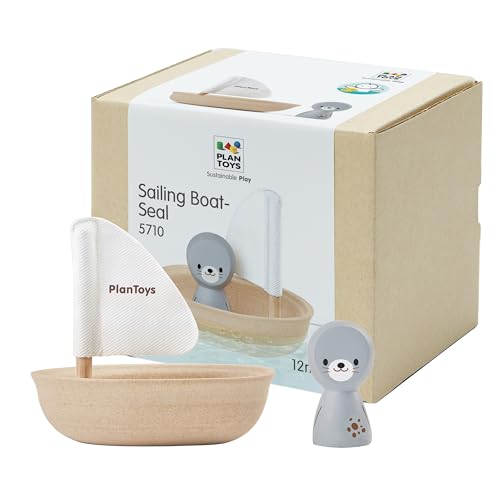
The maker's page calls it "perfect for the bath," made of PlanWood (sawdust and wood scraps) and rubberwood with formaldehyde-free glue, organic pigments and water-based dyes. It does not say whether the boat is solid and gives no drying instructions. Wood and wet bathwater do not mix well, so dry it between baths and stop using it if the finish wears through.
Do the free things first
Dry what you already own
Rinse with clean water, squeeze out what you can, and air-dry somewhere with airflow. It costs nothing and is a reasonable habit, but it is our reasoning, not a tested fix: the study's new toys were squeezed out and left on a shelf between uses and still grew a biofilm.
Squeeze before you decide
Hold a hollow toy over the sink and squeeze. If cloudy or discolored liquid comes out, retire that toy rather than keep cleaning it.
Fill the gap with the kitchen
Plastic measuring cups and scoops are open, cost little and go through the dishwasher. They do the same job as a pour-and-scoop bath toy.
Label traps
- "Non-toxic" on a toy — For toys it is not a defined regulatory term, and a toy legally sold in the US already has to clear the lead limit and the mandatory toy standard.
- "Mold free" or "no hole" — It describes a design, not a test result. A sealed toy keeps water out only while its seal holds, and you cannot look inside to check.
- "BPA-free" on a soft toy — Soft materials never needed BPA. The question that applies to them is PVC.
- "CPSIA compliant" as a selling point — Compliance is the legal baseline for toys sold in the US, so it separates nothing.
- A natural rubber toy and a latex allergy — Natural rubber is latex. If anyone in the house is latex-allergic, choose silicone, wood or plastic instead.
How we choose
We read the maker's own page where one exists and record what it says, including what it does not say. We choose the shape first, as our own reasoning because the research did not test it, and then favor makers that name their material. Where we could not read a maker page, we say so and repeat the listing's words as the brand's statements.
- Solid, open, or draining shape, with no hollow cavity behind a small hole
- A named material and a stated PVC- and phthalate-free claim, where the maker makes one (the Boon Fleet makes no PVC or phthalate statement and is here for its described shape and named material)
- Care instructions we can repeat, where the maker gives them
- Maker's page read and dated on our product panel where we have one (November 13, 2026 for the Boon Fleet). The two caaocho picks rest on Amazon listing text, because caaocho's product pages did not load for us. We left off Boon's Pipes because Boon's page lists PVC without saying which part. We have no silicone pick yet: the silicone sets we found were from unknown brands with nothing to read.
Every source we cite is checked against our criteria first — see how we check our sources.
What the research says
The CPSC this year issued 498 notices of violations for toys through June, as of the latest data available (Sept. 23, 2025).
— A U.S. PIRG Education Fund report authored by Teresa Murray found ...
Trouble in Toyland 2025: A.I. bots and toxics present hidden dangers — U.S. PIRG Education Fund (2025-11-13)
When you buy a toy or any other product online and it's shipped directly to you from another country, it generally doesn't get inspected before it gets to your mailbox.
— A U.S. PIRG Education Fund report authored by Teresa Murray found ...
Trouble in Toyland 2024: Unsafe toys that slip through the border — U.S. PIRG Education Fund (2024-11-19)
Selecting products labeled 'fragrance-free' rather than 'unscented' may help reduce exposure to endocrine-disrupting chemicals because unscented products may contain multiple scents, still bound by phthalates, that are mixed to cancel each other out.
— According to American College of Obstetricians and Gynecologists guidance co-authored by Tracey J. Woodruff, PhD, MPH, ...
Reducing Prenatal Exposure to Toxic Environmental Agents (Committee Opinion No. 832) — American College of Obstetricians and Gynecologists
Sources
- Ugly ducklings: the dark side of plastic materials in contact with potable water — npj Biofilms and Microbiomes (2018)
- The ugly ducklings: biofilms in bath toys — Eawag — Swiss Federal Institute of Aquatic Science and Technology
- CPSC Prohibits Certain Phthalates in Children's Toys and Child Care Products — U.S. Consumer Product Safety Commission (how we check this source)
- Latex allergy — American Academy of Allergy, Asthma & Immunology
- Toy safety requirements for children's products (CPSIA) — U.S. Consumer Product Safety Commission (how we check this source)
Every toys & art suppliesproduct we've reviewed— what we'd buy, what we'd skip, and where each one stands.