
Best cabinet locks for baby proofing: four types compared
The cabinet under the sink is where a toddler finds cleaners and detergent, and a lock on the door is the last layer, not the first. Medicines and chemicals belong up high or in a locked box. For the cabinets that stay low, here are four kinds of lock, what each is good and bad at, and the one maker warning that two of these locks carry.
Four kinds of cabinet lock, side by side
Each type locks a different way and fails a different way. Tap a type to see the lock we checked for it.
- Type 1Adhesive magnetic locksA latch inside the cabinet that a magnetic key releases from outside.1 pick · $60
- Type 2Peel-and-stick latchesA latch and catch stuck to the inside of the cabinet and door, released by an adult.1 pick · $9
- Type 3Screw-in spring latchesA spring latch screwed inside the cabinet and onto the frame.1 pick · $5
- Type 4Sliding locks for knob and handle pairsA bar that goes around two side-by-side knobs or through two D-shaped handles.1 pick · $11
| Type | Good at | Watch out for | Best for |
|---|---|---|---|
| Adhesive magnetic locks | Nothing visible on the outside for a toddler to pull or press, no drilling, and a red and green indicator on the lock. The maker says the key can be stored high. | Each lock holds a small magnet, and so does the key. The maker warns swallowed magnets can cause serious injury. The adhesive needs 24 hours to cure and a firm tug test, and the maker says to use the screws on oily, particleboard, old-paint or refinished surfaces. | Cabinets and drawers where you want no visible hardware and can keep the key up high. |
| Peel-and-stick latches | No magnet, and a placement template that Safety 1st's page says saves you measuring. The maker says it can be switched to an unlock mode so you are not unlocking it all day when children are not around. | Same adhesive limits as the magnetic lock: 24 hours to cure, a tug test, screws on weak surfaces. The maker says the latch can be hard to reach on a top drawer under a counter overhang of 1 inch or more. | A renter with solid, clean cabinet faces, or a house where you want a lock without a key to lose. |
| Screw-in spring latches | Inexpensive per cabinet, and fixed with screws rather than adhesive. | The maker's own guide says not to use it to guard toxic and dangerous substances or sharp objects, and calls it a deterrent only. You drill into the cabinet, which a renter may not be allowed to do. CPSC's 2001 recall of Safety 1st spring latches named no model numbers, so we cannot say whether it covers this one. | Sturdy cabinets you can drill, holding things that are fine if opened, such as pots and plastic containers. |
| Sliding locks for knob and handle pairs | No tools, no adhesive and no drilling, so nothing that fails on particleboard. A double-button release. | The maker says not to use it to guard toxic and dangerous substances. It only works on doors with two knobs or handles up to 4.5 inches apart, and it sits on the outside where a toddler can see and handle it. A different maker's strap and slide locks (Safety 1st models 48391, 48442, 12013 and 12014) were recalled in 2012 because children could disengage them; we found no recall naming this lock. | Rentals and particleboard cabinets with knobs or D-shaped handles. |
Type 1Adhesive magnetic locksOur picks · $60
Our default for low cabinets, with a small-magnet rule: key high, spares put away, babysitters told.
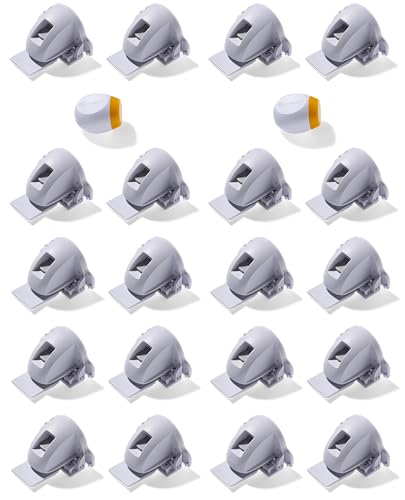
Safety 1st Adhesive Magnetic Cabinet Locks, Includes 20 Child Locks for Cabinets & Drawers, 2 Keys, White
Safety 1st Secure-to-Explore Adhesive Magnetic Locks, 20 locks and 2 keys
Our pick for low cabinets. Safety 1st's guide says to leave the lock in the unlocked position while the adhesive cures for at least 24 hours, tug firmly, then use the screws in the box if it does not hold. It says the device is meant to restrict access by young children but some children may still defeat it, and carries the small-magnet warning. Safety 1st's page says the product is JPMA certified; we could not read JPMA's own directory, so that is the maker's statement. Twenty locks is a lot: count your cabinets first.
Type 2Peel-and-stick latchesOur picks · $9
A key-free option from the same maker. Pack it for the cabinets that pass the tug test.

Safety 1st - Secure-to-Explore Adhesive Cabinet Locks Baby Proofing, Child Locks for Cabinets and Drawers (4 Locks), White
Safety 1st Secure-to-Explore Adhesive Locks, 4 pack
The Amazon listing says 4 locks, which matches the maker's 4 pack (HS395); check the model on the box. Safety 1st calls it "2x stronger than the industry standard", but no test or standard is named, so we cannot tie the claim to anything and do not repeat it as a fact. The guide covers the same 24-hour cure, tug test and screw advice as the magnetic lock, says to clean the surface with isopropyl alcohol first, and says that for best strength you should install it with the included screws. Safety 1st's page says a template means no measuring, though the guide still starts with measuring roughly 1 inch from the hinge side. The maker's own page is inconsistent about pack size, so check the box.
Type 3Screw-in spring latchesOur picks · $5
A nuisance lock for the low cabinets that hold nothing hazardous. Not for the cleaners.
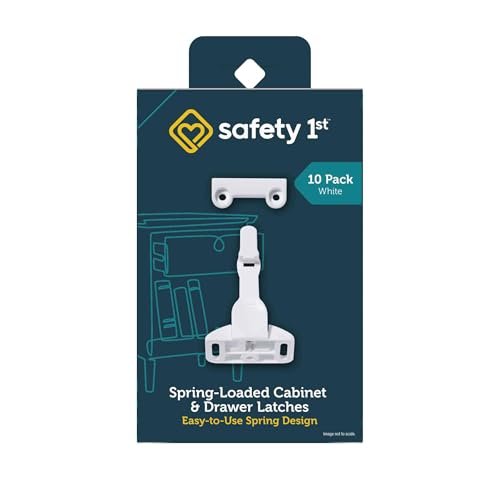
Safety 1st Spring-Loaded Cabinet & Drawer Latch, 10 Pack, White
Safety 1st Spring-Loaded Cabinet and Drawer Latch, 10 pack
The guide's first warning says not to use this product to guard toxic and dangerous substances, or sharp-edged or pointed objects; those should always be placed high up or made completely inaccessible. It asks you to check for security by tugging firmly after installing, and to stop using it once your child can defeat it. CPSC's 2001 recall covered Safety 1st cabinet and drawer spring latches sold in packs of three or four, with an exposed spring end that could break and release a small spring. The recall named no model numbers, so we cannot say whether it covers this one; its replacement latch added a plastic tab over the spring. We found no recall naming model 48392.
Type 4Sliding locks for knob and handle pairsOur picks · $11
The no-damage answer for cabinets with two handles, for cabinets that do not hold chemicals.

Toddleroo by North States - Sliding Cabinet Locks for Baby Proofing: Child Proof Cabinet Locks - 3 Pack - White
Toddleroo by North States Sliding Cabinet Locks, 3 pack
The guide for model 6174 says it fits side-by-side knobs or D-shaped handles up to 4.5 inches apart, needs no tools, and has a double-button release. Its warning says an adult installs it and that it should not guard toxic and dangerous substances or objects, and it asks you to check it regularly for wear and correct positioning. CPSC's 2022 recall of North States Toddleroo rotating cabinet latches (model 6178, a choking hazard) is a different product; we found no recall naming the sliding lock.
← Toddler home safety essentials: the whole kit
The cabinet under the kitchen sink is where cleaners, dishwasher detergent and laundry packets live, and it is at a toddler's eye level. Our kitchen hazard check walks through what to look for in that room, and the bathroom check does the same for medicines. This page is about the lock that goes on the door.
A lock is a backup, not the plan
CPSC's childproofing guidance says safety latches and locks on cabinets and drawers can help prevent children from gaining access to medicines, laundry detergent, household cleaners, matches and lighters, and knives and other sharp objects. It also says even products in child-resistant packaging should be locked away and kept out of reach, because that packaging is often not childproof. The makers of two of the four locks go further in their own instructions: the Safety 1st spring latch guide and the North States sliding lock guide each say not to use the product to guard toxic and dangerous substances, and to keep those items high up or completely inaccessible.
So the order we suggest (this is our reading, not CPSC's wording) is: medicines in a locked box up high; cleaners and detergent up high if you can; and if cleaners have to stay under the sink, a lock on that cabinet, chosen from the types whose makers do not exclude it (the adhesive and magnetic locks), with the tug test done and the key out of reach. Safety 1st's adhesive and magnetic guides still say some children may defeat the lock. A lock slows a toddler. It does not replace watching them.
How we chose
CPSC has no mandatory rule for cabinet locks that we found, and a lock that says it is "childproof" is the maker's word unless a standard or certifier backs it. A voluntary ASTM standard, F3492, covers locks installed on the interior of cabinet doors and drawers; none of the four makers' guides cites it. We therefore started from the maker's own instructions. A lock is here only if we could read its guide on the maker's own site, find a model number we could match to the Amazon listing, find it in stock through Amazon's live catalog, and find no CPSC recall naming it by model in CPSC's recall database (searched 2026-11-23 by name and model number). We did not test any lock.
That left four. We read the Safety 1st guides for the first three, and the North States guide for the fourth. We looked at a few others and left them out because we could not find the maker's instructions on the maker's own site.
Fit it, then pull on it
Whatever you buy, the instructions say the same few things:
- Adhesive locks: clean the surface with isopropyl alcohol, let it dry, install with the lock in the unlocked position, wait 24 hours, then tug firmly on the door or drawer. If it gives, use the screws in the box.
- Screw-in latches: after installing, tug firmly on the door or drawer. If the latch does not hold, adjust its height.
- All of them: an adult installs; keep small parts and spare locks away from children during and after installation; replace a lock that is cracked or broken.
If you rent
A sliding lock needs no adhesive, screws or tools, so it should not mark the cabinet, though North States' guide makes you responsible for any damage. It only fits doors with two knobs or D-shaped handles, and its maker says not to use it for toxic substances. Adhesive locks can come off cleanly or leave a mark depending on the finish; Safety 1st's guide removes the adhesive with fishing line or dental floss and a hair dryer's heat, so test on an inside corner first and ask your landlord before you drill for the screws.
Prices and availability on the cards above update from the live catalog, so what you see is current.
What the research says
Child passenger safety technicians across the country report identifying one to two unregulated or counterfeit seats each month during routine safety checks.
— In 2026-02-07 testimony, Ben Hoffman, MD, CPST-I cited ...
Public testimony on counterfeit car seats, Oregon House Committee on Commerce and Consumer Protection — Oregon Legislative Information System (2026-02-07)
At just 30 miles per hour-a speed consistent with many urban and residential crashes-the counterfeit seat completely disintegrated
— In 2026-02-07 testimony, Ben Hoffman, MD, CPST-I cited ...
Public testimony on counterfeit car seats, Oregon House Committee on Commerce and Consumer Protection — Oregon Legislative Information System (2026-02-07)
The 2022 AAP policy statement (Moon et al.) states that sitting devices - car seats, strollers, swings, infant carriers, and infant slings - are not recommended for routine sleep at home or in the hospital, particularly for infants under 4 months of age.
— According to Pediatrics 150(1), American Academy of Pediatrics guidance co-authored by Rachel Y. Moon, MD, ...
Sleep-Related Infant Deaths: Updated 2022 Recommendations for Reducing Infant Deaths in the Sleep Environment — Pediatrics 150(1), American Academy of Pediatrics
Sources
- Childproofing Your Home (CPSC; page read 2026-11-23) — U.S. Consumer Product Safety Commission (how we check this source)
- Safety 1st Secure-to-Explore Adhesive Magnetic Locks, product page and user guide (read 2026-11-23) — Safety 1st
- Safety 1st Secure-to-Explore Adhesive Locks 4 pack (HS395), product page and user guide (read 2026-11-23) — Safety 1st
- Safety 1st Spring-Loaded Cabinet and Drawer Latch 10 pack, product page and user guide (read 2026-11-23) — Safety 1st
- North States Toddleroo Sliding Cabinet Locks 6174, product page and installation guide (read 2026-11-23) — North States
- ASTM F3492: child safety locks and latches for cabinet doors and drawers (ASTM news, February 25, 2021; page read 2026-11-23) — ASTM International
- CPSC recall 12136: Safety 1st cabinet locks (Push 'N Snap), March 22, 2012 — U.S. Consumer Product Safety Commission (how we check this source)
- CPSC recall 12180: Safety 1st toilet and cabinet slide locks, May 17, 2012 — U.S. Consumer Product Safety Commission (how we check this source)
- CPSC recall 01211: Safety 1st cabinet and drawer spring latches, July 31, 2001 — U.S. Consumer Product Safety Commission (how we check this source)
- CPSC recall 22232: North States Toddleroo rotating cabinet latches, September 29, 2022 — U.S. Consumer Product Safety Commission (how we check this source)
Every source we cite is checked against our criteria first — see how we check our sources.
Related product categories
Related concerns
Common questions
Cheat sheets for this
Part of the Gear & Everyday Items hub— the rest of our coverage in this category.
Every baby gear & diapers product we've reviewed— what we'd buy, what we'd skip, and where each one stands.