
Baby carrier round-up: the hip-healthy way to babywear
The real safety question with a baby carrier is not what the fabric is made of — it is whether it holds your baby's hips in a healthy position. The International Hip Dysplasia Institute has clear, evidence-based guidance on this, and it is the standard this round-up screens against.
A baby carrier's fabric is not the safety question here — its shape is. The International Hip Dysplasia Institute (IHDI) has spent years establishing what a hip-healthy carry looks like: knees higher than the bottom, thighs supported to the knee, an "M" shape rather than legs hanging straight down. Start with the limit, though, because IHDI states it plainly: "no baby carrier can cause or prevent hip dysplasia." This is about the better-supported position while a baby is worn, not a hazard you are avoiding. IHDI also says it "is not a certifying body and has never performed safety testing of any products" — it names carrier lines made by companies in its paid Industry Partner program, which is not the same as having assessed them. So "IHDI hip-healthy" on a listing is the manufacturer's claim measured against IHDI's published criteria, and we say per product what we could and could not confirm.
Brands in this guide
- Momcozy1 pick
- MABĒ1 pick
- Infantino1 pick
The safety question here is shape, not fabric
Most of this site is about what a product is made of. This page is not — the real, evidence-based safety concern with baby carriers is positioning, specifically whether the carrier supports a baby's hips the way orthopedic guidance says it should.
The International Hip Dysplasia Institute (IHDI) is the authority most orthopedic guidance on this points back to. Its research describes a "cone of stability" — roughly 40° to 55° of hip abduction and 90° to 110° of flexion — that keeps the femoral head properly centered in the socket. In plain terms: knees spread and bent, slightly higher than the bottom, thighs supported along their length. IHDI calls this the M-position (also the spread-squat or jockey position).
What actually goes wrong
The shape IHDI's guidance steers away from is the opposite one: legs dangling straight down, weight resting on the crotch instead of distributed across the thighs. That is what a narrow-base carrier does — a seat too small to reach knee to knee, common in inexpensive slings and some doll-style front carriers not built to a real hip-healthy spec.
Worth being exact about how strong that claim is, because a lot of babywearing marketing is not. IHDI's own consensus statements say "no baby carrier can cause or prevent hip dysplasia" and that "products allowing unrestricted motion do not cause hip dysplasia." The condition it does name a cause for is tight swaddling that restricts hip motion, which is a different thing from a carrier. So the M-position is the better-supported position to aim for, not an escape from a hazard — and a carrier that gets it wrong is a comfort and support question, not a diagnosis.
A wide, adjustable seat is not a cosmetic feature. It is the mechanism that puts the hip joint where the evidence says it should be.
"IHDI hip-healthy" is a real claim — with a real limit
Worth being precise about, because it gets flattened into a logo in a lot of marketing: IHDI is an educational nonprofit, not a product-testing lab. Its own words are the clearest statement of the limit — "The IHDI is not a certifying body and has never performed safety testing of any products, but does acknowledge companies whose mission aligns with that of the IHDI." It publishes the hip-healthy design criteria openly, so any manufacturer can build to them without asking anyone.
The list of named products is a different thing, and the heading above it says so: "Industry Partners." IHDI's own description is "our partner companies, which support IHDI's education and advocacy initiatives, and the products they make," and its Corporate Partnership page offers companies the chance to "gain recognition as an advocate for hip-healthy products and practices" at partnership levels running from $25,000 to $500,000 over five years — while stating, in the same breath, that "we do not certify or endorse individual products."
So a brand appearing on that list has funded IHDI's education work. It has not passed anything. That is the same thing we say elsewhere on this site about EWG Verified: a company chose to participate, which is a useful signal about the company, and tells you nothing about the ones that did not.
So when a listing says "IHDI hip-healthy," the honest reading is: the manufacturer states its design was built to IHDI's published M-position criteria. That is a meaningful, checkable claim — you can look at the seat and see whether it actually supports knee to knee — but it is not the same thing as an independent lab re-certifying that exact product run. We say below, per carrier, what each listing actually claims.
The picks
Momcozy PureHug is the top pick here because its retail listing is the most explicit of the three about IHDI hip-healthy design — stated directly in the product title, not buried — paired with a genuinely wide 7–45 lb range and a seated M-position seat.
Mabē Monarch takes a deep-seat M-position approach. We have not independently confirmed a safety-standard claim for it, so we pick it on seat shape alone. It does not carry the same explicit "IHDI" language on its listing, but the design criteria it describes — seat supporting thigh to knee, knees higher than bottom — match IHDI's published guidance.
Infantino Flip Luxe 4-in-1 is the budget, most flexible pick — four carry positions and a 7–35 lb range. A convertible carrier changes shape more as you move between positions and grow into a larger size than a fixed-position carrier does, so it is worth rechecking the M-position each time you adjust it, not assuming the fit that worked at 3 months still holds at 9.
Two more things worth knowing
Inward-facing is the better-supported default, especially in the first six months, when hip development is happening fastest. Outward-facing carrying is not established as harmful, but it does not have the same documented benefit — worth a look if your carrier offers a choice.
Positional asphyxia is a separate risk, mostly relevant for slings and wraps rather than structured carriers: a baby's chin pressed to chest can compress the airway. The rule of thumb — visible face, chin off chest, clear airway — is unrelated to hip positioning but belongs in the same conversation.
For everything else in this category — backpacks, footwear, and the trust problem that runs through gear generally — see the gear hub.
Our top pick

Momcozy PureHug Baby Carrier - Ergonomic, Cozy and Lightweight for 7-45 lbs | Easy to Put On for Baby 3-24M, Hip-Healthy, 3D EVA Lumbar Support, X-Straps for Even Weight Distribution, 100% Cotton, Black
Momcozy PureHug — a seated M-position seat and the widest range here (7–45 lbs), both of which you can see for yourself. Momcozy is a paid Industry Partner of the International Hip Dysplasia Institute and the PureHug is named on its partner list, which means Momcozy funds the institute's education work — not that the institute tested this carrier. We picked it on the seat.
Also worth considering

Mabē Monarch Ergonomic Baby Carrier – Premium Cotton Soft Structured Newborn to Toddler Carrier with Hip-Healthy Design, 3 Carry Positions (9-46 lbs), Lightweight & Breathable, (Ivory)
Mabē Monarch — a deep-seat M-position carrier with premium cotton construction. We have not verified a safety-standard claim for it, so we pick it on the seat shape alone.
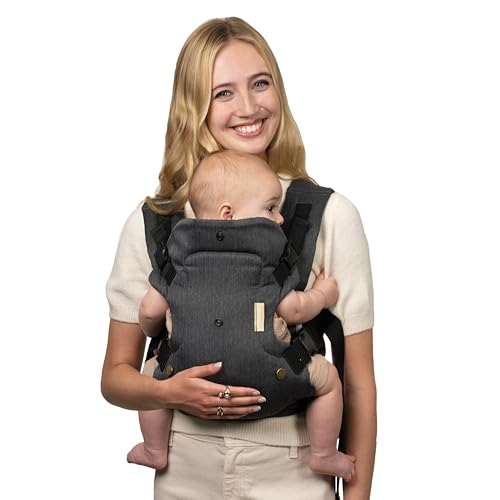
Infantino Flip Luxe 4-in-1 Baby Carrier Ergonomic 7-35 lbs, Onyx | Keeps baby close from 7-35 lbs. Premium herringbone fabric. Four carry modes. M-position lumbar support
Infantino Flip Luxe 4-in-1 — the budget, four-position pick (7–35 lbs); check the seat width against your baby's thighs at each stage, since a convertible carrier changes shape more than a fixed one.
What actually matters for hip health
- Legs dangling straight down — The shape to prefer is the opposite one: thighs supported to the knee, knees above the bottom. IHDI is explicit that no carrier has been shown to cause or prevent hip dysplasia, so this is about the better-supported position while a baby is worn, not a hazard you are dodging.
- A seat narrower than the baby's thighs — A narrow-base carrier — including many inexpensive slings and some baby-doll-style carriers — puts the baby's weight on the crotch rather than distributing it across the thighs. Look for a seat that visibly extends knee to knee.
- Assuming a logo means individual product testing — IHDI is an educational nonprofit and says outright that it "is not a certifying body and has never performed safety testing of any products." It lists partner companies and their products, but a brand printing "hip-healthy" on packaging is describing its own design intent, not an IHDI test of that exact product.
- Outward-facing use as the default — IHDI's guidance favors inward-facing carrying, especially in the first six months when hip development is fastest. Outward-facing is not established as harmful, but it is not the position with the documented benefit either.
- Ignoring fit changes as your baby grows — A convertible carrier's seat width and knee position change as you adjust it. Recheck the M-position each time you move to a new size or carry position, not just once at unboxing.
How we choose
We screen every carrier here against IHDI's published hip-healthy criteria — a seat that supports the thigh to the knee, hips bent and spread into the M-position, and no leg dangling — and we note whether the product listing itself claims IHDI acknowledgment versus a general "ergonomic" description. We do not treat a hip-healthy claim as settled just because a listing uses the phrase; we say what is verifiable and what is the brand's own characterization.
- Seat visibly supports the thigh to the knee in a seated M-position, not a narrow base
- Manufacturer states which age/weight range the hip-healthy fit applies to
- Where the maker states conformity to ASTM F2236, the U.S. soft-carrier standard, we say so as a statement we have not independently confirmed
- We say whether a hip-healthy claim is the brand's own or traceable to IHDI's partner list, and treat neither as a test result
- No active recall on the pick
Every source we cite is checked against our criteria first — see how we check our sources.
What the research says
Child passenger safety technicians across the country report identifying one to two unregulated or counterfeit seats each month during routine safety checks.
— In 2026-02-07 testimony, Ben Hoffman, MD, CPST-I cited ...
Public testimony on counterfeit car seats, Oregon House Committee on Commerce and Consumer Protection — Oregon Legislative Information System (2026-02-07)
At just 30 miles per hour-a speed consistent with many urban and residential crashes-the counterfeit seat completely disintegrated
— In 2026-02-07 testimony, Ben Hoffman, MD, CPST-I cited ...
Public testimony on counterfeit car seats, Oregon House Committee on Commerce and Consumer Protection — Oregon Legislative Information System (2026-02-07)
The 2022 AAP policy statement (Moon et al.) states that sitting devices - car seats, strollers, swings, infant carriers, and infant slings - are not recommended for routine sleep at home or in the hospital, particularly for infants under 4 months of age.
— According to Pediatrics 150(1), American Academy of Pediatrics guidance co-authored by Rachel Y. Moon, MD, ...
Sleep-Related Infant Deaths: Updated 2022 Recommendations for Reducing Infant Deaths in the Sleep Environment — Pediatrics 150(1), American Academy of Pediatrics
Sources
- Hip-healthy babywearing — the M-position and the criteria IHDI publishes — International Hip Dysplasia Institute
- Baby carriers and related products — the "Industry Partners" list, "the IHDI is not a certifying body and has never performed safety testing of any products," and the consensus statement that "no baby carrier can cause or prevent hip dysplasia" — International Hip Dysplasia Institute
- Corporate Partnership — what a listed company pays ($25,000 to $500,000 over five years) and what IHDI says it is not doing in return: "we do not certify or endorse individual products" — International Hip Dysplasia Institute
Side by side
| Attribute | MomcozyPureHug Baby Carrier | MABĒMonarch Ergonomic Baby Carrier | InfantinoFlip Luxe 4-in-1 Baby Carrier Ergonomic 7-35 lbs |
|---|---|---|---|
| Why it's here | Our top pick | — | — |
| Price | $47.99 | $129 | $39.99 |
| Availability | In stock | In stock | In stock |
Common questions
Cheat sheets for this
Part of the Gear & Everyday Items hub— the rest of our coverage in this category.
Every baby gear & diapersproduct we've reviewed— what we'd buy, what we'd skip, and where each one stands.