
Safer BPA-free dishware: why stainless steel skips the question entirely
Plastic and melamine kids' dishware carry the BPA question by default, and heat is the part that makes it worse, not better. Stainless steel skips the question — there is no resin lining to test, no migration curve to worry about.
Most "BPA-free dishware" claims are about a plastic that swapped one resin for another, and the replacement is not always better studied. Food-grade 18/8 stainless steel does not have that problem, because it has no resin at all — nothing to leach, no heat threshold to stay under. That is the whole case for this page.
Brands in this guide
- Ahimsa1 pick
- Tioncy1 pick
The question stainless steel skips entirely
"BPA-free" is printed on a lot of plastic kids' dishware, and it is usually true as far as it goes. The trouble is what it does not say. Most BPA-free plastic dinnerware is still a resin — commonly a substitute bisphenol compound, often BPS — bound into a plastic that can migrate into food. The substitute is newer than BPA and considerably less studied. Removing one named chemical is not the same as removing the category of concern.
Melamine dinnerware carries a related but distinct issue. It is not the same resin as polycarbonate — melamine tableware is made from melamine-formaldehyde plastic, and a small amount of unreacted melamine stays in the material after manufacturing. Heat pulls more of it out. The FDA's own guidance is direct: don't heat food on melamine-based dinnerware in a microwave, because migration increases at higher temperatures. A peer-reviewed 2014 lab study on melamine-formaldehyde tableware found that overall migration rose with each repeated microwave heating cycle, and acidic, very hot food (a bowl of soup, tomato sauce) is a worse pairing than something cool and neutral.
Food-grade stainless steel — 18/8, also labeled 304 — does not have a resin lining at all. There is nothing bound into the metal that could leach out under heat or acid, so there is no migration curve to stay under and no BPA-adjacent question to answer. That is the entire case for this page: not that steel is "safer BPA-free," but that the BPA/melamine-migration question does not apply to it in the first place.
What "BPA-free" doesn't tell you on plastic dishware
Melamine, heated. The single biggest gap between what a listing implies and what is actually true. Melamine dishware is often sold as a safe, durable alternative to soft plastic, and for cool food at the table it generally is. Put it in a microwave, or run it through a dishwasher's heated dry cycle for years, and that changes.
"BPA-free" plastic that is still plastic. A bisphenol substitute is a narrower fix than parents often assume it is. It removes BPA specifically; it does not remove the underlying question of "what's in this resin, and what happens to it under heat."
Acidic or very hot food on any resin surface. Migration tracks with both heat and acidity across melamine and BPA-substitute plastics alike. The pairing that causes the most concern — hot, acidic food, repeated exposure — is exactly the pairing a toddler's dinner plate sees constantly.
The dishwasher, not just the microwave. Heated dry cycles apply the same kind of stress as a microwave, more slowly and more often. A plate that looks fine after one wash is not the same test as a plate that has been through a thousand.
Our picks
Ahimsa's 5-piece stainless steel dinnerware set is the top pick because it is the most verifiable option we found in this category, not just the most marketed one. Ahimsa's dishes are MADE SAFE certified — independently tested free of lead, BPA, PVC, phthalates and melamine — and built from 304 (18/8) food-grade stainless steel, the same grade used in surgical instruments. The company also states its products are tested in a CPSC-certified US lab. That is a real certification behind a real claim, which is the bar this page is trying to hold brands to.
Tioncy's 15-piece set is here as the budget option, and we want to be direct about why it is ranked below the top pick rather than beside it. It is a 304 stainless steel set that covers plates, bowls, cups and utensils for less money per piece — but we could not find independent certification or third-party testing behind Tioncy's safety claims the way we could for Ahimsa. That does not mean the steel itself is suspect; 304-grade stainless is a well-defined standard regardless of who sells it. It means the claim rests on the manufacturer's word rather than a lab result, which is a meaningfully different level of confidence than our top pick. If independent verification matters more to you than price, that is the trade-off.
Where this page stops
This page is about the BPA/melamine-migration question specifically — resin dinnerware, and why switching to metal sidesteps it. It is not about lead, which is a separate risk that applies to a different category of dishware (ceramic glazes, mainly) and is covered in full on our lead-free dishes guide. Food-grade stainless steel happens to be a strong answer to both questions for the same underlying reason — no resin, no glaze, nothing to leach — but the two pages exist because the two questions come up separately, and we did not want to repeat one page's research inside the other.
Prices and availability on the cards above update from the live catalog, so what you see is current.
Our top pick

Ahimsa Stainless Steel Kids Dinnerware Set, 5-piece — MADE SAFE certified, confirmed on 2026-09-10 in the certifier's own directory rather than from the brand's copy, which is what makes it the most verifiable pick here. 304 (18/8) food-grade steel. MADE SAFE covers materials, not lead testing, so we have dropped the 'independently tested lead-free' line that used to sit here: we could not find the test behind it.
Also worth considering
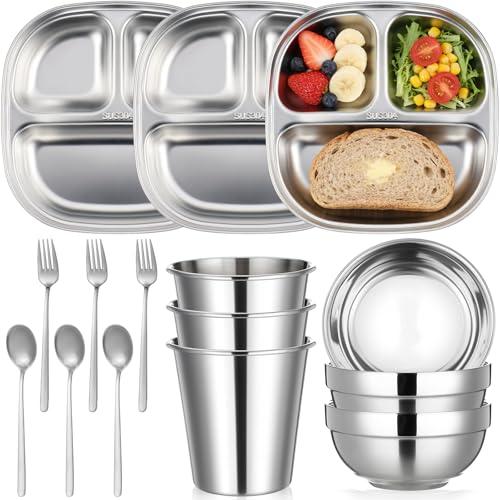
Tioncy 15 Pcs Stainless Steel Divided Plates Bowls Cups Set for Kids | Includes Spoons Forks for Toddlers, Safe Dinnerware for Balanced Meals, Metal Lunch Dishware Suitable for Baby Feeding
Tioncy 15-piece stainless steel set — budget option that covers plates, bowls, cups and utensils in one buy. We could not find independent certification behind it; see the caveat below before treating it as equivalent to the top pick.
What 'BPA-free' on plastic dinnerware doesn't tell you
- Melamine dinnerware, heated — Melamine-formaldehyde plastic dinnerware retains a small amount of unreacted melamine, and heat increases how much migrates into food. The FDA's own guidance is not to heat food on melamine dishware in a microwave at all.
- "BPA-free" plastic that is still plastic — A plastic swapping BPA for a substitute resin (often BPS or a similar bisphenol analog) has removed one named chemical, not the category of chemical. The substitutes are newer and less studied than BPA itself.
- Acidic or very hot food on any resin surface — Migration from melamine and similar plastics increases with both heat and acidity — hot tomato sauce is a worse pairing than room-temperature rice, regardless of which resin is used.
- The dishwasher's heated dry cycle — Repeated exposure to dishwasher heat is functionally the same stress as microwaving, applied more slowly. A surface that is fine for one wash is not necessarily fine for the thousandth.
How we choose
We start from the material, not the label. Food-grade 18/8 (304) stainless steel has no resin lining and nothing to migrate, so there is no BPA question to answer in the first place. We verify what certifications a brand actually holds rather than repeating a listing's own language, and we say plainly when we could not verify a claim.
- 304 (18/8) food-grade stainless steel construction
- No plastic or resin food-contact surface
- Independently verifiable safety certification where the brand claims one
- Durable enough for daily toddler use
- No active recall on the pick
Every source we cite is checked against our criteria first — see how we check our sources.
What the research says
A flexible 9-day road map for safely introducing top allergens
— Malina Malkani, MS, RDN, CDN told BenBella Books (distributed by Simon & Schuster), ISBN 9781637745359 that ...
Safe and Simple Food Allergy Prevention: A Baby-Led Feeding Guide to Starting Solids and Introducing Top Allergens — BenBella Books (distributed by Simon & Schuster), ISBN 9781637745359 (2024-11-12)
the tactile investigation of food is part of development - it's necessary, productive and speeds up the learning curve.
— Jill Castle, MS, RDN told The Washington Post that ...
Let picky eaters play with their food, and don't force 'thank you' tastes — The Washington Post (2018-11-01)
When a child's appetite is ignored, he or she may lose the ability to regulate his or her own internal hunger and fullness cues
— Jill Castle, MS, RDN told CNN that ...
Of the four parental 'feeding styles,' only one is good for kids' health, experts say — CNN (2018-10-04)
Sources
- Melamine Tableware: Questions and Answers — U.S. Food and Drug Administration (how we check this source)
- Effects of microwave heating on the migration of substances from melamine formaldehyde tableware — Food Additives & Contaminants: Part A, via PubMed
Side by side
| Attribute | AhimsaStainless Steel Kids Dinnerware Set | Tioncy15 Pcs Stainless Steel Divided Plates Bowls C… |
|---|---|---|
| Why it's here | Our top pick | — |
| Price | $54.99 | $40.99 |
| Availability | In stock | In stock |
Common questions
The cheat sheet for this
Part of the Food Storage hub— the rest of our coverage in this category.
Every food storage & cookwareproduct we've reviewed— what we'd buy, what we'd skip, and where each one stands.