
Green cleaning products: the environmental side of the same shelf
"Green" and "non-toxic" get used interchangeably and they are not the same question. One is about what the product does to you; this one is about what it does to everything else — the packaging, the water it goes into, and the fact that most cleaning spray is already water you paid to ship.
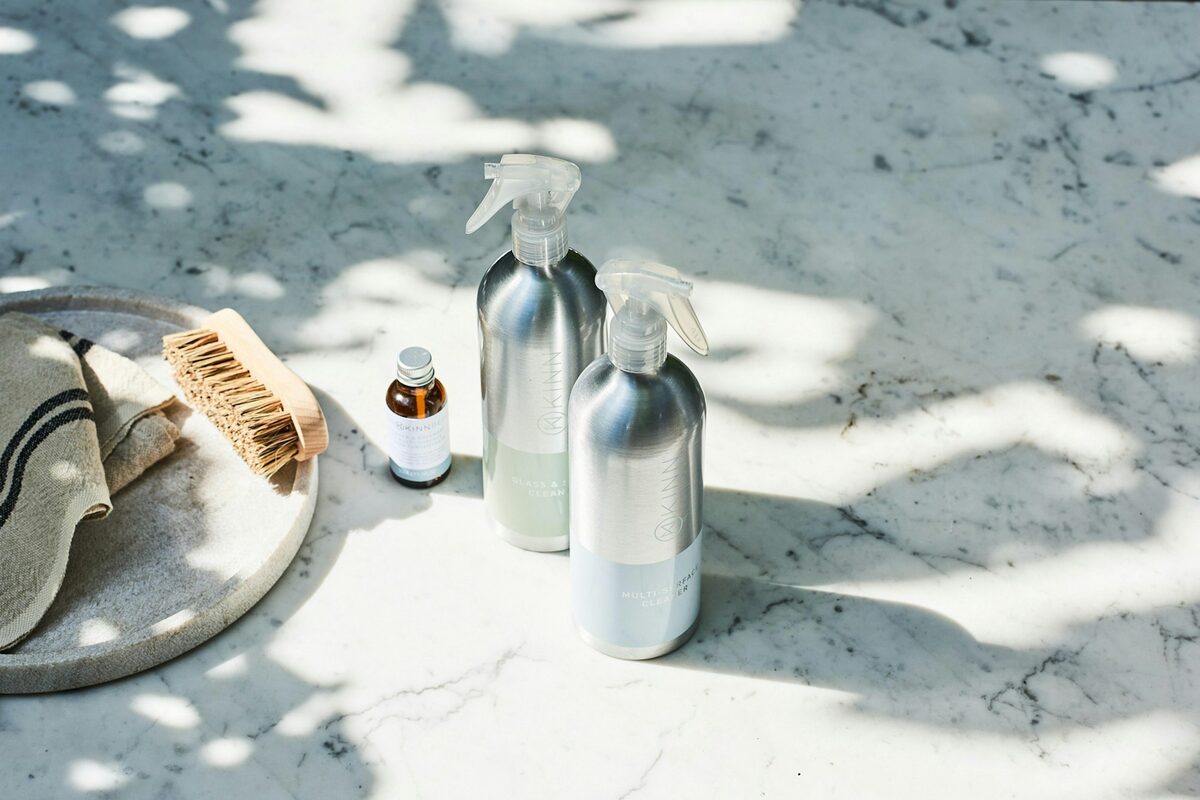
"Green" and "non-toxic" get used as synonyms on packaging and they are not the same thing. Non-toxic asks what a product does to the people in the room — which is why the companion page leads with fragrance, the thing you actually inhale in an enclosed space.
Brands in this guide
 BLUELAND1 pick · safety review
- Puracy1 pick
 Branch Basics1 pick · safety review
 Dr. Bronner's1 pick · safety review
- ATTITUDE1 pick
Two different questions wearing the same word
"Green" and "non-toxic" are used as synonyms on packaging, and they are not the same thing.
Non-toxic asks what the product does to the people in the room — which is why our non-toxic cleaning page leads with fragrance, the thing you actually inhale in an enclosed space.
Green asks what it does to everything downstream: the plastic it came in, what goes into the water, and the diesel spent moving it. Those answers can diverge sharply. A beautifully disclosed, fragrance-free spray in a single-use bottle is a good non-toxic product and a mediocre green one.
This page weights the second question. If you want the first, the other page is the one you want.
The unglamorous fact that decides most of this
A ready-to-use cleaning spray is 85 to 95% water.
You bought water. It was shipped to you in a plastic bottle, from a warehouse, in a truck. Then you threw the bottle away and did it again.
Almost every genuinely green improvement in this category traces back to that one fact: concentrates, tablets, refill systems and multi-use soaps all exist to stop you shipping water. Once you see it, the ranking on this page is fairly obvious.
What we recommend
Blueland is the top pick because it answers the packaging question most completely: tablets plus one bottle you keep and refill. It is also the format most likely to still be in use a year later, which matters more than a marginal ingredient difference.
Puracy and Branch Basics are concentrates — you add the water at home. Branch Basics goes further by covering all-purpose, glass and bathroom from one concentrate, which reduces product count rather than swapping products one-for-one.
Dr. Bronner's castile soap is the least glamorous entry and possibly the most effective. One bottle does many jobs, it is widely available, and there is no proprietary refill system to be locked into if a company changes its line or goes under.
ATTITUDE is the pick if you want a ready-to-use spray rather than a system — EWG Verified, fully disclosed, and honest about being a bottle of mostly water.
On certifications
EPA Safer Choice and Green Seal certify against published, documented standards, and both are in our Sources registry with their scope spelled out.
EWG Verified is an ingredient-hazard screen. Useful — and answering the health question, not the environmental one. Worth knowing which you are looking at.
Everything else — "natural," "eco," "green," "plant-based," "biodegradable" with no standard named — is unregulated in this category and can appear with no third-party review at all.
The two changes that beat switching brands
Own fewer products. Most routine cleaning is covered by a general-purpose cleaner, a dish soap (what the common ones list on their labels), a scouring agent, and one disinfectant used properly. A cupboard of single-purpose sprays is an impact problem before it is a chemical one.
Do not replace what you already have. Buying a complete new green set while usable product goes in the bin is worse than finishing what is under the sink. Switch as things run out.
Neither costs anything, and both outperform choosing between two well-certified bottles.
One safety note that belongs on every page in this vertical: never mix bleach with ammonia, and never mix bleach with acids — vinegar included. Both combinations produce dangerous gases, and the usual route is not a deliberate mixture but using one product on a surface that still has another on it.
And one item on this shelf that is not a bottle at all: professional carpet cleaning. Low-moisture carbonated methods use less water and dry faster than standard hot water extraction — a genuine mechanical difference rather than marketing language. It does not make any cleaning solution chemical-free, and no mainstream carpet-cleaning process reasonably claims to be. Our carpet-cleaning review explains both halves, and what to ask any company you are considering.
Our top pick

Blueland — tablets plus one refillable bottle you keep. The clearest packaging answer in the category, and the format most likely to still be in use in a year.
Also worth considering

Puracy concentrate — you dilute it, which means you stop paying to ship water and one small bottle replaces several large ones.
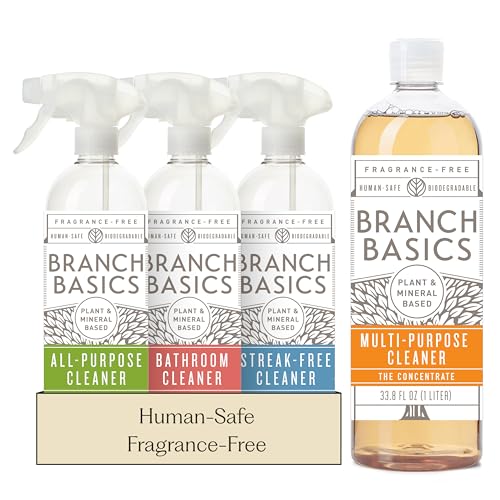
Branch Basics — one concentrate across all-purpose, glass and bathroom, which cuts product count rather than swapping it.

Ingredient panel checked · source
Dr. Bronner's castile soap — the least glamorous and possibly most effective entry: one bottle doing many jobs, no proprietary refill system to stay locked into.

ATTITUDE all-purpose — EWG Verified and fully disclosed; the pick if you want a ready-to-use spray rather than a system.
Is that brand actually green?
Four brands come up by name more than any others, and the question is always some version of "is this one real." One answer settles it: is there a certification against a published standard behind the claim, and can you look it up yourself. Each answer below links the register we searched and the date we searched it. If what you actually want to know is what a product does to the people in the room, that is the non-toxic page, not this one.
- Is Mrs. Meyer's actually green?Brand's word only
- Not in the sense this page means. Mrs. Meyer's publishes a complete ingredient list on its own product pages, which is more than many competitors do — but we searched EPA's own Safer Choice certified-product data (4,985 records) for "Meyer," "Clean Day" and "SC Johnson" and found none of them, and Green Seal's own directory lists eight SC Johnson certifications — Estesol, Refresh, Solopol and Stoko, every one of them a professional hand- or body-wash, and not one of them branded Mrs. Meyer's. The flagship spray is also ready-to-use, which is to say mostly water in a bottle you throw away, though the brand does sell a separate concentrate. The garden-scented positioning is doing the work here, not a standard. Source (checked )
- Is Method actually green?Brand's word only
- Same answer, same reason, and Method is an SC Johnson brand like Mrs. Meyer's. It publishes its full ingredient list on its own product page — we read the French Lavender all-purpose panel there, down to "Fragrance (Parfum: Linalool)" — and it sells a concentrated refill, so it is doing two of the things this page rewards. It is not in EPA's Safer Choice data, and it is not among the eight SC Johnson products in Green Seal's directory. Absence of a certification is not evidence of a bad product; plenty of good ones never apply. It does mean the green claim rests on the company's own word rather than on a register. Source (checked )
- Is Seventh Generation certified, or just marketed that way?Certified to a standard
- Certified, and it is the clearest yes of the four. Seventh Generation appears in EPA's own Safer Choice data 170 times, a partner since 2009 and currently in good standing, and the certified list includes the products you would actually buy — All Purpose Cleaner Free & Clear, the Lemon Chamomile and Yuzu Basil sprays, the disinfecting hydrogen peroxide cleaner, and a Multi-Surface Cleaner Concentrate. Not appearing in Green Seal's directory is not a mark against it: they are different programs, and clearing one has never required clearing the other. Source (checked )
- Simple Green says Green Seal certified — is that the bottle I'd buy?Certified to a standard
- The certification is real but it is not the bottle, and the distinction is worth knowing. Green Seal's own directory lists five Sunshine Makers products, every one of them from the professional "Simple Green Clean Building" line — the all-purpose, bathroom, carpet and glass concentrates sold to facilities, not the household bottle on a supermarket shelf. The household bottle clears the bar a different way: "Simple Green All-Purpose Cleaner" is in EPA's Safer Choice data in its own right, Sunshine Makers a partner since 2017 and in good standing. So the answer is yes — via a different register than the one the marketing points at. Source (checked )
Green claims that do not survive contact
- "Natural," "eco," "green," "plant-based" on the front — None is a regulated term in this category. They can appear on a product with no third-party review of any kind, and frequently do.
- "Biodegradable" with no standard named — Almost everything biodegrades eventually. Without a named standard and timeframe, it is not a claim you can check.
- A recyclable bottle you will throw away anyway — Recyclability is not recycling. A refill system that keeps one bottle in service beats a recyclable bottle replaced monthly.
- Buying a whole new set to be greener — Replacing usable products is worse, not better. The greenest bottle is usually the one already under your sink.
- Shipping water — A ready-to-use spray is 85 to 95% water. You paid to move it, and it arrived in plastic.
How we choose
On this page we weight environmental impact rather than personal exposure — packaging and refillability, concentration, and third-party certification against a published standard. Where a product is strong on health but ordinary on impact, it belongs on our non-toxic page instead, and we say so rather than listing it twice.
- Refillable, concentrated, or otherwise not mostly water
- Third-party certified against a published standard, where such certification exists
- Full ingredient disclosure, not just actives
- Reduces product count rather than adding to it
- No proprietary lock-in that fails when the company does
Every source we cite is checked against our criteria first — see how we check our sources.
What the research says
Fragranced products-including air fresheners, dryer sheets, and perfume-and sunscreens had the largest number of target chemicals and some of the highest concentrations.
— Robin Dodson, ScD of Silent Spring Institute explains that ...
Consumer Products Contain Potentially Harmful Chemicals Not Listed on Labels — Silent Spring Institute (2012-03-08) (how we check this source)
Farmer co-led the HOMEChem experiment, in which roughly 60 scientists from 13 universities measured indoor chemistry during typical household activities in a test house. Cooking produced the largest concentrations of potentially toxic compounds, including benzene, formaldehyde, acrolein and isocyanic acid. Farmer's team reported that most emitted compounds occur in low quantities and can be cleared through ventilation.
— Delphine Farmer, PhD of Colorado State University College of Natural Sciences explains that ...
Indoor air quality experiments show exposure risks while cooking, cleaning — Colorado State University College of Natural Sciences (2022-09-21)
This paper is a key initial step towards providing actionable and practical information on how to protect yourself and clean your home.
— Delphine Farmer, PhD of Colorado State University College of Natural Sciences explains that ...
Wildfire smoke may linger in homes long after initial blaze — Colorado State University College of Natural Sciences (2023-10-13)
Sources
- Safer Choice standard and certified product list — U.S. Environmental Protection Agency (how we check this source)
- Green Seal certification standards — Green Seal (how we check this source)
- Cleaning Products Fact Sheet: Default parameters for estimating consumer exposure (2018 update) — National Institute for Public Health and the Environment (RIVM)
Side by side
| Attribute | BLUELANDMulti-surface Spray Cleaner | PuracyAll Purpose Cleaner Concentrate | Branch BasicsSurface Cleaning Kit: 33.8 oz Concentrate | Dr. Bronner'sBaby Unscented Pure-Castile Liquid Soap | ATTITUDEAll Purpose Cleaner Spray |
|---|---|---|---|---|---|
| Why it's here | Our top pick | — | — | — | — |
| Price | $21.99 | $19.99 | $67 | $17.17 | $6.75 |
| Availability | In stock | In stock | In stock | In stock | In stock |
Common questions
Cheat sheets for this
Part of the Cleaning Products hub— the rest of our coverage in this category.
Every cleaning & laundryproduct we've reviewed— what we'd buy, what we'd skip, and where each one stands.