
The organic bedding cheat sheet
One winner for each way people buy organic bedding.
The at-a-glance version for sheets, duvet covers, comforters and blankets: what GOTS and OEKO-TEX each promise, what "made with organic cotton" does and does not mean, and the organic bedding we could match to a maker's page and a certifier's own register, sorted by how people actually buy.
How we scoreHow we earnChecked October 23, 2026
Our winner for each way people buy
How we scoreHow we earnChecked October 23, 2026
Best organic percale

Coyuchi
Organic Crinkled Percale Cooling Sheet SetCoyuchi's crinkled percale set, 100% GOTS-certified organic cotton per the maker, with the company's GOTS certificate confirmed in the register. Crinkled by design. No OEKO-TEX claim.
Meets our published criteria, as of Oct 23, 2026
$198ViewBest organic sateen

Boll & Branch
Signature Hemmed Sheet SetBoll & Branch's sateen set: GOTS-17617 and OEKO-TEX 18.HUS.40240 both confirmed at company level. Check the current price.
Meets our published criteria, as of Oct 23, 2026
$279ViewBest budget GOTS

Whisper Organics
100% Organic Cotton Bed Sheets with Deep Pocket 4 Pc.…Whisper Organics' 300 thread count sateen set, with a GOTS certificate confirmed in the register (GOTS-22164). Fairtrade, claimed on the page, was not checked.
Meets our published criteria, as of Oct 23, 2026
$89.99ViewBest organic duvet cover

Coyuchi
Crinkled Percale Duvet CoverCoyuchi's crinkled percale duvet cover in GOTS-certified organic cotton. A cover only; the insert is separate.
Meets our published criteria, as of Oct 23, 2026
$178ViewThe comforter we could verify (organic cotton fill)
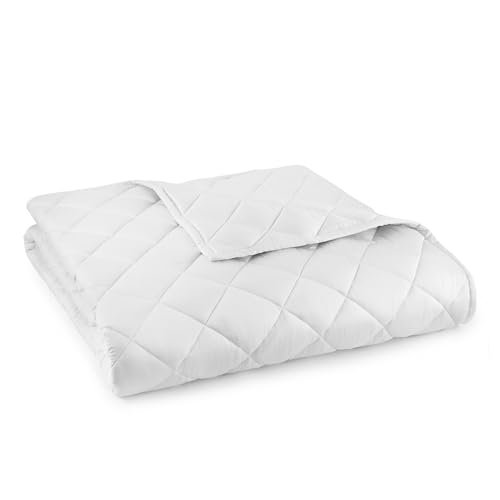
Whisper Organics
100% Organic Cotton ComforterWhisper Organics' all-cotton comforter: organic cotton shell and fill, GOTS and Fairtrade per the maker; GOTS confirmed at company level, though the register's scope names quilts and blankets, not comforters. We reviewed no wool or down comforter.
Meets our published criteria, as of Oct 23, 2026
$209.99ViewThe blanket we could verify

Boll & Branch
Waffle Bed BlanketBoll & Branch's waffle bed blanket, named explicitly in its OEKO-TEX record and covered by the company's GOTS scope.
Meets our published criteria, as of Oct 23, 2026
$259ViewThe twin set we could verify

Makemake Organics
Organic Twin Fitted Sheet Set GOTS Certified Organic…Makemake Organics' sateen twin fitted sheet and pillowcase from a GOTS-certified maker (GOTS-26390, in the register). No flat sheet in the set.
Meets our published criteria, as of Oct 23, 2026
$68ViewThe crib sheet we could verify

Naturepedic
Organic Crib Mattress SheetNaturepedic's organic sateen crib fitted sheet, GOTS-certified cotton per the maker, with the company's GOTS certificate confirmed in the register.
Meets our published criteria, as of Oct 23, 2026
$29View
What to avoid
- "Made with organic cotton" and no certificate — inside GOTS that phrase is a defined grade, at least 70 and under 95 percent organic fiber with the exact percentage stated; outside any certificate it has no fixed meaning
- "Bamboo" sheets — US rules say a textile can be called bamboo only if it is made directly from bamboo fiber; rayon or viscose made from bamboo must be labeled that way (FTC)
- "Wrinkle-free" and "non-iron" finishes — durable-press finishes for cotton have used formaldehyde-based resins, a documented cause of allergic skin reactions in sensitized people; ask what the finish is. "Easy care" on its own usually describes laundering, not a finish
- A GOTS logo you cannot trace to a company in the GOTS database — a GOTS label should show the certification body and the certificate number; if the page shows only a badge, search the company name in the GOTS database and check the scope
- Thread count as a safety signal — neither GOTS nor OEKO-TEX measures it; it describes the weave, not what is in the fabric
What to look for
- GOTS, with a certificate number — organic fiber plus restricted chemistry in processing, audited from fiber to finished product
- OEKO-TEX STANDARD 100, with a label number — the finished item's components tested for over 1,000 substances; class II is the class for direct skin contact such as bed linen
- A company-level match you can verify — both registers list the company or an article category, not a single model, so check the product page names the item
- 1Skip: Sheets that say "organic" and give you no certificate to look upBuy instead: Coyuchi, Boll & Branch, Whisper Organics Why
- 2Skip: A duvet or comforter where only the cover, or only the label, is organicBuy instead: Coyuchi, Boll & Branch, Whisper Organics Why
- 3Skip: A blanket sold as organic with nothing to say about how it is certifiedBuy instead: Boll & Branch Why
- 4Skip: Kids' and crib bedding labeled "organic" with no certificate you can look upBuy instead: MakeMake Organics, Naturepedic Why
What the label card means
What to skip, and why
"Made with organic cotton" and no certificate
Inside GOTS that phrase is a defined grade, at least 70 and under 95 percent organic fiber with the exact percentage stated; outside any certificate it has no fixed meaning.
"Bamboo" sheets
US rules say a textile can be called bamboo only if it is made directly from bamboo fiber; rayon or viscose made from bamboo must be labeled that way (FTC).
"Wrinkle-free" and "non-iron" finishes
Durable-press finishes for cotton have used formaldehyde-based resins, a documented cause of allergic skin reactions in sensitized people; ask what the finish is. "Easy care" on its own usually describes laundering, not a finish.
A GOTS logo you cannot trace to a company in the GOTS database
A GOTS label should show the certification body and the certificate number; if the page shows only a badge, search the company name in the GOTS database and check the scope.
Thread count as a safety signal
Neither GOTS nor OEKO-TEX measures it; it describes the weave, not what is in the fabric.
Where to buy
The full guide: how we chose
Organic cotton has a real case and a thin one. The real case is farming: the one life-cycle study we read found far lower water use and warming impact per ton of fiber. The thin case is your skin: we found no measurement tying pesticide residue on finished retail sheets to a health effect. What is worth paying attention to is which promise a label makes. GOTS certifies organic fiber and the processing chemistry, audited from fiber to finished product. OEKO-TEX STANDARD 100 tests the finished item for harmful substances and says nothing about how the cotton was grown. Look for a certificate number you can look up, and ignore the rest.
What this sheet covers
This is the quick version of how to choose organic sheets, duvet covers, comforters and blankets, for a parent who is registering for a nursery, making up a first twin bed, or replacing a set of adult sheets. It points at our longer pages instead of repeating them: the reasoning for why a bed deserves more scrutiny than most furniture is in the sleep hub, and the detail on off-gassing and the federal fire rule is in can mattresses be toxic.
The sheet sorts ten picks by how people actually buy: percale and sateen sheets, a budget GOTS set, duvet covers, one comforter, a blanket, a twin fitted sheet for a kid's bed, and a crib sheet. Every maker's certificate was found in the certifier's own register on 2026-10-23, and every pick was matched to a page on the maker's own site.
GOTS and OEKO-TEX do different jobs
GOTS, the Global Organic Textile Standard, certifies the organic fiber and the processing. Every stage from the fiber to the finished product must be certified, and a GOTS label must show the certification body and the company's certificate number. The standard's manual sets residue limit values for finished goods (section 5.2.7), lists the pesticides to test for, and puts formaldehyde on its suggested test list for fabrics. It leaves the testing regime to each certified company and its certification body to plan by risk.
OEKO-TEX STANDARD 100 is a different promise: it tests the finished item's components for over 1,000 harmful substances, in four product classes. Class II is the class for direct skin contact such as bed linen, and class I, for babies and children up to three, has the strictest limits. The standard does not address how the cotton was grown, and one nuance is worth knowing: OEKO-TEX's own page says the testing costs for the finished product are waived when every component has already passed STANDARD 100 testing, which is how Boll & Branch's certificate is described ("exclusively produced using components pre-certified"). In the standard's limit table, free and partially releasable formaldehyde is capped at 75 mg/kg for class II and must be not detectable for class I. It caps formaldehyde; it does not ban it. That is the line the certifier draws, not a finding that sheets at or below it cause harm; the documented problem is allergy in people who are already sensitized.
Neither standard promises "no chemicals". GOTS restricts the chemistry in processing and OEKO-TEX limits what is in the finished article. Both are narrower than the word non-toxic, and both are more useful.
The swaps in prose
For percale, Coyuchi's crinkled set is the pick: GOTS certified per the maker, and Coyuchi's certificate (GOTS-27150) is in the register with a scope that lists bed linen. "Crinkled" is the point of it, so expect a rumpled, lived-in look. Boll & Branch's percale is the runner-up and the only percale here with both GOTS and OEKO-TEX confirmed. It costs noticeably more.
For sateen, Boll & Branch's Signature set is the pick. We confirmed GOTS-17617 in the GOTS database and a valid OEKO-TEX STANDARD 100 certificate, 18.HUS.40240, class II, in OEKO-TEX's label check. Both records are about the company and a class of articles, not this model, so the match to the exact set rests on the maker's own page, which says GOTS Certified and cites that OEKO-TEX number. The maker states no thread count.
The budget pick is Whisper Organics' 300 thread count sateen set, with a GOTS certificate (GOTS-22164) confirmed in the register. It claims Fairtrade too, which we did not check (nor Coyuchi's or Boll & Branch's Fair Trade claims), and it makes no OEKO-TEX claim. The register's entry is for the company; we matched the model by its maker's page.
For duvets, Coyuchi's percale cover is described as the same crinkled percale cotton as its sheets, and Boll & Branch's sateen set adds two shams at a higher price. Neither includes an insert. The comforter we could verify is Whisper Organics': an organic cotton shell and organic cotton fill. Wool, down and kapok comforters have their own certification questions and we did not review them here.
The blanket pick is Boll & Branch's waffle bed blanket, which is named explicitly in its OEKO-TEX record. For kids' beds we sourced Makemake Organics' twin fitted sheet and pillowcase, whose product page publishes a GOTS number (the page we read is the solid ivory set and the Amazon listing is a printed colorway; GOTS-26390; the register shows it is Makemake's own certificate, though the page words it as the factory's), and Naturepedic's sateen crib sheet. Naturepedic is the maker of the crib mattress in our full review; its brand profile has the record.
What the evidence supports, and what it does not
There are two separate cases for organic cotton and they should not be blended.
The environmental case is real. Textile Exchange's 2014 life-cycle assessment of organic cotton fiber, carried out by PE International, found about 46 percent lower global warming potential, 70 percent lower acidification potential and 91 percent lower blue water consumption per 1,000 kg of fiber than conventional cotton. Two caveats the report itself states: the comparison draws on two independently done studies, so it is "indicative", the report says the comparability of the two studies was not verified in its critical review, and Textile Exchange, an organic-cotton group, commissioned it.
The skin-exposure case is weak. We did not find a measurement tying pesticide residue on finished, retail cotton sheets to a health effect. What exists is a limit: GOTS sets residue limits for finished goods, and OEKO-TEX STANDARD 100 caps pesticides on the finished article at 1.0 mg/kg in total for class II. A certificate from either gives you a reason to expect low residues; the word "organic" on its own does not. If you buy organic for the farming, the certificate is what tells you about the finished product.
Where to go next
For the full reasoning, start with the sleep hub and the Naturepedic review. The mattress is the larger exposure than the sheet; can mattresses be toxic covers off-gassing, flame retardants and what the certifications on a mattress do and do not cover.
The swaps, in full
Sheets that say "organic" and give you no certificate to look up
GOTS requires the whole chain, from organic fiber to the finished product, to be certified, and its label must carry the certification body and the company's certificate number. That number is what you can check. Every maker below has a GOTS certificate we found in the register itself; the register lists companies, not individual models, so the match to the exact set rests on the maker's own page.
Hides in: The label or product page's certification line, then the GOTS database at global-standards.org (search the number, or the company name)
A crinkled percale set the maker says is 100% GOTS-certified organic cotton, grown and woven in India. Coyuchi's GOTS certificate (GOTS-27150, expiry 2027-05-02) is in the register and its scope lists bed linen. Crinkled means it comes out of the dryer rumpled on purpose. The maker's page claims GOTS and Fair Trade and does not mention OEKO-TEX.
Coyuchi Organic Crinkled Percale Cooling Sheet Set | Breathable 100% Organic Cotton, Queen, Ginger
Certifier record checked · source
Crisp percale from Boll & Branch. We confirmed its GOTS certificate (GOTS-17617) and a valid OEKO-TEX STANDARD 100 certificate (18.HUS.40240, class II, for direct skin contact) in the certifiers' own registers. The only percale here with both confirmed.
Boll & Branch's sateen set, with the same two certificates confirmed at company level. Sateen is smoother and a little warmer than percale. The maker's page states no thread count.
Certifier record checked · source
Whisper Organics' 300 thread count sateen set, with a GOTS certificate confirmed in the register (GOTS-22164, expiry 2027-07-16). Check the current price before you compare: it was the budget-priced full sheet set among these when we looked. The maker's page claims GOTS and Fairtrade and does not mention OEKO-TEX. We did not check Fairtrade.
A duvet or comforter where only the cover, or only the label, is organic
A duvet cover is a layer; the insert is another product with its own fill. The comforter here is organic cotton shell and organic cotton fill, which keeps the certification question to one fiber. We did not review wool or down fills for this sheet.
Hides in: The fill described on the maker's page, not the cover
Described by the maker as 100% GOTS-certified organic cotton, in the same crinkled percale as Coyuchi's sheet set, as a cover only. Buy the insert separately.
Boll & Branch's sateen duvet cover with two shams. Its OEKO-TEX record lists "comforter and duvet" among covered articles, and its GOTS certificate is confirmed. It costs noticeably more than the Coyuchi cover and includes two shams. The insert is not included.

Certifier record checked · source
Whisper Organics' all-cotton comforter: 300 thread count organic cotton shell, 240 GSM organic cotton fill, diamond stitching, and a GOTS and Fairtrade claim on the maker's page. The register confirms the company's certificate and words its scope as blankets, bedspreads and quilts rather than comforters, so read the scope as the register's, not ours.
A blanket sold as organic with nothing to say about how it is certified
A cotton blanket has no fill to question, which makes it the simplest thing on this sheet to verify. Boll & Branch's OEKO-TEX record names the waffle bed blanket explicitly.
Hides in: The article list on the OEKO-TEX label-check record, and the GOTS scope
An organic cotton waffle-weave bed blanket. OEKO-TEX label 18.HUS.40240 lists "waffle bed blanket" by name and GOTS-17617 covers blankets. It is the only blanket we could verify for this sheet.
Certifier record checked · source
Kids' and crib bedding labeled "organic" with no certificate you can look up
A twin or crib sheet is the fabric a child spends the whole night against, so a certificate you can verify is a reasonable thing to ask for, though we found no study linking sheet residues to harm. These two makers' GOTS certificates are both in the register, and both register scopes list sheets.
Hides in: The maker's page, then the GOTS database, searching the company name
Makemake Organics' 300 thread count sateen twin fitted sheet and a pillowcase, made at a GOTS-certified factory in India per the maker, who gives the certificate number on the page (GOTS-26390, expiry 2027-09-17). The page puts the number against the factory; the register shows it is Makemake's own certificate. It is a fitted sheet and pillowcase only, with no flat sheet, so it is not a full set.
Naturepedic's organic sateen crib fitted sheet, the maker of the crib mattress we reviewed. The maker's page says GOTS-certified organic cotton and no GOTS-prohibited dyes or chemical treatments. Naturepedic's GOTS certificate (GOTS-15720) is in the register. The mattress underneath matters more than the sheet; see the crib mattress cheat sheet.
Certifier record checked · source
Do the free things first
Look the certificate up
It takes two minutes and it is the one step that separates a certified sheet from a word on a box. A GOTS number goes into the GOTS public database; an OEKO-TEX number goes into OEKO-TEX's label check.
Wash before the first night
Ordinary hygiene, and it softens new cotton. It is not a detox: no standard on this sheet promises washing removes any particular substance.
Keep the softener out
Skip fabric softener and dryer sheets. They add fragrance and a coating, new bedding does not need them, and leaving them out costs nothing.
Label traps that are not ingredients
- "Made with organic cotton" — GOTS defines "made with organic" as at least 70 and under 95 percent organic fiber, with the exact percentage on the label; its "organic" grade is 95 percent or more. Anything outside GOTS or another certification is a company's own description. Ask for the percentage and the certificate number.
- Wrinkle-free or non-iron — Durable-press finishes for cotton have long used formaldehyde-based resins. A 1992 case series of 17 patients at two dermatology clinics documented allergic contact dermatitis from formaldehyde textile resins in permanent-press clothing. We found no study of sheets and no current prevalence figure. Makemake's page carries a "NO formaldehyde" badge, a maker statement with no test report cited. No other maker page we read names a finish, so for those we cannot say whether any sheet has one.
- "Bamboo" sheets — The FTC's position is that a textile can be called bamboo only if it is made directly from bamboo fiber; viscose or rayon made from bamboo must be labeled that way. In 2022 the FTC alleged that making rayon from bamboo uses toxic chemicals and emits hazardous pollutants. That concerns manufacturing, not the finished sheet, and it was an allegation in a complaint, not a finding. We reviewed no bamboo sheets for this sheet.
How we choose
We read the maker's own product page, record what it said and on what date, and then check the certificate in the certifier's own register in a browser: the GOTS public database for GOTS, and OEKO-TEX's label check for OEKO-TEX. A register lists the company or a class of articles, not a model, so we match the exact item on the maker's page and say where that match is by name only. A pick the maker's page could not support is left out, and so are brands whose certificate we could not find in the register under their own name. Where only one product in a category met these criteria, it is the only entry and its label says so.
- A certificate we could look up in the certifier's own register, with its number and expiry
- A maker's page that names the item, its fiber and its certifications, read on a stated date
- No claim larger than what the certificate covers: fiber and processing for GOTS, tested components for OEKO-TEX
Every source we cite is checked against our criteria first — see how we check our sources.
What the research says
The 2022 AAP policy statement, first-authored by Rachel Y. Moon, directs caregivers to place infants on a firm, flat, non-inclined sleep surface such as a tightly fitting crib mattress in a safety-approved crib, covered by a fitted sheet with no other bedding or soft objects, and states that sleep surfaces with inclines of more than 10 degrees are unsafe for infant sleep.
— According to Pediatrics 150(1), American Academy of Pediatrics guidance co-authored by Rachel Y. Moon, MD, ...
Sleep-Related Infant Deaths: Updated 2022 Recommendations for Reducing Infant Deaths in the Sleep Environment — Pediatrics 150(1), American Academy of Pediatrics
The 2022 AAP policy statement (Moon et al.) states that sitting devices - car seats, strollers, swings, infant carriers, and infant slings - are not recommended for routine sleep at home or in the hospital, particularly for infants under 4 months of age.
— According to Pediatrics 150(1), American Academy of Pediatrics guidance co-authored by Rachel Y. Moon, MD, ...
Sleep-Related Infant Deaths: Updated 2022 Recommendations for Reducing Infant Deaths in the Sleep Environment — Pediatrics 150(1), American Academy of Pediatrics
The AAP 2022 technical report, first-authored by Moon, states that room sharing decreases the risk of SIDS by as much as 50%, and the companion policy statement recommends infants sleep in the parents' room, close to the parents' bed but on a separate surface designed for infants, ideally for at least the first 6 months.
— According to Pediatrics 150(1), American Academy of Pediatrics guidance co-authored by Rachel Y. Moon, MD, ...
Evidence Base for 2022 Updated Recommendations for a Safe Infant Sleeping Environment (Technical Report) — Pediatrics 150(1), American Academy of Pediatrics
Sources
- GOTS frequently asked questions: how to identify a correctly certified and labeled product — Global Standards gGmbH (GOTS)
- Manual for the Implementation of GOTS Version 8.1 (June 2026) — Global Standards gGmbH (GOTS)
- GOTS Certified Suppliers Database — Global Standards gGmbH (GOTS)
- OEKO-TEX STANDARD 100 — OEKO-TEX Service GmbH (how we check this source)
- OEKO-TEX STANDARD 100, Annex 4: product-class limit values — OEKO-TEX Service GmbH (how we check this source)
- OEKO-TEX Label Check — OEKO-TEX Service GmbH (how we check this source)
- The Life Cycle Assessment of Organic Cotton Fiber (2014) — Textile Exchange (research by PE International)
- Allergic contact dermatitis from formaldehyde resins in permanent press clothing: an underdiagnosed cause of generalized dermatitis — Journal of the American Academy of Dermatology, 1992
- Bamboo Textiles — U.S. Federal Trade Commission
- FTC Uses Penalty Offense Authority to Seek Largest-Ever Civil Penalty for Bogus Bamboo Marketing from Kohl's and Walmart (2022) — U.S. Federal Trade Commission
Common questions
Every mattresses & beddingproduct we've reviewed— what we'd buy, what we'd skip, and where each one stands.