
Safer bug repellent cheat sheet
One winner for each way people buy bug repellent.
How to keep mosquitoes and other biting insects off your family without reaching straight for DEET — including the plant-derived active that is genuinely proven, which is the part most natural-repellent lists get wrong.
How we scoreHow we earnChecked October 26, 2026
Our winner for each way people buy
How we scoreHow we earnChecked October 26, 2026
Plant-derived, EPA-registered protection (ages 3 and up)

Repel
Plant-Based Lemon Eucalyptus Mosquito & Insect…Repel plant-based lemon eucalyptus: the plant-derived active we list, with EPA-registered efficacy data behind it. Not for children under three.
Meets our published criteria, as of Oct 26, 2026
$18.99ViewSame active, lower price

Cutter
Lemon Eucalyptus Mosquito & Insect Repellent SprayCutter lemon eucalyptus: the same active ingredient at a much lower price, under the same EPA product registration as Repel (305-62; Cutter's distributor number is 305-62-121). Not for under-threes.
Meets our published criteria, as of Oct 26, 2026
$10.71ViewSame active, every inert named

Natrapel
Lemon Eucalyptus Tick & Insect RepellentNatrapel lemon eucalyptus: 30% oil of lemon eucalyptus, EPA-registered as an alternate brand name on Reg. No. 84878-2. The EPA-filed label reads "Other Ingredients — 70.0%"; Natrapel's own page names them as water, ethanol and isopropanol. Not for under-threes.
Meets our published criteria, as of Oct 26, 2026
Short exposures

Badger
Bug Repellent TinBadger bug repellent tin: a citronella-family balm for a short evening outside. FIFRA 25(b) exempt, so every ingredient is named but there is no registered efficacy data. For under-threes, netting and long sleeves come first; ask your pediatrician before using any balm.
Meets our published criteria, as of Oct 26, 2026
$21.99ViewSearch Badger's siteShort exposures, in a spray

Quantum Health
Buzz Away Extreme Mosquito & Tick DEET-Free RepellentBuzz Away Extreme, 4 oz: a botanical spray that names every ingredient, with geraniol (6%) leading five listed actives. Every ingredient is on EPA's FIFRA 25(b) minimum-risk lists, and it carries no EPA registration number, so there is no registered efficacy data behind it. Its directions say to reapply continuously while outdoors, so it suits a short evening, not a long hike. The label says to apply to children only with adult supervision and never to their hands; for under-threes, netting and long sleeves come first.
Meets our published criteria, as of Oct 26, 2026
Shop by type
Each type has its own page with every pick, what each maker says about its can, and the brands we checked.
DEET-free bug spray
The picaridin pick, four oil of lemon eucalyptus sprays, a PMD spray and the botanical balms, with what each label says about age.
See DEET-free bug spray by active ingredient
Our pick
Off! Clean Feel Insect Repellent Clear Gel with 20% Picaridin
$9.99
What to avoid
- Unregistered "other ingredients" line on a non-EPA product — on an unregistered botanical spray sold as a cosmetic, an unitemized ingredients line is a choice, not a label requirement
- OLE for children under three — the Repel and Cutter label and the CDC both say not under three, and we hold the rule for every OLE product
- Essential-oil-only sprays for long exposure — wear off quickly; fine for a short evening, unreliable for a long hike or heavy mosquito pressure
- Combined sunscreen-and-repellent products — the two need reapplying on completely different schedules
- Repellent applied straight onto small hands — apply to your own hands first, then to a child's exposed skin — keep away from eyes and mouth
What to look for
- Active ingredient named with its exact percentage — tells you what is actually protecting you
- Registration status stated — shows how much of the label the law actually requires — EPA-registered and FIFRA 25(b) exempt disclose differently
- Honest duration language — a FIFRA 25(b) exempt balm with no registered efficacy data is a different claim from an EPA-registered active that holds for hours longer
- Clear age guidance — OLE's under-three restriction is the one hard rule in this category
What the label card means
What to skip, and why
Unregistered "other ingredients" line on a non-EPA product
On an unregistered botanical spray sold as a cosmetic, an unitemized ingredients line is a choice, not a label requirement.
OLE for children under three
The Repel and Cutter label and the CDC both say not under three, and we hold the rule for every OLE product.
Essential-oil-only sprays for long exposure
Wear off quickly; fine for a short evening, unreliable for a long hike or heavy mosquito pressure.
Combined sunscreen-and-repellent products
The two need reapplying on completely different schedules.
Repellent applied straight onto small hands
Apply to your own hands first, then to a child's exposed skin — keep away from eyes and mouth.
Brands in this guide
We keep a full safety review for each of these — company facts, recalls, and our verdict.
Where to buy
The full guide: how we chose
Among the DEET-free options we list, two are not interchangeable. Oil of lemon eucalyptus is plant-derived, EPA-registered, and holds for hours — but not for children under three, the one rule we hold for every lemon eucalyptus product here (the Repel and Cutter label and the CDC both say it). Citronella-family balms are gentle and short-lived: right for a short evening outside, wrong for a long hike under real mosquito pressure.
The honest version of this list
Most "natural bug repellent" round-ups have the same problem: they list pleasant-smelling botanical sprays, imply they are equivalent to DEET, and send you into a mosquito-heavy evening under-protected. Then you get bitten, and conclude that natural options do not work.
So this cheat sheet separates two different things.
Oil of lemon eucalyptus (OLE) is plant-derived, EPA-registered, and has efficacy data in the same conversation as lower-concentration DEET. If you want plant-derived protection that genuinely holds up for a few hours, this is it. It is not the only non-DEET option: the CDC also lists picaridin and IR3535 as EPA-registered. Our picaridin pick is on DEET-free bug spray, by active ingredient, with the picaridin products we read and did not pick; we have not added an IR3535 product yet.
Citronella-family botanical balms and sprays are pleasant, gentle and short-lived. They are a good answer for a short evening outside, for children too young for OLE, and for people who react to almost everything. They are not an answer for a long hike in heavy mosquito pressure, and we would rather tell you that here than have you find out at dusk.
The one hard rule: OLE is not for children under three. The Repel and Cutter label says so, the CDC says so, and we hold the same rule for every lemon eucalyptus product here — so for babies and toddlers, physical protection does the work.
Why they bite you
Biting insects find you mostly by carbon dioxide, which your skin and breath give off continuously, plus body heat and skin odor. Repellents interfere with that signal. Nothing you apply makes you invisible; it makes you harder to resolve.
Our ingredient criteria, and the one place they collide with our own top pick
Repellents on this list are free of DEET, parabens, phthalates, PEGs, sulfates, dioxanes, propylene glycol and synthetic fragrance, and every one of them names its active ingredient and the exact percentage of it. The one exception is OFF! Clean Feel Clear Gel, the picaridin pick on our DEET-free bug spray page: its maker names propylene glycol among its other ingredients, and it is the only picaridin product we read that names all of them with no PEG or fragrance among them. That page says why we kept it.
We used to publish a fourth criterion here — "inactive ingredients fully disclosed" — and it is worth saying plainly that our own top pick does not meet it. Repel's EPA-filed label reads "Oil of Lemon Eucalyptus — 30.0%; Other Ingredients — 70.0%." So does Cutter's; they share a registration (EPA Reg. No. 305-62).
The criterion was the thing that was wrong, not the pick. Federal pesticide labeling (40 CFR 156.10(g)) requires a registered product to state the name and percentage of each active ingredient and a single combined total for the inerts; EPA names an individual inert only where it determines that inert may pose a hazard. That 70% line is the format, not a brand declining to answer — and demanding full inert disclosure from a registered repellent would have meant dropping the only plant-derived EPA-registered active we list, on a labeling technicality that applies to every registered repellent on the shelf.
What we ask instead is that you know which kind of product you are holding, because the disclosure rules genuinely differ:
- EPA-registered (Repel, Cutter, and every DEET product): active ingredient and percentage, inerts as one total. Comes with registered efficacy data.
- FIFRA 25(b) minimum-risk (Badger's balm): exempt from registration, and one condition of that exemption is that every ingredient, active and inert, is listed on the label by name. Full disclosure — and no registration number, which also means no registered efficacy data.
In this category those two things pull against each other, and a list that pretends otherwise is selling you something. Where a label is neither — an unregistered spray marketed as a cosmetic with an unitemized "other ingredients" line — that vagueness is a choice, and the usual suspects apply.
What we recommend
Repel plant-based lemon eucalyptus is the top pick for anyone over three who wants real protection without DEET. Cutter's version uses the same active for considerably less money — buy on price between them.
Natrapel and Murphy's Naturals sell a third and fourth version of the same 30% oil of lemon eucalyptus, under a shared EPA registration (84878-2) that is a different one from Repel and Cutter's. The EPA-filed label for that registration says only "Other Ingredients — 70.0%", but both makers name the 70% on their own pages: water, ethanol and isopropanol for Natrapel; water and corn ethanol for Murphy's. Murphy's markets its spray for all ages. On this page the rule is the same for every lemon eucalyptus product: not under three.
Badger's balm is the pick for short exposures, for young children, and for the times you want something you can rub on a wrist without a cloud of spray. Murphy's Naturals' mosquito balm and Badger's balm stick are the same short-exposure tier in other formats: a second balm with a percentage beside every ingredient, and a stick for a bag. Murphy's says its balm repels mosquitoes for up to two hours per application. In Badger's own lab test of its balm, repellency against mosquitoes and stable flies was 95% for up to an hour and a half and stayed high against mosquitoes to three and a half hours; that is the maker's test, not an EPA review.
If you would rather spray than rub, Badger's bug spray and Quantum Health's Buzz Away Extreme are the spray alternatives, in the same no-registered-data tier as the balms. Both name every ingredient. Badger's own lab test of its spray averaged 3.4 hours; its protocol is not published, EPA did not review it, and Badger does not recommend relying on the spray against ticks. Buzz Away's five actives are geraniol and four essential oils, and its directions say to reapply continuously while you are outdoors.
What to do about the yard
This is the part that outperforms every product on the page, and it is free.
Empty standing water once a week. Plant saucers, buckets, watering cans, gutters, forgotten toys, birdbaths, the base of a paddling pool. Mosquitoes breed in remarkably little water — a saucer under a pot plant is a functioning nursery — and eliminating breeding sites near the house does more than repelling adults one at a time.
Put a fan on the porch. Mosquitoes are weak fliers and largely give up against moving air.
Avoid dawn and dusk where you can, which is when most biting species are active.
Applying it properly
Apply to your own hands first, then to a child's exposed skin — never straight onto small hands that are going directly to a face. Keep it away from eyes and mouth, do not apply under clothing, and wash it off once you are back indoors.
And buy your sunscreen separately. Combination sunscreen-repellent products need reapplying on two incompatible schedules, so one of the two always ends up wrong. Our sunscreen cheat sheet is the other half of that bag.
The swaps, in full
DEET, if you want an EPA-registered option that isn't DEET
Oil of lemon eucalyptus (OLE) is plant-derived, EPA-registered, and has real efficacy data behind it — in the same conversation as lower-concentration DEET. The CDC also lists picaridin and IR3535 as EPA-registered, and our picaridin pick is below. Oil of lemon eucalyptus is not for children under three.
Hides in: The Active ingredient line on the EPA-registered label
Repel plant-based lemon eucalyptus — the plant-derived active we list, with EPA-registered efficacy data behind it. Not for children under three.
Cutter lemon eucalyptus — the same active ingredient at a much lower price. Also not for under-threes.
Natrapel lemon eucalyptus — 30% oil of lemon eucalyptus, with the rest named on the maker's page as water, ethanol and isopropanol. It is EPA-registered, as an alternate brand name on Reg. No. 84878-2. Not for under-threes.
Ingredient panel checked · source
Murphy's Naturals lemon eucalyptus pump spray — 30% oil of lemon eucalyptus, EPA-registered. Its maker's page names the other 70% as water and corn ethanol. Murphy's markets it for all ages; our rule stays: not under three.

Certifier record checked · source
OFF! Clean Feel Clear Gel — 20% picaridin, with an EPA registration number printed on the maker's page (not matched to this listing), every other ingredient named on the maker's page and no PEG or fragrance among them. It does name propylene glycol. The maker's directions say 2 years and up, once a day. More on our DEET-free bug spray page.
Oil of lemon eucalyptus, for children under three
The one hard age rule in this category, and we hold it for every OLE product here. The CDC says not to use products containing OLE or PMD on children under 3 years old, the Repel and Cutter label reads "Do not use on children under the age of three years", and EPA's guidance says some oil of lemon eucalyptus products should not be used on children under three (it adds that certain products with OLE as the only active at 30% or less carry no such restriction; we hold the stricter rule for all of them).
Badger bug repellent tin — a citronella-family balm for short exposures and for children too young for OLE. It's FIFRA 25(b) exempt, which means every ingredient is disclosed by name but also means no registered efficacy data — it genuinely holds up for a few hours, not the longer stretch an EPA-registered active offers.
Murphy's Naturals mosquito balm — castor, lemongrass, rosemary, cedarwood and peppermint oils in an olive oil and beeswax base, each named with its percentage. The maker says it repels mosquitoes for up to two hours per application. It shows no EPA registration number, so there is no registered efficacy data behind it. For under-threes, netting and long sleeves come first; an adult applies it, never on a child's hands; ask your pediatrician.

Ingredient panel checked · source
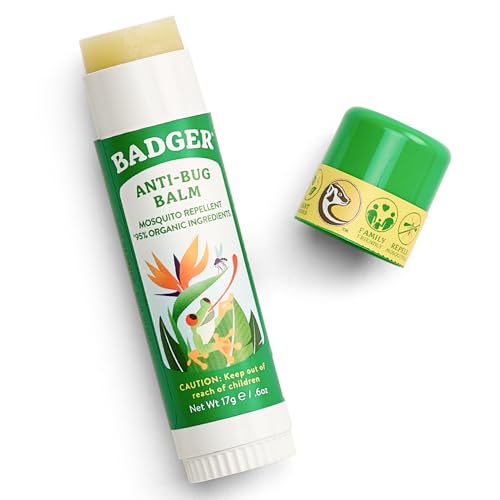
Badger bug repellent stick — the same maker and the same family of oils as the tin. In Badger's own lab test of its balm (the maker's test, not an EPA review), repellency against mosquitoes and stable flies was 95% for up to an hour and a half, and stayed high against mosquitoes to three and a half hours. Every ingredient is named, with no registration number and no registered efficacy data. For under-threes, netting and long sleeves come first; ask your pediatrician before using any balm.
What to watch for
- "Other ingredients" on a product that is NOT an EPA-registered pesticide — On an EPA-registered repellent, an ingredient statement reading "Other Ingredients — 70.0%" is the federal label format, not a brand being cagey: 40 CFR 156.10(g) requires the active ingredient and its percentage plus a single total for the inerts, and EPA names an individual inert only where it decides that inert may pose a hazard. On an unregistered botanical spray sold as a cosmetic, the same phrase is a choice — and there the usual suspects apply.
- Oil of lemon eucalyptus on children under three — The one hard age rule in this category, and we hold it for every OLE product here. The CDC says not to use products containing OLE or PMD on children under 3 years old, the Repel and Cutter label reads "Do not use on children under the age of three years", and EPA's guidance says some oil of lemon eucalyptus products should not be used on children under three (it adds that certain products with OLE as the only active at 30% or less carry no such restriction; we hold the stricter rule for all of them).
- Essential-oil sprays for long exposure — Pure botanical blends wear off quickly. Fine for a short evening on the porch, unreliable for a long hike or heavy mosquito pressure.
- Combined sunscreen-and-repellent products — The two need reapplying on completely different schedules. Buy them separately.
- Repellent on hands, or near eyes and mouth — Apply to your own hands first, then to a child's exposed skin — never directly onto small hands that go straight to a face.
How we choose
We prefer DEET-free options and we are honest about what each one can actually do. Where a plant-derived active has real registered efficacy data behind it, we say so and recommend it. Where a product is a short-duration botanical balm, we say that too rather than implying it will carry a long hike. On ingredients we ask for what the label is actually required to carry — which is not the same thing for an EPA-registered repellent as it is for an exempt botanical balm, and we say which one you are holding.
- Free of DEET, parabens, phthalates, PEGs, sulfates and synthetic fragrance
- Active ingredient named on the label with its exact percentage
- Registration status stated, so you know how much of the panel the law requires
- Honest about protection duration
- Age guidance stated clearly
- No open recall on the product we recommend
Every source we cite is checked against our criteria first — see how we check our sources.
What the research says
Perhaps the biggest misconception is that 'natural and fresh' means safe, while 'synthetic and shelf stable' means harmful.
— Perry Romanowski told Fashionista that ...
Is 'Freshly Made' Skin Care 'Clean' Beauty's Next Phase? — Fashionista (2026-04-14)
Marketers use the term 'chemical-free' to mean a wide variety of things, such as paraben-free, sulfate-free or petrochemical-free. But all products are made up of chemicals. It's a disingenuous, misleading claim.
— Perry Romanowski told Fashionista that ...
8 Common Fear-Mongering Natural Beauty Marketing Claims, Fact-Checked — Fashionista (2019-04-10)
The main reason is that essential oils come from plants. Plants have evolved defense mechanisms to either attract pollinating insects or kill off organisms that might harm it. There are lots of chemicals that plants have created that are terrible for our skin.
— Perry Romanowski told Fashionista that ...
8 Common Fear-Mongering Natural Beauty Marketing Claims, Fact-Checked — Fashionista (2019-04-10)
Sources
- 40 CFR 156.10 — pesticide labeling requirements (ingredient statement) — U.S. Environmental Protection Agency (eCFR)
- Conditions for minimum risk pesticides (FIFRA section 25(b)) — U.S. Environmental Protection Agency (how we check this source)
- Preventing Mosquito Bites: choosing an EPA-registered repellent (DEET, picaridin, IR3535, OLE, PMD, 2-undecanone) — U.S. Centers for Disease Control and Prevention (how we check this source)
- Using insect repellents safely and effectively — U.S. Environmental Protection Agency (how we check this source)
Common questions
Every bug spray product we've reviewed— what we'd buy, what we'd skip, and where each one stands.