
The 7 best straw and open cups for your baby's transition off the bottle
Cups start around six months and bottles are meant to be gone between twelve and eighteen. The part most guides get wrong is the ranking: the American Academy of Pediatrics names sippy, straw and open cups as three acceptable options and does not rank them. Here is what the guidance actually says, and seven cups worth the money.
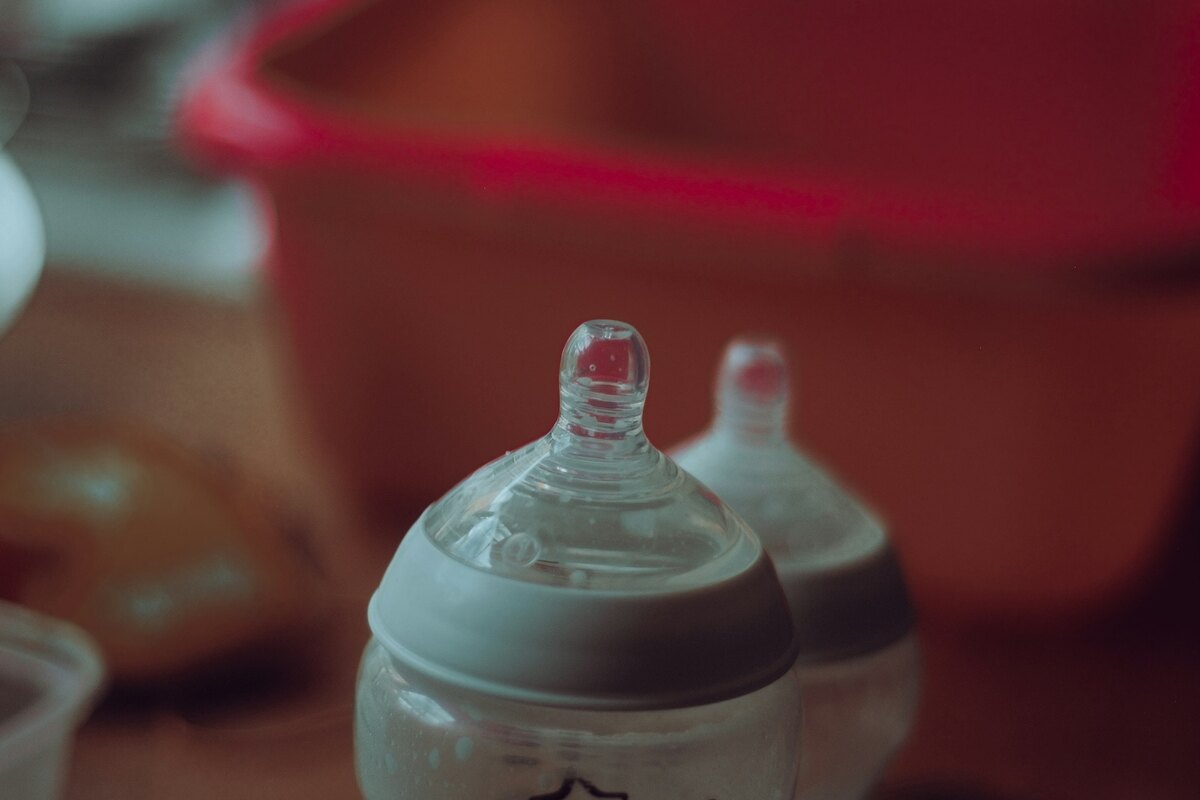
Offer a cup when solids start, around six months, and finish the bottle between twelve and eighteen — that is the American Academy of Pediatrics' own timeline, and the American Academy of Pediatric Dentistry's reason for the deadline is tooth decay, not speech. The AAP does not rank cup types: it lists a spouted sippy, a cup with a straw, and a plain open cup as three acceptable options. We still lead with open and straw cups, because an open cup is the skill the AAP wants in place by about age two and a child only gets it by practicing it. What we do not claim is that either one makes a child talk sooner.
Brands in this guide
- ezpz1 pick
 Olababy2 picks · safety review
- Munchkin1 pick
- mushie1 pick
- WeeSprout1 pick
- Legendairy Milk1 pick
The timeline, in the words of the people who set it
The American Academy of Pediatrics recommends offering a cup when your child starts eating solid foods, usually around six months, then reducing bottle feeds slowly and "completing the transition sometime between 12 and 18 months." It adds one more marker that most articles skip: "It's healthiest for kids to drink from an open cup by about 2 years of age."
Early on this is practice, not replacement. Milk or formula is still doing the nutritional work; the cup is a skill being built at the edges of a meal.
The deadline is not arbitrary, and the main reason for it is teeth. The American Academy of Pediatric Dentistry's own best-practice document says that "breastfeeding and bottle use beyond 12 months, especially if frequent and/or nocturnal, are associated with" early childhood caries. The same document names the two dietary facts that decide decay risk in infancy: "the age at which sugar is introduced to a child and the frequency of its consumption." Frequency. Hold on to that — it comes back at the end of this page.
The AAP adds one more consequence of a bottle that outstays its welcome, and it is worth quoting exactly because it is easy to confuse with a different claim further down this page: "Little ones who drink from bottles well into their second year may also have tooth alignment problems and even speech delays, since little mouths need to strengthen the muscles for clear speech." Note what that sentence is about — how long the bottle lasts, not which cup replaces it.
The part that gets overstated
If you have read anything about this online, you have met the rule: skip the sippy, it delays speech. It is repeated with great confidence, and it is stronger than anything a national body actually publishes.
Keep it separate from the sentence quoted above. The AAP does link staying on a bottle into the second year to possible speech delays. It says nothing of the kind about a spouted cup — and those are two different claims that get folded into one another constantly.
Here is the AAP's own sentence on cup type, in full: "You can use a 'sippy' (training) cup with a spouted lid or offer a cup and straw. Some children may choose to drink from an open cup without a straw — and that's just fine, too." Three options, no ranking. Meanwhile the American Speech-Language-Hearing Association's family-facing feeding milestones list "drinks from a sippy cup without help; can drink from an open cup with some spilling" as ordinary development at twelve to eighteen months — a milestone, not a warning.
We went looking for the trial evidence behind the speech claim and did not find it. What exists is clinical practice guidance from feeding therapists, which is a real thing but is not the same thing, and this page is not going to dress one up as the other.
So why do we still lead with open and straw cups? Because of what the AAP does say: an open cup by about two. That is the destination, and a child arrives at it by practicing it, not by aging into it. A straw cup earns its place for a duller reason — it travels, and straws are everywhere a child will eat for the rest of their life. Offering both is about accumulating skills, not about avoiding a hazard.
What to look for
In a straw cup: a weighted bottom, so the first knock does not end the experiment. A food-grade silicone straw, gentler on gums while everything is still being bitten. A design you can take apart, because straws and valves are where residue collects. And ideally a brush in the box — the straw is the part that fails, and no amount of rinsing substitutes for actually cleaning it.
In an open cup: genuinely small. Two ounces, not eight. Silicone rather than glass or hard plastic, so the inevitable drop is uneventful, and a rim that is kind to new teeth.
If your question is the material rather than the stage — how to get plastic out of the drinking path generally, for a toddler or a seven-year-old rather than a baby learning to drink — that is our stainless steel sippy cups and water bottles cheat sheet, not this page. Every cup here is silicone, chosen for the six-to-eighteen-month window.
On valves, honestly: a valve or bite stopper keeps liquid in the straw so the cup does not leak in a bag, at the cost of requiring more suction and adding one more part to brush and dry. A free-flowing straw is easier to learn on and will leak. Two of the makers here address it head-on and land on the same side — Olababy says its straw "has no valve to suck against", WeeSprout describes "an open valve" — while mushie and Munchkin say nothing either way and the honey bear avoids the question because you supply the pressure by squeezing. Note that none of these seven claims to be leak-proof: WeeSprout says "spill-resistant", Legendairy says "leak-resistant", and those are different words on purpose. For learning at the table, that is the right trade.
The seven, and the choice behind each
Two are plain open cups, and between them sits the whole first decision. The ezpz Tiny Cup is a straight-sided 2 oz cylinder with nothing else to it. The Olababy First Cup is the same volume, slanted so a baby can see the liquid without tipping their head back, on a wider weighted base. Both are 2 oz on purpose.
Two convert, which is the sensible buy if you would rather own one cup than two. Munchkin's C'est Silicone! is 4 oz and "converts from open cup to straw cup to grow with your child"; Olababy's training cup is 5 oz, does the same thing lid-off and lid-on, and is the only one on the page that tells you its straw has no valve. Munchkin is the cheaper entry per cup and the name you already know; Olababy publishes the broader material claim and sells the lid and straw as replaceable parts, so the piece that fails first does not condemn the cup.
Three are straw cups proper, and they differ on the things that actually decide whether a cup gets used. mushie's 6 oz cup has two handles and the most specific safety wording on this page — the only one that names which standards its third-party testing was against. WeeSprout's set is two cups in one box with the straw cleaner included — and the spare matters more than it sounds when the first one is in the dishwasher at dinner time. And the Legendairy Milk honey bear is the outlier: a squeeze cup, rated from four months, for a baby who has the lip seal but cannot yet draw suction — the shape borrowed from feeding therapy, where an adult supplies the pressure until the child takes over.
Fill an open cup with about half an inch of water at first. The mess is proportional to the volume, and a small volume makes this a manageable daily thing rather than an event.
Two habits worth setting now
Sit down to drink. This is the habit with hard numbers behind it. Keim and colleagues, writing in Pediatrics in June 2012, pulled twenty years of US emergency-department records — 1991 to 2010 — for children under three injured while using a bottle, pacifier or sippy cup. Their estimate: 45,398 such injuries over the period, an average of 2,270 a year. Bottles accounted for 65.8 percent, pacifiers 19.9 percent and sippy cups 14.3 percent. The mouth was the most commonly injured area (71.0 percent) and lacerations the most common diagnosis (70.4 percent).
Two figures from that paper decide what you actually do about it. 86.1 percent of the injuries were falls that happened while the child was using the product — and product malfunctions accounted for only 4.4 percent of cases. It is not the cup failing. It is walking with the cup. One-year-olds, new on their feet, were injured most often. Drinking sitting down is the entire intervention.
Keep the cup at the table. A cup carried around all day, containing anything other than water, keeps teeth exposed to sugars for hours — and frequency is precisely what the AAPD names as one of the two things that drive decay risk in infancy. The AAP's position on juice runs along the same line: none before twelve months, because it "can increase risk of tooth decay and cause a preference for sweeter flavors instead of plain water", then no more than four ounces a day and never at bedtime. Cups at meals, water in between. It is an easy habit to set at six months and a hard one to undo at two.
What we could not confirm
Four of the seven cups here come from makers that publish no lead-free claim anywhere — mushie, Munchkin, WeeSprout and Legendairy Milk. Two makers do address it, covering three of the cups: ezpz and Olababy. That is an absence of a claim, not evidence of lead, and silicone is not a material where lead is expected. We are flagging it because a shopper comparing two boxes on a shelf would never see that difference.
"Third-party tested" is doing very different work on different pages. mushie names three standards. Olababy names an FDA regulation. ezpz says an annual third-party laboratory test but not what against. WeeSprout says "rigorous safety standards" and names none. Munchkin cites material grades, which are not a test. Legendairy Milk makes no testing claim at all. That spread was the single most useful thing we found reading these pages, and none of it is visible on the packaging.
We did not find the evidence behind the speech claim. Not "we disagree with it" — we looked for a published body of work establishing that a spouted cup delays speech or oral development, and what we found was clinical practice guidance rather than trials, against national guidance that treats sippy-cup drinking as an ordinary milestone. If that evidence exists, we will cite it here and say we were wrong.
Our top pick
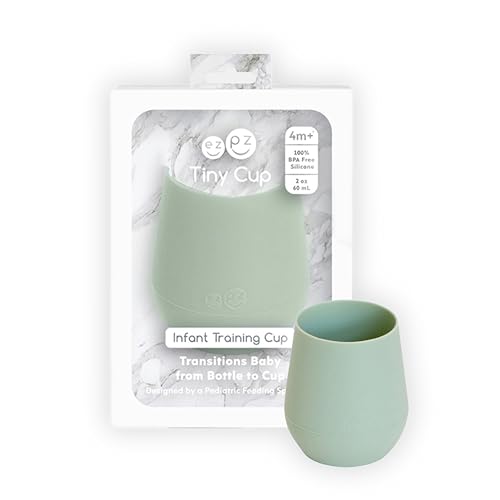
ezpz Tiny Cup — 2 oz, one piece of silicone, no lid, no straw, nothing to lose. It is the easiest place to start an open cup because the volume is what makes the mess manageable, and ezpz publishes the widest exclusion list here: "Free of BPA, BPF, BPS, PVC, lead, cadmium and phthalates", with annual third-party laboratory testing.
Also worth considering

Manufacturer statement checked · source
Olababy First Cup, 2 oz, slanted so a baby can see the liquid without tipping their head back, on a wide weighted base. Its material claim is the most specific here — Olababy is the only maker that points at an FDA food-contact regulation by number (21 CFR 177.2600) rather than stopping at "food grade". ezpz's exclusion list is the longer one; Olababy's is shorter but carries a citable regulation behind it. Note the age discrepancy: Olababy's own FAQ says 6 to 12 months, the retail listing markets it from 4 to 6.

Manufacturer statement checked · source
Munchkin C'est Silicone! — a 4 oz silicone cup that, in the maker's words, "converts from open cup to straw cup to grow with your child." The smaller of the two convertibles here, and the mainstream-brand option. Munchkin cites FDA and LFGB food-grade silicone and says free of BPA, BPS and PVC; it publishes no phthalate-free or lead-free claim. Sold as a two-color pair.

Olababy's 5 oz training cup also works both ways — lid off for open-cup practice, lid on for the straw. Only two makers here say anything about the valve at all, and this is the one that says there is none: "has no valve to suck against." Tapered weighted base, lid and straw sold as replaceable parts, and the same lead-and-phthalate-free wording as the First Cup. There is a 9 oz size to grow into.

Manufacturer statement checked · source
mushie's 6 oz training cup with two handles is three parts — cup, lid, straw — and its page is the only one here that says what its testing was against: "Third-party tested to meet CPSIA, ASTM, and Prop 65 standards." Of the rest, ezpz and WeeSprout say "tested" without naming a standard and two say nothing at all.

Sold as a set of two — in 4 oz and 8 oz options — with the straw cleaner included, which is the tool that decides whether a straw cup lasts. WeeSprout describes the straw as carrying "an open valve", so it draws easily; the built-in stoppers stop the straw being pulled out, they do not make the cup leak-proof. Its safety wording is thinner than the others': "third-party tested to meet rigorous safety standards", with no standard named.

Manufacturer statement checked · source
The honey bear is a squeeze cup: you press the body and the liquid comes up the straw, so the baby learns the lip seal before they can generate suction. Rated from four months — the earliest start here alongside the ezpz Tiny Cup, and the only way onto a straw that early. It is also the thinnest safety page of the seven: Legendairy states BPA-free and phthalate-free and publishes no PVC claim, no lead claim and no testing claim at all.
What to look for, and what to skip
- Buying an 8 oz open cup first — The mess is proportional to the volume. Start at 2 oz with about half an inch of water in it. Almost every open-cup failure we hear about is a volume problem wearing a skill problem's clothes.
- A cup that cannot be fully taken apart — Straws and valves are where residue collects. If a part cannot be separated, brushed and dried, it will eventually need replacing rather than cleaning — which is why a straw brush in the box is worth more than it looks.
- Assuming "third-party tested" means the same thing twice — One maker names the standards (mushie: CPSIA, ASTM, Prop 65). One names a regulation (Olababy: 21 CFR 177.2600). ezpz says its products are "tested annually by a third-party laboratory" but does not name what against. Munchkin cites FDA and LFGB material grades, which are not a test result. WeeSprout says "rigorous safety standards" and names none. Legendairy Milk makes no testing claim at all. Read the sentence, not the badge.
- Treating a spouted sippy as a mistake — It is not one. The AAP lists a spouted training cup as an acceptable option alongside a straw and an open cup. The reason to offer the other two is that they are skills your child needs anyway, not that the sippy does damage.
- Letting any cup become an all-day accessory — This is the habit that actually has evidence behind it. Frequency of sugar exposure is what drives early tooth decay, and walking around with a cup is also how the falls happen.
How we choose
Every cup here is food-grade silicone at the parts that reach a baby's mouth, and every material claim quoted on this page was read on that manufacturer's own site on 10 September 2026 — six product pages and, for ezpz, the FAQ where it publishes its materials policy. None of it is taken from a retail listing. We favor cups sized for the stage they are sold for over scaled-down toddler cups, weighted or wide bases, and designs simple enough to actually get clean. Where one maker's claim is thinner than another's, we say so on the pick rather than leveling them all up to the same wording.
- Food-grade silicone at all mouth-contact points
- Material claim published by the manufacturer, in its own words
- Weighted or wide base
- Few parts, and all of them separable for cleaning
- Sized for the stage it is sold for
- No active recall on the pick
Every source we cite is checked against our criteria first — see how we check our sources.
What the research says
Child passenger safety technicians across the country report identifying one to two unregulated or counterfeit seats each month during routine safety checks.
— In 2026-02-07 testimony, Ben Hoffman, MD, CPST-I cited ...
Public testimony on counterfeit car seats, Oregon House Committee on Commerce and Consumer Protection — Oregon Legislative Information System (2026-02-07)
Car seat use reduces the risk for injury in a crash by 71-82% for children, compared with seat belt use alone
— In 2026-02-07 testimony, Ben Hoffman, MD, CPST-I cited ...
Public testimony on counterfeit car seats, Oregon House Committee on Commerce and Consumer Protection — Oregon Legislative Information System (2026-02-07)
A flexible 9-day road map for safely introducing top allergens
— Malina Malkani, MS, RDN, CDN told BenBella Books (distributed by Simon & Schuster), ISBN 9781637745359 that ...
Safe and Simple Food Allergy Prevention: A Baby-Led Feeding Guide to Starting Solids and Introducing Top Allergens — BenBella Books (distributed by Simon & Schuster), ISBN 9781637745359 (2024-11-12)
Sources
- From Bottle to Cup: Helping Your Child Make a Healthy Transition (updated 3 July 2023) — American Academy of Pediatrics — HealthyChildren.org (how we check this source)
- Perinatal and Infant Oral Health Care — The Reference Manual of Pediatric Dentistry, 2025:337-41 — American Academy of Pediatric Dentistry
- What To Expect: Your Child's Feeding Development (feeding milestones, 12 to 18 months) — American Speech-Language-Hearing Association
- Keim SA, Fletcher EN, TePoel MR, McKenzie LB. Injuries associated with bottles, pacifiers, and sippy cups in the United States, 1991-2010. Pediatrics 2012;129(6):1104-1110 — Pediatrics — record via Europe PMC
- Where We Stand: Fruit Juice (updated 27 July 2022) — American Academy of Pediatrics — HealthyChildren.org (how we check this source)
Side by side
| Attribute | ezpzTiny Cup | OlababyBaby Cup | MunchkinC'est Silicone! Open Training Cup | OlababySilicone Straw Training Cup | mushie100% Silicone Training Cup & Straw for Toddle… | WeeSproutSilicone Baby Cups | Legendairy MilkHoney Bear Straw Cup for Baby & Toddler |
|---|---|---|---|---|---|---|---|
| Why it's here | Our top pick | The open cup that cites a regulation by number | The smaller convertible, from a name you already know | The convertible whose straw has no valve, and says so | The only one that names the standards it was tested against | A pair of cups, and the brush is in the box | For a baby who cannot draw a straw yet |
| Price | $11.49 | $9.99 | $20.47 | $15.95 | $16.99 | $14.98 | $19.99 |
| Availability | In stock | In stock | In stock | In stock | In stock | In stock | In stock |
Free things to try before you buy anything
Offer a sip from your own glass
Half an inch of water in a normal small glass, held by you, at a meal. This is cup practice, and it costs nothing. A dedicated tiny cup makes it easier; it does not make it possible.
Put a straw in a regular cup
Before buying a straw cup, see whether your baby can draw on a straw at all. Hold the cup, dip a straw, cap the top with your finger to trap a little liquid, then release it into their mouth. That is how most feeding therapists teach the first pull.
Move the cup to the table
The single biggest change on this page is where the cup lives, not which cup it is. Cups at meals, water in between — that costs nothing, and it is the one habit that answers both the tooth-decay question and the falls data.
Common questions
Cheat sheets for this
Part of the Feeding & Soothing hub— the rest of our coverage in this category.
Every feedingproduct we've reviewed— what we'd buy, what we'd skip, and where each one stands.