
Best outlet covers that aren't choking hazards
The best outlet cover is not a cover. CPSC says covers and plates should be too large for a child to choke on and hard for a child to remove, and that a replaced receptacle should be the tamper-resistant kind. We read that as pointing away from the small plug-in caps most shelves are full of; CPSC does not name caps.

Skip the small plug-in caps. CPSC says outlet covers and plates should be large enough that a child cannot choke on them and hard for a child to remove, and that a receptacle you replace should be tamper-resistant (TR). A TR receptacle has spring-loaded shutters built in, needs no cap to remember, and ESFI says it should be installed by a licensed electrician. Renting, or not ready to rewire? Look for a large replacement wall plate rather than a cap. We could not read a maker's own page for any plate or box cover, so we do not name one, and that is the honest state of this page.
Brands in this guide
- Leviton2 picks
What CPSC and ESFI say, and what we did with it
We read two sources on the day we wrote this (2026-11-23): CPSC's childproofing guide and the Electrical Safety Foundation International (ESFI) pages on tamper-resistant receptacles. ESFI is a nonprofit electrical-safety group, not a regulator; we quote it for its description of the code and its figures, not as the code itself.
CPSC says outlet covers and outlet plates can help protect children from electrical shock, that protectors should not be easily removed by children and should be large enough that children cannot choke on them, and that if you are replacing receptacles you should use a tamper-resistant type. It also says no device is completely childproof.
ESFI says tamper-resistant (TR) receptacles have spring-loaded shutters over the slots, that they should be installed by a licensed electrician, and that plastic outlet covers are not tested by nationally recognized testing laboratories for tamper resistance. That last sentence is ESFI's, and we cannot check it ourselves.
Why this page names no plate or cap
The usual outlet-cover page is a list of caps. We did not build that one. A cap is small by design, a child can pull it out, and we read CPSC's choking wording as covering small caps; CPSC does not name them. So the answer this page can stand behind is the receptacle.
For the plates and box covers we looked at, we could not read a maker's own page: one maker's site returned a certificate error, another had no readable page, and one would not load. A plate we cannot read the maker's page for is a plate we would be guessing about, and "large enough that a child cannot choke on it" is a claim that needs a size we have not seen. So there is no plate pick. If that changes, this page changes.
The fix: tamper-resistant receptacles
A TR receptacle looks like a standard outlet. The shutters open only when both slots are pushed at once, as a plug's blades do, so a hairpin or a key into one side does not get through. That is why we put it ahead of a cover: the protection is built in, and you do not have to remember to put anything back. CPSC lists covers and plates as a measure too; ranking the receptacle first is our view.
Our two picks are 15 amp Leviton receptacles, in the two plate styles most homes have. We read Leviton's own pages for both, and each lists a shutter mechanism, a TR mark and UL 498. They come in 10-packs, so they suit a swap of the outlets a child can reach, not a single one. If your outlet has a T-shaped slot (a 20 amp receptacle) or is a GFCI outlet, ask the electrician which TR part fits; do not buy the 15 amp part on our say-so.
Putting them in
Have the work done by a licensed electrician, as ESFI says, and start with the rooms where a child spends time, at the heights a child can reach. Per ESFI, the NEC does not require TR on receptacles higher than 5.5 feet (and exempts a few other cases), so the outlets near the floor and countertops are the ones to do first. Keep the old plates if they are in good shape, and a new plate is cheap if they are not.
Prices and availability on the cards above update from the live catalog, so what you see is current.
Our top pick
Manufacturer statement checked · source
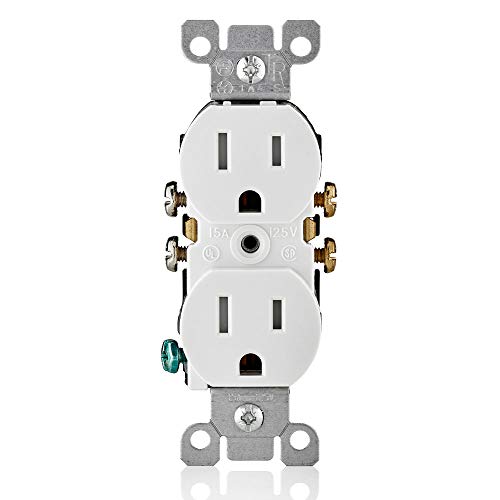
Leviton T5320 tamper-resistant receptacle (10-pack) is the default fix. Leviton's own page for the white T5320-W lists a 15 amp, 125 volt standard-style duplex receptacle with a shutter mechanism that, in Leviton's words, blocks access to the contacts unless a two-prong plug is inserted, a TR mark on the strap, UL 498 (file E13399) and a 2-year limited warranty. Leviton lists the T5320 as a standard-style duplex receptacle, which takes a standard duplex wall plate; its page does not name a plate. Decora, below, is Leviton's flat, rectangular-face style and needs a Decora-style plate. Match the plates you have now. The Amazon listing is a 10-pack, so buy it for a whole-house swap, not one outlet. Leviton's page describes the single-unit T5320-W rather than the pack; check the box for the TR mark. UL's own directory was not checked, so UL 498 is Leviton's statement here.
Also worth considering

Leviton 15 Amp Decora Tamper-Resistant Duplex Electrical Wall Outlet, 10 Pack, T5325-WMP, White
Manufacturer statement checked · source
Leviton T5325 Decora tamper-resistant receptacle (10-pack) is the same 15 amp TR receptacle for homes whose wall plates are the Decora style (Leviton's flat, rectangular-face line; the page does not describe the plate, so that description is ours). Leviton's page for the white T5325-W lists the same shutter mechanism, TR mark on the strap, UL 498 (file E13399) and 2-year limited warranty. Choose between the two by looking at your existing plates, not by price; the Decora pack cost more per pack when we checked the catalog. Same caveat as above: a 10-pack, and UL 498 is Leviton's statement.
What to avoid
- Small plug-in caps — CPSC's childproofing page says outlet covers and plates should be large enough that a child cannot choke on them, and should not be easily removed by a child. A small cap that pulls out fits the case that sentence describes; CPSC does not name caps. ESFI cites Temple University Biokinetics Laboratory research that 47 percent of 4-year-olds studied could remove one brand of cap and 100 percent of 2- and 4-year-olds could remove a second brand, in many cases within 10 seconds; ESFI does not name the brands, and we have not seen the study. ESFI adds that adults forget to put the caps back after using the outlet. There is no plug cap on this page, and none on our toddler kit.
- Any cover you cannot show a child cannot remove — Small parts and hard-to-remove are the two CPSC tests. If a cover comes off with a fingernail or a tug, or has pieces that can come loose (screws, caps, covers on a hinge), it fails one of them. We have not tested any plate or cap.
- Assuming a plate is a fix because it is sold as one — In 2011 CPSC announced a recall of about 37,000 Prime-Line Child Safe drawer and cabinet latches and outlet covers (the outlet covers have rotating receptacle covers), because the screws could loosen or break and let young children reach electrical outlets and other hazards. Prime-Line reported four screw breaks and no injuries. It is one example from 2011, and we do not know whether that product is still sold; it is here because, in our reading, a plate held on by screws can fail in a way a TR receptacle's built-in shutters cannot.
- Treating a cover as proof an outlet is safe to leave in use — CPSC says no device is completely childproof and that determined toddlers have been known to overcome or disable them. A cover on an unused outlet does nothing for a cord that is plugged in and within reach, so keep cords short and behind furniture where you can.
- Doing the receptacle swap yourself because the part is cheap — ESFI's own pages say TR receptacles should be installed by a licensed electrician. The part is inexpensive; the work is live-circuit work. Whether a homeowner may do it varies by place, so ask your local building department before you decide.
How we choose
We start from what CPSC and ESFI say about outlets and children, and only then look at products. A pick has to be a receptacle the maker describes as tamper-resistant on its own page, with a published model number and standards listed, and in stock when we checked the catalog. We did not pick a plate or a box cover: we could not read a maker's own page for any we found, and CPSC's wording needs a size and a removal claim we could not ground.
- CPSC's two tests for anything covering an outlet: large enough that a child cannot choke on it, and not easily removed by a child
- Tamper-resistant receptacle where one is being replaced (CPSC)
- The maker's own page describes the tamper-resistant mechanism and lists a standard (read, not assumed)
- In stock on the day we checked the catalog
Every source we cite is checked against our criteria first — see how we check our sources.
What the research says
Child passenger safety technicians across the country report identifying one to two unregulated or counterfeit seats each month during routine safety checks.
— In 2026-02-07 testimony, Ben Hoffman, MD, CPST-I cited ...
Public testimony on counterfeit car seats, Oregon House Committee on Commerce and Consumer Protection — Oregon Legislative Information System (2026-02-07)
At just 30 miles per hour-a speed consistent with many urban and residential crashes-the counterfeit seat completely disintegrated
— In 2026-02-07 testimony, Ben Hoffman, MD, CPST-I cited ...
Public testimony on counterfeit car seats, Oregon House Committee on Commerce and Consumer Protection — Oregon Legislative Information System (2026-02-07)
The 2022 AAP policy statement (Moon et al.) states that sitting devices - car seats, strollers, swings, infant carriers, and infant slings - are not recommended for routine sleep at home or in the hospital, particularly for infants under 4 months of age.
— According to Pediatrics 150(1), American Academy of Pediatrics guidance co-authored by Rachel Y. Moon, MD, ...
Sleep-Related Infant Deaths: Updated 2022 Recommendations for Reducing Infant Deaths in the Sleep Environment — Pediatrics 150(1), American Academy of Pediatrics
Sources
- Childproofing Your Home (CPSC safety guide; page read 2026-11-23) — U.S. Consumer Product Safety Commission (how we check this source)
- Tamper Resistant Receptacles (TRRs): Prevent Shocks and Burns (page read 2026-11-23) — Electrical Safety Foundation International
- Tamper Resistant Receptacles (TRR): White Paper (page read 2026-11-23) — Electrical Safety Foundation International
- Q & A: Tamper Resistant Receptacles (page read 2026-11-23) — Electrical Safety Foundation International
- Electrical Receptacle Related Injury Statistics (page read 2026-11-23) — Electrical Safety Foundation International
- Tamper Resistant Receptacles (TRR) - Code Requirements: Revisions from the NEC 2008 and 2011 (page read 2026-11-23) — Electrical Safety Foundation International
- Child Safety Latches and Outlet Covers Recalled by Prime-Line (CPSC recall 11-284, July 27, 2011; read through CPSC's recall API 2026-11-23) — U.S. Consumer Product Safety Commission (how we check this source)
- Leviton T5320-W 15 Amp Tamper-Resistant Duplex Outlet/Receptacle (maker page read 2026-11-23) — Leviton
- Leviton T5325-W 15 Amp Decora Tamper-Resistant Duplex Outlet/Receptacle (maker page read 2026-11-23) — Leviton
Side by side
| Attribute | Leviton15 Amp 125 Volt Tamper Resistant Duplex Recep… | Leviton15 Amp Decora Tamper-Resistant Duplex Electri… |
|---|---|---|
| Why it's here | Our top pick | — |
| Price | $9.98 | $21.28 |
| Availability | In stock | In stock |
Common questions
Cheat sheets for this
Part of the Gear & Everyday Items hub— the rest of our coverage in this category.
Every baby gear & diapers product we've reviewed— what we'd buy, what we'd skip, and where each one stands.