
Cheat Sheet: Calendula cream for dry, irritated skin
One winner for each way people buy calendula cream for dry, irritated skin.
Calendula — pot marigold — is one of the more genuinely studied botanicals in baby skincare, with real (if mixed) clinical evidence behind it rather than just marketing language. This page is about general dry, chapped, or wind-burned skin — chapped cheeks, dry patches, cradle-cap-adjacent scalp skin. For diaper rash specifically, see our separate cheat sheet, linked below.
How we scoreHow we earnChecked September 9, 2026
Our winner for each way people buy
How we scoreHow we earnChecked September 9, 2026
Best for whole-body dry patches

Badger
Organic Calendula Baby Balm for Dry SkinFive organic ingredients: olive oil, castor oil, beeswax, chamomile oil and calendula flower extract. Thick enough for dry patches anywhere on the body.
Meets our published criteria, as of Sep 9, 2026
$11.99ViewBest for chapped cheeks and noses

Earth Mama Organics
Organic Baby Face Nose & Cheek BalmSunflower oil, beeswax, coconut oil, shea butter and calendula flower extract, all organic, with no fragrance on the panel. Marketed for chapped, dry faces rather than full-body use.
Meets our published criteria, as of Sep 9, 2026
$9.97ViewBest lotion for everyday moisturizing
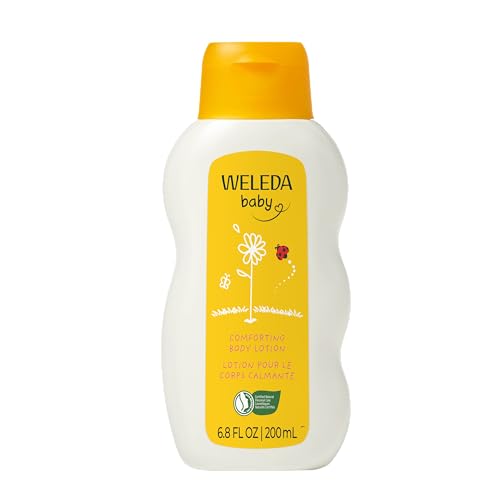
Weleda
Baby Calendula Comforting Body LotionA lighter, faster-absorbing lotion for routine daily moisturizing. It contains an added fragrance (Weleda lists Parfum plus limonene, linalool, geraniol and citral), so pick the unscented lotion below for fragrance-sensitive skin.
Meets our published criteria, as of Sep 9, 2026
$10.63ViewBest unscented cream

California Baby
Calendula CreamCalifornia Baby Calendula Cream, No Fragrance: after water, a calendula flower infusion and calendula extract come first, and the panel has no fragrance or essential oil (label read 2026-08-21). It also carries basil, anise and rosemary extracts and runs about twenty ingredients, so it is the longest list among our winners, and it is a cream, not a thin lotion. In FDA's drug enforcement reports we found no California Baby recalls (searched 2026-11-11); we did not search CPSC.
Meets our published criteria, as of Sep 9, 2026
$19.99View
What to avoid
- "Calendula" as a name only — check the ingredient list, not the front label — some products carry the name with no calendula extract or oil in the formula
- Added synthetic fragrance — fragrance-free is the safer default, especially on skin that's already dry or irritated
- Marketing that implies calendula is a cure — the evidence is real but mixed — a soothing, moisturizing ingredient, not a treatment for a skin condition that isn't improving
- Diaper products used off-label — diaper creams are built around a barrier active like zinc oxide at a stated percentage that a calendula balm doesn't have
What to look for
- Calendula listed as an actual ingredient — not just a name on the front label
- Fragrance-free, or fragrance clearly disclosed — the same rule that applies across every category on this site
- Marketed for general dry/sensitive skin — distinguishes it from a diaper-rash product built around a different active ingredient
- A short, checkable ingredient list — makes it easier to know how much of the effect, if any, is actually coming from the calendula
What the label card means
What to skip, and why
"Calendula" as a name only
Check the ingredient list, not the front label — some products carry the name with no calendula extract or oil in the formula.
Added synthetic fragrance
Fragrance-free is the safer default, especially on skin that's already dry or irritated.
Know the risks: Fragrance not fully itemizedMarketing that implies calendula is a cure
The evidence is real but mixed — a soothing, moisturizing ingredient, not a treatment for a skin condition that isn't improving.
Diaper products used off-label
Diaper creams are built around a barrier active like zinc oxide at a stated percentage that a calendula balm doesn't have.
Where to buy
The full guide: how we chose
Calendula (Calendula officinalis, also called pot marigold) is a topical botanical with more clinical study behind it than most "natural" skincare ingredients — including a well-known phase III trial that found it reduced radiation-induced skin dermatitis in breast cancer patients better than a standard barrier cream. That is not the same claim as "cures baby's dry skin," and the wound-healing evidence overall is mixed rather than settled. What calendula has going for it on a baby's face or dry patches is a long safety track record as a gentle, generally well-tolerated topical, usually blended with other skin-barrier ingredients like sunflower oil, beeswax, or shea butter rather than used alone.
What calendula actually is
Calendula (Calendula officinalis), commonly called pot marigold, is a flowering plant whose petals have been used in topical skin preparations for a long time — long enough, and studied enough, that it has a genuinely different evidence base than most botanicals marketed for baby skin. It shows up in balms, lotions, and oils as an infused oil or extract, usually alongside a base like sunflower oil, olive oil, beeswax, or shea butter that's doing much of the actual moisturizing work.
This page is about general dry or irritated skin — chapped cheeks, wind-burned patches, dry skin anywhere but the diaper area. It is not about diaper rash. Our diaper rash cheat sheet covers that category separately, because diaper rash creams are built around a different, FDA-recognized active ingredient — zinc oxide, at a disclosed percentage — with calendula appearing only as a secondary, soothing addition in some formulas. If you're here for diaper rash, that's the page you want.
What the evidence actually shows
Calendula is one of the more genuinely studied botanicals in this space, and it's worth being precise about what "studied" means here rather than treating it as marketing shorthand.
The strongest single piece of evidence is a phase III randomized clinical trial (Pommier et al., Journal of Clinical Oncology, 2004) in 254 breast cancer patients undergoing radiation therapy. Patients using calendula ointment on the irradiated skin had significantly less severe dermatitis — 41% developed grade 2-or-higher dermatitis versus 63% on trolamine, a standard reference barrier cream — and reported less radiation-related pain. That's a real, published, randomized result, not an anecdote.
Broader wound-healing evidence is more mixed. Systematic reviews describe faster resolution of inflammation and better granulation tissue formation in several animal studies and one clinical trial of acute wounds. But results for chronic wounds are inconsistent — some studies on venous ulcers showed improvement, a trial on diabetic leg ulcers showed none, and a burn-healing trial found no benefit over standard care. Germany's health authority (the Commission E) has approved topical calendula for poorly healing wounds and skin inflammation, and ESCOP (the European scientific body for herbal medicine) recommends it on similar grounds — but researchers reviewing the field consistently note the evidence, while real, is not as rigorous as the number of positive studies might suggest.
The honest summary: calendula has a real, if imperfect, evidence base for skin-irritation support, and a long track record of being gentle and well-tolerated. It is not a proven treatment for a specific skin condition, and none of that evidence is baby-specific — the strongest trial was in adult cancer patients. Treat it the way the products on this page are actually formulated: a soothing, moisturizing ingredient in a broader balm, not medicine.
Reading the label
Check the ingredient list, not the front of the bottle. "Calendula" in a product name doesn't guarantee calendula extract or oil is actually in the formula in a meaningful amount — look for Calendula officinalis flower extract or infused oil on the ingredient list itself.
Fragrance-free is still the safer default, the same rule that applies across every category on this site. It matters more, not less, on skin that's already dry or irritated.
Short ingredient lists make the calendula easier to evaluate. A balm built on a carrier oil, beeswax, and calendula extract or calendula-infused oil is straightforward to assess. A long list of botanical extracts makes it harder to know how much of the effect (if any) is actually coming from the calendula.
Our picks
Badger Organic Calendula Baby Balm is the top pick. It's a simple balm of five organic ingredients — olive oil, castor oil, beeswax, chamomile oil and calendula flower extract — from Badger, a family-owned, B Corp-certified company. It's the same brand behind our top diaper-rash pick, and the same reasons we trust it (organic certification we could verify, and a real paper trail) apply here.
One correction, because this page used to say Badger had no recall history we could find: that was a check of CPSC's database, and for a personal-care product it is FDA's register that matters. Searched on 2026-09-09, FDA's drug enforcement reports list three W.S. Badger recalls, all closed — two Class II sunscreen-lot recalls for microbial contamination in September 2013, and a Class III labeling recall of one sunscreen lot in January 2025. None involves this balm, and the diaper rash cheat sheet carries the detail.
This is a whole-body balm, thick enough for dry patches anywhere — not sized or marketed specifically for a baby's face.
Earth Mama Organic Baby Face Nose & Cheek Balm is built for exactly the use case its name suggests: chapped cheeks and dry noses, the kind of wind-burned skin that shows up in cold, dry months. It has no fragrance on its five-ingredient panel, with calendula flower extract as the last of them, from Earth Mama, a founder-led company we've already reviewed independently — see our Earth Mama brand review and our Belly Butter review for how we checked the company. Pick this one if you specifically want a face-sized balm rather than a whole-body product.
Weleda Baby Calendula Comforting Body Lotion is the lightest-textured option here — a lotion rather than a balm, formulated to absorb faster for everyday moisturizing rather than sitting as a thick barrier layer. Weleda has used calendula in baby skincare for decades and this is their everyday, whole-body lotion, not a spot-treatment balm. Reach for this one for routine daily moisturizing rather than a specific dry patch or wind-burned area. It is the one pick here with an added fragrance: Weleda lists "Fragrance (Parfum)" and its allergen components (limonene, linalool, geraniol, citral). If fragrance is your line, California Baby's fragrance-free Calendula Cream, our unscented pick on the board, is the swap.
What we didn't include
Anything marketed as a diaper rash treatment (see our diaper rash cheat sheet instead), anything listing "calendula" in the product name without calendula appearing in the actual ingredients, and anything from a brand with an open recall.
Related reading
For the diaper area specifically — zinc oxide percentages, fragrance, and what EWG Verified actually checks on a diaper cream — see our diaper rash cheat sheet. That page uses a different Weleda product (their diaper cream, not the body lotion above) and a different set of picks, because it's answering a different question.
The swaps, in full
"Calendula" as a product name, with no calendula extract or oil in the ingredients
Some products use "calendula" in the product name for its soft, botanical association without calendula extract or oil actually appearing in the ingredient list. Check the ingredients, not the front-of-label name.
Hides in: The ingredient list itself — look for Calendula officinalis flower extract or infused oil
Badger Organic Calendula Baby Balm — five organic ingredients: olive oil, castor oil, beeswax, chamomile oil and calendula flower extract, from a family-owned, B Corp-certified brand. FDA's drug enforcement reports list three closed W.S. Badger recalls (two 2013 sunscreen-lot recalls, one 2025 sunscreen labeling recall) — none involving this balm.
Earth Mama Organic Baby Face Nose & Cheek Balm — five organic ingredients ending in calendula flower extract, no fragrance on the panel, and named and sized for chapped cheeks and noses.
Ingredient panel checked · source
Diaper-rash-specific products used off-label as a face balm, or vice versa
Diaper creams are formulated around a barrier active like zinc oxide at a stated percentage. A calendula face or body balm doesn't have that ingredient and isn't tested for the diaper area. See our diaper rash cheat sheet for that category specifically.
Weleda Baby Calendula Comforting Body Lotion — a lighter, faster-absorbing lotion format for everyday dry-skin moisturizing, not a diaper-area product. It contains an added fragrance, which Weleda lists along with its allergen components.
Ingredient panel checked · source
What to check on a calendula skincare label
- "Calendula" as a scent name, not an ingredient — Some products use "calendula" in the product name for its soft, botanical association without calendula extract or oil actually appearing in the ingredient list. Check the ingredients, not the front-of-label name.
- Added synthetic fragrance — The same rule as everywhere else on a baby's skin: fragrance-free is the safer default, especially on cheeks or patches that are already irritated.
- Marketing that implies calendula is a cure — The clinical evidence for calendula is real but mixed — strong for some uses (radiation-dermatitis prevention, some wound studies), inconclusive for others (chronic ulcers, burns). It's a gentle, well-tolerated moisturizing ingredient, not a treatment for a skin condition that isn't improving.
- Diaper-rash-specific products used off-label as a face balm, or vice versa — Diaper creams are formulated around a barrier active like zinc oxide at a stated percentage. A calendula face or body balm doesn't have that ingredient and isn't tested for the diaper area. See our diaper rash cheat sheet for that category specifically.
How we choose
Every pick here lists calendula extract or calendula-infused oil as an actual ingredient, not just a name on the front label. We favor fragrance-free formulas and short ingredient lists, and we're specific about what the clinical evidence for calendula does and doesn't support rather than let 'clinically studied' stand in as a blanket safety claim.
- Calendula extract or calendula-infused oil listed as an actual ingredient
- Fragrance-free, or fragrance clearly disclosed
- Marketed for general dry/sensitive skin, not diaper rash specifically
- Short, checkable ingredient list (the unscented cream is the exception: about twenty ingredients, disclosed on its card)
- No open recall on the product itself, and any brand recall history stated rather than implied away
Every source we cite is checked against our criteria first — see how we check our sources.
What the research says
Fragranced products-including air fresheners, dryer sheets, and perfume-and sunscreens had the largest number of target chemicals and some of the highest concentrations.
— Robin Dodson, ScD of Silent Spring Institute explains that ...
Consumer Products Contain Potentially Harmful Chemicals Not Listed on Labels — Silent Spring Institute (2012-03-08) (how we check this source)
One way you avoid phthalates is to choose fragrance-free products.
— Robin Dodson, ScD told Consumer Reports that ...
5 Ingredients to Watch Out For in Beauty and Personal Care Products — Consumer Reports (2026-02-03) (how we check this source)
encourage application of a bland moisturizer titrated to symptomatic benefit (at least once, often multiple times, per day)
— According to Annals of Allergy, Asthma & Immunology guidance co-authored by Peter A. Lio, MD, ...
Atopic dermatitis (eczema) guidelines: 2023 AAAAI/ACAAI Joint Task Force on Practice Parameters — Annals of Allergy, Asthma & Immunology
Sources
- Drug enforcement reports for recalling firm "Badger" (checked 2026-09-09) — U.S. Food and Drug Administration (openFDA)
Common questions
Every skincare & bathproduct we've reviewed— what we'd buy, what we'd skip, and where each one stands.